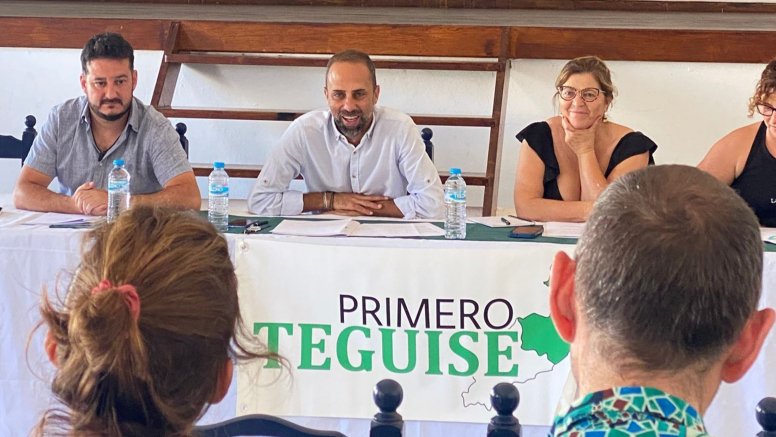
Primero Teguise has denounced in a press release that a new maritime-terrestrial boundary promoted by the Directorate General of the Coast and the Sea "could directly affect the urban center of Caleta del Sebo in La Graciosa. A proposal that would extend the protection servitude up to one hundred meters in the town".
From Primero Teguise, they consider that this interpretation of the Coastal Law "is not only disproportionate but profoundly disconnected from the social, economic, and human reality of the eighth island, generating a sense of legal uncertainty. Something difficult to accept for a population that already lives with significant limitations derived from its environmental condition." "It seems that protecting the territory always involves pointing to the same place and the same people," says Jonás Álvarez, spokesperson and councilor for PTG, as if the residents of La Graciosa were a problem to be managed and not an essential part of the balance they claim to want to protect."
"We must remember," the councilman continues to explain, "that La Graciosa is one of the territories with the highest level of environmental protection in the Canary Islands, including protection measures that limit urban growth, land use, mobility, and economic development, and that, for years, residents have amply demonstrated that it is possible to live while respecting the environment without the need to apply these types of extreme measures."
From Primero Teguise they warn that "the new demarcation being proposed deliberately ignores this reality and treats Caleta del Sebo as if it were a virgin space with no history or social fabric when we are talking about the only urban center on the island with consolidated housing, basic services, local economic activity, and community projects underway".
"The incoherence is evident," explain those in the party, "they speak to us of sustainability while questioning the possibility of rehabilitating a home, improving its energy efficiency, or ensuring that a young family can continue to live on the island." "Perhaps that is what modern sustainability, which some aspire to, should be," criticizes Jonás Álvarez in this publication.
First, Teguise criticizes the way this procedure is being carried out, "without clear information, without transparency, and without a real process of citizen participation, something especially serious in a small, isolated, and fragile territory where every administrative decision has a direct and disproportionate impact on the daily lives of its residents".
"It gives the impression that someone in an office has decided that La Graciosa is better protected in silence and without counting on its neighbors," explains the spokesperson for the islandist party. The consequences of this demarcation "directly affect the lives of the residents, as the expansion of the easement would pose significant problems when it comes to renovating or maintaining homes in adequate condition."
Therefore, from Primero Teguise, they demand the halting of the demarcation in its current terms and the opening of a real dialogue process with residents. These dialogues should be accompanied by a specific and differentiated technical study for Caleta del Sebo, taking into account its status as a consolidated urban area.
"And not only that," demands Álvarez, "we need the active involvement of the Teguise City Council and the Cabildo of Lanzarote, clearly defending their residents. They fill their mouths talking about defending the idiosyncrasies of the towns, but then they apply policies that have nothing to do with defending, but with suffocating and abandoning them to their fate."
From Primero Teguise, they consider that coastal protection "cannot and should not be incompatible with the right of a community to exist, develop, and plan its future." "La Graciosa does not need to be protected from its people; it needs to be protected with its people," states Jonás Álvarez.
Add La Voz de Lanzarote as a preferred Google source.
Stay informed with the latest current news.