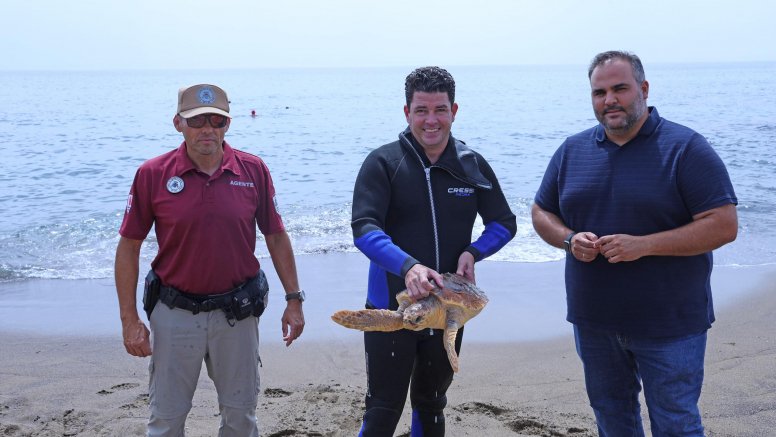
The Cabildo of Lanzarote has announced that it will integrate starting from next April 1st the Injured Wildlife Rescue Service into the Environment Area and that it will assume its direct management.
Until now the service was managed by the public company Tragsa.
This change has been possible thanks to the reinforcement of the area with the incorporation of eight new Environment agents, which will allow improving the response capacity, coordination, and specialized attention to the wildlife of the island.
In this regard, the Minister of Environment, Samuel Martín, has highlighted that “the integration of this service into the Cabildo's own structure represents an important step to advance in the protection of our natural heritage, guaranteeing more agile, close, and effective care for injured wild animals.”
“With this human and technical reinforcement, we make a qualitative leap in the environmental management of the island, betting on a more direct and committed model with the conservation of biodiversity,” he/she added.
A key service: How to act before injured fauna?
The Service for the Rescue of Injured Wildlife has as its objective the location, collection, veterinary care and recovery of injured or at-risk wild animals, with the purpose of reintroducing them into their natural habitat and avoiding losses that affect the conservation of populations.
This service acts upon citizen notices or its own detections, transferring the specimens to specialized centers where they receive diagnosis, treatment, and care until their recovery. In addition, it has specific action protocols for different species such as turtles, cetaceans, birds, or small vertebrates, paying special attention to those classified as vulnerable or in danger of extinction.
In this regard, councilor Samuel Martín highlights the importance of citizen collaboration: “It is fundamental that the population knows how to act when faced with an injured wild animal and that they place it in the hands of qualified professionals, since an inadequate intervention, even if with good intention, can worsen its condition.”
From the Cabildo it is insisted that, upon the finding of injured fauna, one must avoid handling the animal and immediately contact the authorized services through 112, available 24 hours, or the specific phone number 696 733 177.
Likewise, it is recalled that apparently well-intentioned actions, such as releasing an entangled animal on one's own, can be harmful if a prior assessment is not carried out. For example, removing elements that cause wounds can favor serious infections or aggravate internal injuries if the appropriate treatments are not applied.
In the case of marine species such as turtles, it is recommended to keep the animal in the shade, not to turn it over, so as not to compromise its breathing, and to await the intervention of specialized personnel.
Commitment to conservation and legality
In addition to contributing to the recovery of specimens, this service also plays an essential role in social awareness about the conservation of the natural environment. Within this framework, the Cabildo reminds that it is forbidden to harm, capture, pursue or disturb wild fauna, as well as to destroy or deteriorate their nests or breeding areas, as established by Law 42/2007 on Natural Heritage and Biodiversity.
Add La Voz de Lanzarote as a preferred Google source.
Stay informed with the latest current news.