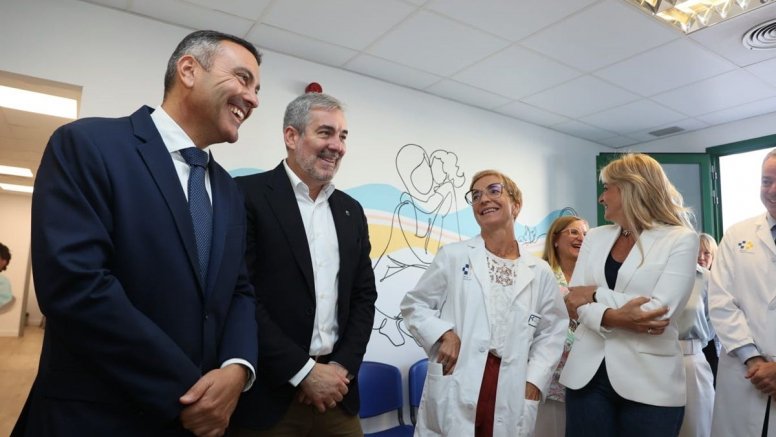
The President of the Canary Islands, Fernando Clavijo, recognized this Thursday the “human work” of the professionals of the Early Care Unit of Lanzarote. During a visit to this service, located in the Molina Orosa Hospital, which will provide coverage to boys and girls between zero and six years old with developmental disorders or at risk of suffering from them and their families from all the municipalities of the island, the president stressed that this resource allows “the boys and girls of Lanzarote to have the same opportunities as the boys and girls who are born in the capital islands”.
The visit to the Early Care Unit, which is located in the Doctor José Molina Orosa University Hospital, was also attended by the Ministers of Health and Universities, Science, Innovation and Culture of the Government of the Canary Islands, Esther Monzón, and Migdalia Machín, and they learned about the care services for boys and girls between zero and six years old with developmental disorders or at risk of suffering from them and their families.
The President of the Cabildo of Lanzarote, Oswaldo Bentancort, and the Deputy Mayor of Arrecife, Echedey Eugenio, also attended the visit, and toured the facilities together with the Director of the Health Area of Lanzarote, Esther Machín, and the Manager of the Health Services of the island, Pablo Eguia.
This Early Care device, which will begin its activity in July, is added to the network of resources and devices that already operate in the rest of the islands and are part of the Comprehensive Early Care Plan.
During the visit, the President of the Canary Islands, Fernando Clavijo, stated that this resource on the Island “allows us to meet the priority objective of placing the patient at the center of the public health system.” He also recognized the role of the professionals of the Management of Health Services of the island who “have managed to launch this new service, a demand from families who saw how Lanzarote had been the only island that did not have an Early Care Unit.”
The Minister of Health, Esther Monzón, assured that “the Early Care Unit facilitates an early and multidisciplinary response to minors who present some type of problem in their development and require specialized intervention.”
Early Care Unit
The Early Care Unit of Lanzarote will be attended by a multidisciplinary team composed of professionals from Clinical Psychology, Physiotherapy, Speech Therapy and Occupational Therapy who, together with the administrative staff and the orderlies, all of them attached to the Mental Health service, will offer comprehensive care to facilitate the greatest degree of integration of the child both at the family, school and community level. The Unit will also have the collaboration of a social worker from the Department of Social Welfare of the Cabildo of Lanzarote and an educational counselor from the area of Education.
This device, with an area of 130 square meters, is located on the ground floor of the Doctor José Molina Orosa University Hospital and has direct access from the street where parking spaces have been enabled for users of the service. The facilities, which have involved an investment of nearly "85,000 euros, have a multipurpose consultation, a gymnasium, two offices, a waiting room, services and areas for staff.
The specific Early Care device will benefit around 30 boys and girls between zero and six years old with developmental problems or at risk of suffering from them, as well as their families.
Early Care
Early Care is the set of actions aimed at the prevention, detection, diagnosis and treatment of developmental disorders of the child in ages between zero and six years.
The patients treated present developmental disorders (motor, cognitive, language, emotions and behavior, etc.) or are in situations of risk (prematurity, genetic diseases, marginalization, poverty, abuse, etc.) that may alter their maturation process.
Add La Voz de Lanzarote as a preferred Google source.
Stay informed with the latest current news.