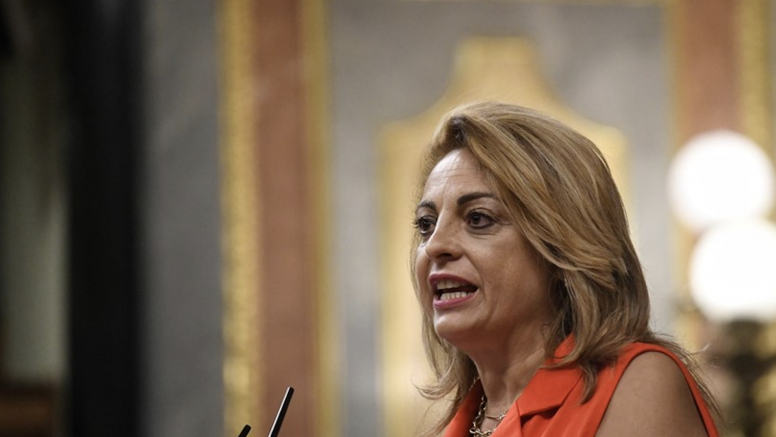
The spokesperson for the Canary Coalition (CC) in the Congress of Deputies, Cristina Valido, lamented this Tuesday the rejection in Congress of Royal Decree-Law 7/2025, which included urgent measures to guarantee the energy security of the Archipelago. At the same time, she celebrated the final approval of the modification of the Economic and Fiscal Regime (REF) to allow the use of the RIC in the construction or acquisition of homes for residential and long-term rental.
Thus, the nationalist spokesperson denounced that "the political tactics of some and others once again prevail over the interests of the Canary Islands" and censured that "the partisan calculation is above the interests of
a fragile territory like ours".
The nationalist spokesperson recalled that the rejected decree included measures worked on for weeks between the Government of the Canary Islands and the Government of the State to prevent new energy blackouts like those experienced in Tenerife and La Gomera, and to reinforce a vulnerable electrical system.
"The Congress cannot continue to be hostage to political noise. Today, an opportunity has been lost to protect the islands and give security to the citizens," she stated.
A decree with key measures for the Archipelago
Among the initiatives blocked by the Chamber was the express authorization of temporary emergency facilities (such as generators) in the face of the urgency of improving energy coverage on several islands; the extension of the agile procedure to energy storage systems, incorporating a direct claim from the Canary Coalition, the incorporation of new synchronous compensators in La Palma and Lanzarote, which are added to those already planned in Tenerife and Gran Canaria, to improve the firmness and stability of the electrical system.
It also contemplates the specific conditions for the Green Islands (La Palma, La Gomera and El Hierro), which will have special quotas for investment in energy distribution networks due to their territorial uniqueness.
In relation to renewable energies, the text included everything from boosting energy storage in existing projects, reducing the need to occupy new land and making it easier for clean energies to be manageable, to a new regime for R&D&I facilities, such as PLOCAN, which would have allowed processing type projects and replacing prototypes without repeating all the bureaucracy.
This places the Canary Islands as an international hub for marine innovation.
There were also significant advances for self-consumption, including the creation of the figure of the Self-consumption Manager, which would facilitate collective initiatives in communities, industrial areas or urban spaces, the extension to 5 km of the radius to consider a self-consumption facility, a historical demand included in the RDL and the streamlining of electric charging points, which would have resolved bottlenecks in the connection with distributors, as well as incentives for sustainable electric air conditioning in residential buildings through geothermal and aerothermal energy, including municipal tax benefits.
"These were not ideological measures. They were necessary, technical, useful. Today the Canary Islands loses because of a policy that turns its back on reality," Valido sentenced.
Housing: the REF at the service of families
In contrast, the Canary Coalition managed to get the Congress to approve the modification of Law 19/1994 of the REF, which will allow funds from the Canary Islands Investment Reserve (RIC) to be allocated to the construction or acquisition of homes for residential and long-term rental.
The nationalist spokesperson argued that "we have finally managed to put the REF at the service of the citizens. This measure will encourage the investment of thousands of small and medium savers in affordable housing, with a use clearly limited to long-term rental. Holiday rentals are expressly excluded".
During her speech in the Plenary, the nationalist deputy warned that "we cannot stop effective measures for fear of fraudulent use. That's what control is for. But we cannot continue to stand idly by
when there are thousands of people who have no access to either protected housing or market prices".
"With this rule we want to respond to a large part of our society that cannot find a roof, neither in the public system nor in the private offer," she added.
Valido also recalled that "this is a measure designed from the Canary Islands, for the Canary Islands", and that its final approval should mark a before and after. "We hope that it will begin to change the reality in many municipalities where today we cannot have doctors or teachers because there is no housing available. We are here to talk about what really worries the citizens".
Likewise, Valido continued that despite the setback to the energy decree "the Canary nationalists will continue working from rigor and commitment. Because while others turn politics into a spectacle, we understand it as a tool to improve the lives of the Canarians", she concluded.
Add La Voz de Lanzarote as a preferred Google source.
Stay informed with the latest current news.