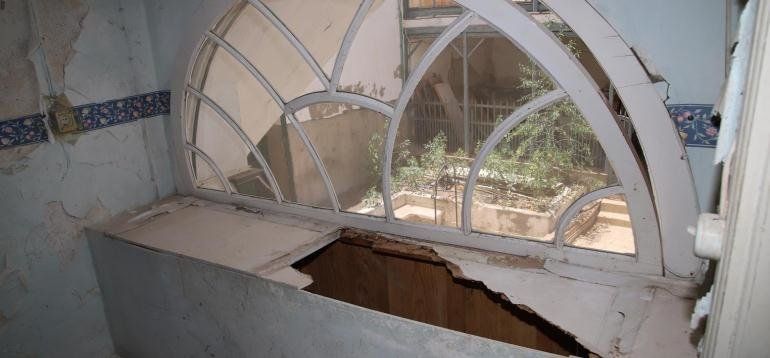
The Coalición Canaria group in the Cabildo has once again defended one of the most controversial actions of the former president, Pedro San Ginés: the purchase of a "ruinous" property on Calle Fajardo, which remains closed after a commitment of more than 5 million euros to turn it into an archaeological museum. Thus, CC has responded to the latest figures provided by the new government group, which has revealed that the small part of the Fermín house that was opened to the public generated losses of more than 185,000 euros last year.
"It seems that the new CEO of the CACT, Benjamín Perdomo, does not know how to distinguish between business and investment in heritage and confuses just that: investment in culture and archaeological heritage - as is the case - with operating losses," the party questions in a statement.
Specifically, Perdomo revealed that the "museum" collected an average of 455 euros per month in ticket sales, while it had "direct operating costs, that is, those corresponding to salaries and wages, security, cleaning, supplies, repair and conservation expenses and professional services that amounted to 191,278.95 euros".
However, the group led by San Ginés continues to defend these expenses and argues that they are investment rather than losses. "Losses that, in any case, all archaeological museums would have to the extent that they are the costly showcase of, in turn, very expensive research work that is not usually the subject of massive tourist visits, as the CACT may have, or as happens with the International Museum of Contemporary Art MIAC itself, or the Digital Memory of Lanzarote installed in the old Cabildo house, which since its creation have generated maintenance and exhibition costs far above the income they generate, without anyone considering closing them," he argues in a statement.
Ensures that "it was planned" that the Cabildo would assume the expenses
Next, the CC group acknowledges that when they promoted this project and included it in the network of Tourist Centers they knew that it would generate more expenses than benefits. "It was planned that it would be assumed by the Cabildo via assignment to the CACT - as a mere management instrument - and that they should not bear the difference in income and operating expenses as their own, but rather be passed on to the Cabildo of Lanzarote," they assure. However, the truth is that while San Ginés governed they did not correct that situation, and it is the Centers that bear the expenses it generates.
On the other hand, CC dedicates most of the statement to talk about the urban situation of the property, which is what has prevented the pending works from being undertaken and the announced museum from being opened, since the General Plan that is currently in force does not allow that intervention. In this regard, San Ginés has made public a report that he commissioned almost three years ago from the Government of the Canary Islands and that he had not disclosed until now. And he has done so to defend that by making a specific modification of the General Plan or approving provisional ordinances in Arrecife to modify the Catalog, this controversial project could continue.
"The alarmism with which the president of the Cabildo of Lanzarote tries to confuse citizens, assuring that a museum cannot be made because the property is not suitable given the residential use it currently has in the General Plan, is nothing more than a pretext that in no way prevents the development of the project," argues CC, which accuses the president of putting "excuses" and of "distorting reality, when not lying directly, to adapt it to her obsession with pretending the dismantling of the management carried out by the government group of which the PSOE was also part, instead of working to defend all the investments made by the First Island Corporation and promote the culmination of this project called to be the great archaeological reference in the capital of the island".
Based on that report from the Ministry of Territorial Policy of the Government of the Canary Islands that has now been made public, and which is dated July 2018, CC affirms that "for the use of the property as a museum, it would effectively only be necessary to modify the corresponding file and lower the degree of protection of the same to be able to advance in the actions". In addition, San Ginés assures that he "knows" that the Heritage Office of the Cabildo of Lanzarote "shares this approach because it is something common in the intervention in old buildings".
Add La Voz de Lanzarote as a preferred Google source.
Stay informed with the latest current news.