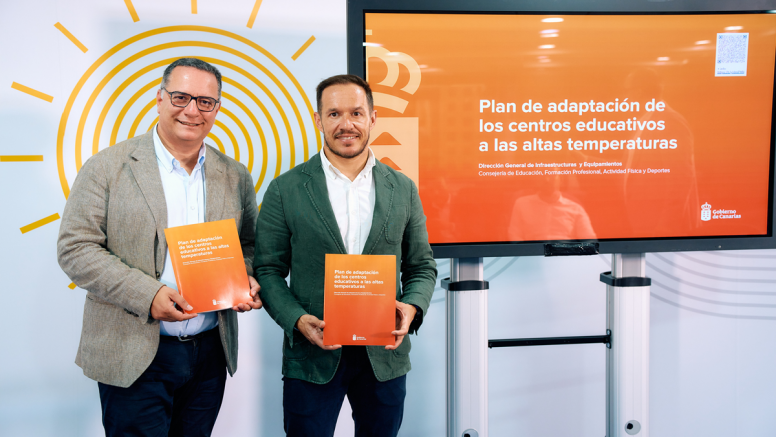
The Government of the Canary Islands takes a further step towards the adaptation of its schools to episodes of high temperatures with the creation of a specific plan endowed with more than 30 million euros and which was presented this Tuesday by the Ministers of Education and Sports and Ecological Transition and Energy, Poli Suárez and Mariano H. Zapata, respectively.
“It was necessary to condition the educational centers so that, as far as possible, they are adapted to episodes that have been repeated in recent times,” explained Suárez regarding this plan, which complements the Action Protocol in the educational field in the face of high temperatures, already presented in April, and includes new measures and actions with an initial budget for the remainder of the legislature of 30,817,570.86 euros, of which 3.9 million will be contributed by Ecological Transition.
Among these measures, the systematic analysis of the environmental conditions of the centers; the creation of more friendly and naturalized spaces; the incorporation of cooling systems or the implementation of renewable energies, as pointed out by both officials.
In addition, the plan includes other simpler and more immediate actions, ranging from the installation of fans to the generation of shade (through awnings, pergolas or canopies) or the creation of natural ventilation. All this will be added to more training in climate change, in order to “turn this issue into a true educational challenge for the islands,” according to Poli Suárez.
Likewise, he stressed that the financing to make the plan possible will come from the European Union - European Regional Development Fund (ERDF) and Recovery and Resilience Mechanism (MRR) -; from the Autonomous Community itself; from other administrations, with which agreements will be signed, and from the Canary Islands Special Employment Plan.
Eight lines
The plan includes the current Action Protocol in the educational field in the face of high temperatures, which already provides a framework of guidelines to guide actions in the face of this type of situation with the establishment of four risk levels and the corresponding measures for each of them: level zero (no risk or green); level 1 (low or yellow risk); level 2 (medium or orange risk); level 3 (high or red risk).
Among the novelties that are now incorporated, the aforementioned analysis of the environmental conditions of the centers, which will be carried out through the General Directorate of Infrastructure and Equipment in collaboration with Territorial and Environmental Management and Planning (Gesplan), through the development of a web platform and the installation of temperature, humidity and CO2 sensors, which, in the first instance, will reach 120 centers selected by Gesplan according to technical criteria and with an initial investment of 255,679.98 euros.
These tools will allow, in real time, “a constant and direct monitoring of the climatic conditions in which the educational activity takes place, which will help to determine what actions should be carried out and the degree of urgency of the same,” said Suárez.
In that sense, the plan will be applicable in all centers of the Canary Islands, but the first improvement and adaptation measures will be implemented only where it is most necessary, depending on the analysis of the environmental conditions of the different facilities and following objective criteria, with a totally transparent procedure.
From now on, the planning of projects with a climate approach and in four phases (selection and prioritization; analysis and diagnosis of needs, zoning and harmonization) will be essential for the creation of more friendly spaces (accessible, safe, sustainable, adjusted to the needs of the students) and naturalized, both in newly created equipment and in existing ones, which must have facades adapted to high temperatures, shade spaces, covered sports facilities and drinking water sources.
In addition, new cooling systems will be incorporated in order to improve the habitability conditions of educational facilities against the effect of high temperatures, prioritizing the so-called adiabatic systems, which consist of passing air through membranes impregnated with water, reducing the temperature with hardly any cost, compared to conventional air conditioning.
Finally, together with various training actions, and within that integral philosophy of fighting climate change, photovoltaic energy installations will be promoted in 48 centers of the islands with the 3.3 million euros contributed by Ecological Transition.
For this, there are already several files underway in different parts of the archipelago, and collaboration has also begun with energy communities (without going any further, a recent agreement with the entity Energía Bonita Sociedad Cooperativa already allows in La Palma the private use of the roofs of seven educational centers for the installation of solar plants for self-consumption, with the aforementioned entity ceding a fee for the installed power).
Add La Voz de Lanzarote as a preferred Google source.
Stay informed with the latest current news.