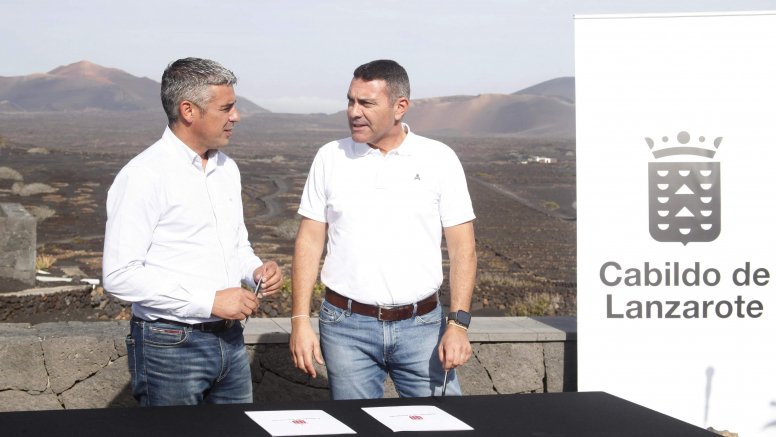
The Minister of Agriculture, Livestock, Fisheries and Food Sovereignty of the Government of the Canary Islands, Narvay Quintero, and the president of the Cabildo of Lanzarote, Oswaldo Betancort, ratified this Thursday a collaboration agreement for the development of an action project for the conservation of the agro-systems of the wine-growing area of La Geria and to stop the abandonment of agricultural land.
This initiative, co-financed by the regional Executive and the island corporation, contemplates an investment of one million euros to implement support measures for winegrowers for the maintenance of this agricultural landscape, as well as actions to promote the dissemination and training in agricultural tasks characteristic of this enclave to recover the cultivation of the vine in the lands where it has been abandoned, and improve knowledge about this Protected Natural Space of great beauty and agricultural, cultural and ethnographic value, which covers 5,255 hectares of land in the municipalities of Tinajo, Yaiza, Tías, San Bartolomé and Teguise.
Thus, this program also includes the elaboration of a study of geographic characterization of the crop to have a deeper knowledge of it and georeference the typologies of holes according to their diameter, depth or protection wall, among other aspects, and also of vine varieties.
During the signing ceremony, Quintero stressed that "La Geria forms a unique landscape in the world shaped by the winegrowers of the island, which is part of the history and culture of the Canary Islands." For this reason, the head of the department stressed the importance of establishing measures to "protect a traditional agricultural legacy that places Lanzarote as an international benchmark for agro-tourism and reinforces the external image of the Archipelago in this area, which is based on wines that are at the highest level of excellence, recognized for their quality and uniqueness."
For his part, Betancort said that "with this project, farmers will not only receive financial support, but also technical training. Our goal is to ensure that the cultivation techniques that support La Geria remain alive in future generations." In this sense, the president stressed that "this collaboration with the Government of the Canary Islands is essential to preserve the agricultural and cultural value of our island and that it is an example to the whole world."
According to data from the Crop Map, in La Geria there are 1,368 hectares of vineyard cultivation of which 237 hectares are abandoned (15% of the surface), of which 145.7 are in the heart of this space.
The lands of La Geria, known as natural sands, are covered by the thickest layer of volcanic sand in Lanzarote, which conditions the way in which the vines are planted. The plants are located inside conical holes dug in the sand layer and it is common to manufacture a small stone wall of about 15-20 cm. that occupies approximately half of the perimeter of the hole in the part exposed to the northwest winds, which are the predominant ones on the island during most of the year.
This unique cultivation system entails a series of differentiating processes with respect to other wine-growing areas, such as the excavation, which entails added difficulties to the meteorological conditions of this enclave and also an increase in production costs. This work consists of extracting from the interior of the hole the sand that has been deposited around the plant by the effect of the wind or as a result of the transit necessary for other operations of manipulation of the crop, such as the removal of dry pruning leaves, the disbudding or the harvest.
To avoid the constant accumulation of sand at the base of the plant, the excavation must be carried out periodically in order to allow the scarce rains that occur annually on the island to filter into the soil and reach the roots. Likewise, this process prevents various phytosanitary problems that can compromise the viability of the crop or reduce its production.
Add La Voz de Lanzarote as a preferred Google source.
Stay informed with the latest current news.