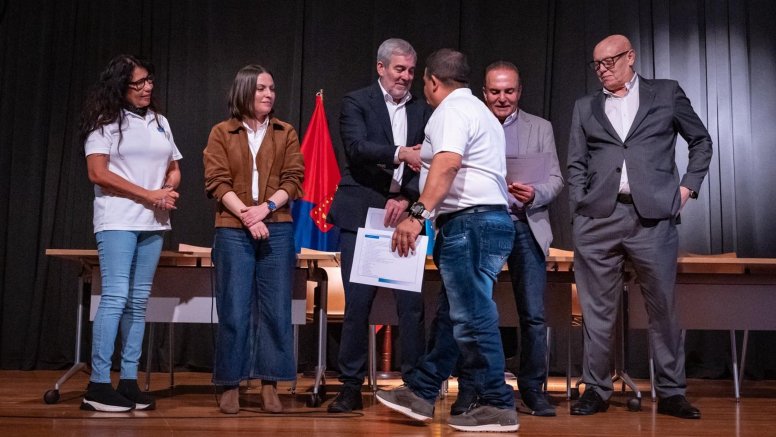
The president of the Canary Islands, Fernando Clavijo, highlighted this Thursday in Tinajo the regional government's commitment to moving towards a "Canary Islands of care," with more home care services, more qualified professionals, and more job opportunities linked to the care of the elderly.
Clavijo participated in the ceremony for the awarding of certificates, which was also attended by the Minister of Universities, Science, Innovation and Culture, Migdalia Machín, to the fifteen people who have completed the first training cycle of the Rural Domus project's School of Care, a pioneering initiative promoted by the Canary Islands Health Service (SCS) in collaboration with the Order of Hospitallers of Saint John of God.
The president of the Canary Islands stated that “the Canary Islands need to prepare for the challenge of aging and that means reinforcing care, bringing it closer to home, and doing so with trained professionals and with more humane and closer attention”.
Likewise, he/she pointed out that “our objective is that older people can remain as long as possible in their home, in their environment and with quality of life, especially in rural municipalities where access to services is more complex”.
He also highlighted that “this project demonstrates that care is also an opportunity to generate employment, offer a job outlet for unemployed people, and facilitate the social and labor integration of migrants”.
The head of the Canarian Executive added that “when administrations and social entities work together, we are capable of giving real answers to the great social challenges and improving people’s lives”.
During his speech, the general director of San Juan de Dios, Juan José Afonso, highlighted the importance of "humanized care" as an approach that "is part of the DNA of San Juan de Dios and is what we also want to transmit to those who are training in this project today."
For his part, the president of the Cabildo of Lanzarote, Oswaldo Betancort, pointed out that "initiatives like Rural Domus align with the island's commitment to making Lanzarote and La Graciosa 'the Islands of Care', within the framework of the Insular Strategy for Accessibility and Inclusion 2024–2030, endowed with more than 7 million euros". He stressed that the project reinforces a model of care that is "closer, more human, and more accessible, especially in rural environments".
Betancort recalled that the Cabildo has recovered the collaboration and consolidated 35 million euros for the social concert 2024–2029, guaranteeing stability for Third Sector entities. Furthermore, he described the new dependency agreement as a “historic milestone,” whose contributions from the Government of the Canary Islands and the Cabildo amount to more than 75 million euros until 2028 to continue improving care for dependency and disability in Lanzarote and La Graciosa.
Likewise, for the mayor of Tinajo, Jesús Machín, "it is a source of pride that this project has started in Tinajo, demonstrating that we have the ideal conditions to place our elders at the center of management, with close, direct, and top-quality attention. Furthermore, this training will contribute to continuing to raise the level of care for our people."
Care for the elderly in rural areas
The Rural Domus project is part of the Program for care of vulnerable elderly people in rural areas, which is promoted by the Canary Islands Health Service and is currently being developed in the municipalities of Tinajo (Lanzarote) and San Sebastián de La Gomera.
The initiative aims to improve access to professional home care through a comprehensive, humanized, and person-centered care model, which allows older adults to remain in their usual environment for as long as possible, reducing avoidable hospital admissions and improving their well-being.
The training program is especially aimed at people who are unemployed, migrants needing labor and social integration, and informal caregivers who wish to professionalize. Currently, nearly fifty people are participating or have enrolled in the Care School in both municipalities.
Employment, cohesion and future
The School of Care offers theoretical and practical training in home socio-health care to equip students with the necessary skills to provide safe, professional, and quality care.
The project is developed within the framework of the cooperation agreement signed between the Canary Islands Health Service and the Order of the Hospitallers of Saint John of God, financed with 400,000 euros and valid until the end of 2026, with the possibility of extension.
Furthermore, the president of the Canary Islands highlighted that this type of initiative is part of a global strategy to strengthen the public care system and dependency care. In this regard, he recalled the recent signing of new dependency agreements with the island councils, which will involve an investment of 1.63 billion euros over the next four years. In the case of Lanzarote, this funding will allow for the allocation of more than 75 million euros – 26 million contributed by the Lanzarote Island Council – over the next 4 years, which will make it possible to create 647 new socio-health places and strengthen the care network for the elderly and dependent individuals on the island.
With this initiative, the Government of the Canary Islands reinforces its strategy to improve care for the elderly, boost employment linked to the care sector, and move towards a more accessible, accessible, and adapted socio-health model to the territorial reality of the archipelago.
Add La Voz de Lanzarote as a preferred Google source.
Stay informed with the latest current news.