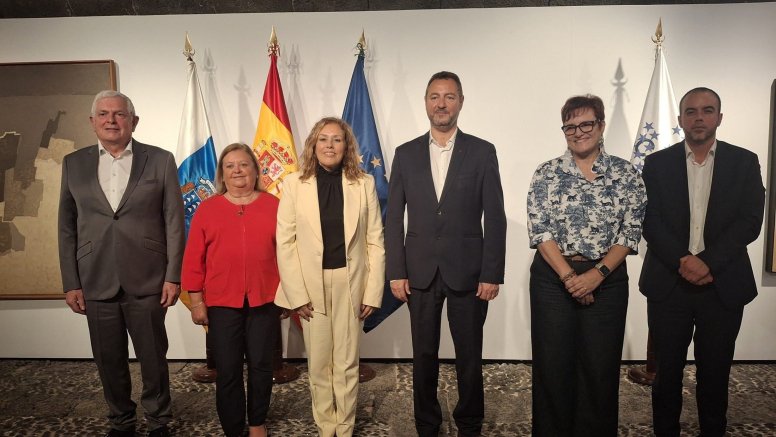
The Conference of European Regional Legislative Assemblies (CALRE) launched its first video podcast this Tuesday, December 2, a new communication tool focused on the debate of European policies. The inaugural episode, promoted by the Working Group on Migration, focuses on the challenges of migration management and the future implementation of the new European Pact on Migration and Asylum, scheduled for 2026.
The meeting, held at the Castillo de San José in Arrecife (Lanzarote), was moderated by the president of CALRE and the Parliament of the Canary Islands, Astrid Pérez, who brought together institutional representatives and experts in the field.
During the debate, Astrid Pérez underscored the need for joint action: "Europe needs a shared and supportive response to the migratory challenge," she stated, insisting that "regions on the front line, like the Canary Islands, must play a decisive role in the implementation of any European migratory policy." Furthermore, she highlighted that migration is both "the southern border of Europe" and "a space for welcoming and reflecting on the migratory phenomenon."
The video podcast featured the participation of various personalities who contributed different perspectives on the migratory crisis. The Vice-President of the Parliament of Brussels, Mohamed Ouriaghili, stated that "we will have to put our heart and soul into this problem, Europe must take charge of this flow of people arriving on the Canary Islands' coasts, it is the only solution." For her part, the Minister of Social Welfare of the Canary Islands Government, Candelaria Delgado, explained that the only three development cooperation projects at the source funded by Spain are financed by the Canary Islands Government.
From civil society, Juan Carlos Lorenzo, coordinator of the Spanish Commission for Refugee Aid (CEAR), focused on the need for coordination not to be an end in itself, but a tool for action. Immigration lawyer Louelia Mint, a member of the Lanzarote Bar Association, criticized the Pact's lack of territorial vision, pointing out that the European Parliament "failed to visit the Canary Islands before drafting" the document. Finally, Antonio Tirso Ester Sánchez, professor of Legal Theory at the University of Las Palmas de Gran Canaria, highlighted the "limbo" that exists from the departure from the African coast to the arrival in the Canary Islands, emphasizing that "life is the most important value."
The participants analyzed key aspects such as border management, inter-institutional coordination, the situation of unaccompanied minors, and the role of European agencies like FRONTEXThe video podcast can be viewed from this Tuesday on the social media of CALRE and the Parliament of the Canary Islands
Add La Voz de Lanzarote as a preferred Google source.
Stay informed with the latest current news.