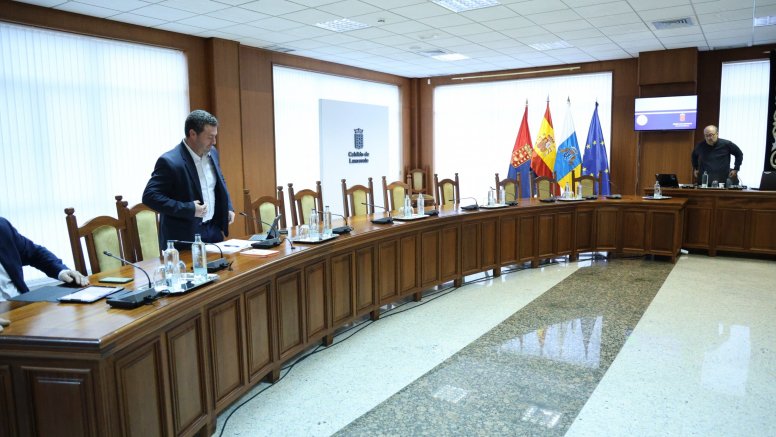
The councilors of the Socialist Party in the Cabildo of Lanzarote left this Thursday morning, February 12, the plenary session convened for the approval of the budgets of the First Insular Institution, as a sign of protest for what they consider an "undemocratic" procedure.
The plenary session began at 8:00 AM and was focused on one of the most relevant debates of the political year on the Island: the island's accounts. However, the socialist group decided to walk out and leave the plenary hall, understanding that the regulatory deadlines for the study and presentation of amendments had not been respected.
The socialist councilor Ariagona González later explained the reasons for the decision in an interview granted to the program Buenos Días Lanzarote of Radio Lanzarote-Onda Cero. "We cannot legitimize an anti-democratic exercise in this way," she stated. As she detailed, the group only had "a day and a half" to analyze the budgetary document and present amendments, when the ordinary deadline established is seven days, or three in case of urgent processing.
“What would be next? They give you a day and a half to present amendments and what is going to happen in the 2027 budget? Are they going to give us half a day?”, questioned the councilor, who assured that the PSOE made the decision “with great concern”, aware of the relevance of the plenary session and the responsibility that it implies to represent their voters.
González acknowledged that leaving the budget session, “one of the most important of the year,” is not a decision taken “with pleasure,” but insisted that what they are not willing to do is “legitimize undemocratic behaviors by Oswaldo Betancort or whoever it may be.”
The councilwoman defended that in a democracy “all groups have the right to express ourselves” and that “the rules of the game” must be respected, something that, in her opinion, has not been fulfilled on this occasion by the president of the Cabildo.
The plenary session continued its development without the presence of the socialist councilors. For their part, the councilors from the mixed group, who also criticized the little time they were given to analyze the accounts, remained.
Add La Voz de Lanzarote as a preferred Google source.
Stay informed with the latest current news.