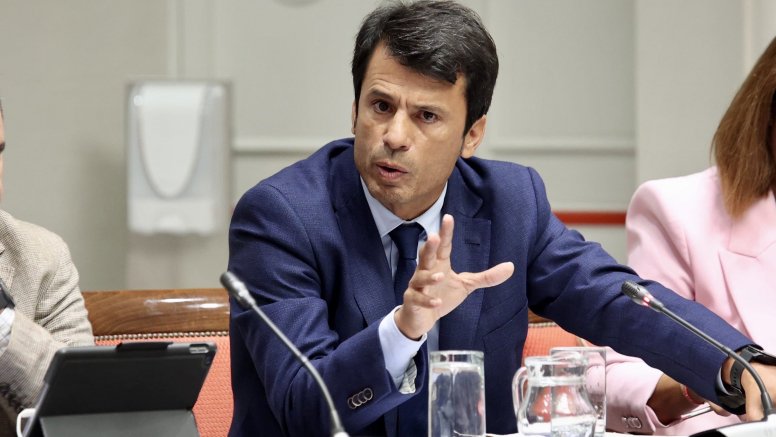
The socialist deputy for Lanzarote and La Graciosa, Marcos Bergaz, asked this Thursday in the Parliament of the Canary Islands about the controversy surrounding the Renewable Acceleration Zone (ZAR) on the island, an institutional conflict that has remained open for seven months.
During his intervention in parliamentary committee, Bergaz questioned the management of the Minister of Ecological Transition of the Government of the Canary Islands, Mariano Hernández Zapata (PP), and of the president of the Cabildo of Lanzarote, Oswaldo Betancort (CC), considering that “they are taking too long to close the conflict generated with renewables on the island”.
The ZAR protocol was signed in July 2025 by both institutions and then presented as the first in the Canary Islands, with the aim of accelerating the implementation of renewable energies in Lanzarote. However, after its signing discrepancies have arisen between the autonomous Government and the Cabildo regarding its scope and content.
“His department has been starring for months in the main conflict or institutional clash between the Government of the Canary Islands and the Cabildo de Lanzarote,” stated Bergaz at the beginning of his intervention.
The deputy, contrary to the dimension of the surface area planned for the implementation of renewable projects within the ZAR, which exceeds 3,100 hectares, the equivalent of 4,200 football fields, explained that "while the regional Executive maintains that these figures were agreed upon with the Cabildo, the island institution maintains that they were not agreed upon in those terms, despite the fact that the protocol has the signature of the Cabildo's own president".
Bergaz lamented "the subsequent management of the disagreement and the lack of transparency regarding the available information," which, in his opinion, "fuels confusion and distrust."
In this context, he focused on the Joint Monitoring Commission provided for in the protocol itself. This body, composed of two representatives of the Government of the Canary Islands and two from the Cabildo of Lanzarote, is intended to resolve interpretation problems, propose modifications and revisions, and even, propose the resolution of the ZAR. At this point, the deputy asked if its members have already been appointed and if there is a work plan to address the existing discrepancies.
For his part, Councillor Mariano Hernández Zapata (PP) defended that the work carried out in Lanzarote was “fully consensual” and regarding the monitoring committee he replied that, “it is a useful body, for work, participation and transparency”, and confirmed that after almost eight months since the signing of the Protocol "it still cannot be put into operation because the Cabildo has not designated its members".
During his reply, Bergaz addressed the reasons for the disagreement between both administrations. “I don't know if we are facing a change of criteria on the part of the Cabildo, if its government partner backed down in the face of social reactions on the island, if the president signed without fully knowing the content of the protocol or if the maps were changed.”
“What we do know is that neither is a joint explanation offered, nor has the Joint Commission foreseen in the protocol been activated, so it is not surprising that distrust and a bad institutional image continue to increase, councillor,” concluded Marcos Bergaz.
Add La Voz de Lanzarote as a preferred Google source.
Stay informed with the latest current news.