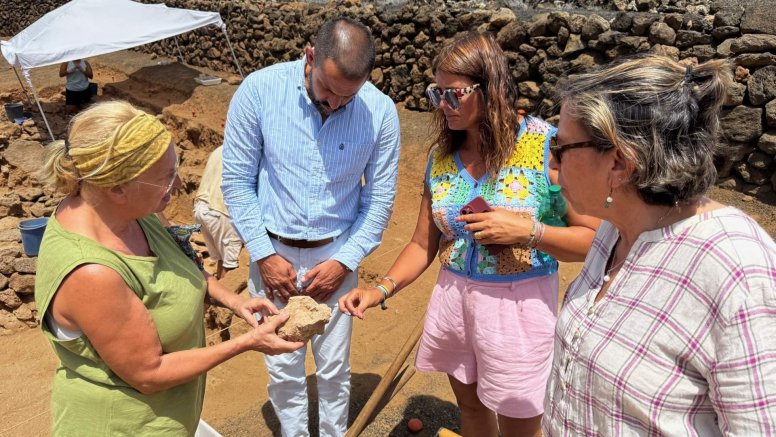
The Teguise City Council reports the completion of the 2025 archaeological excavation campaign at the El Bebedero site, a benchmark in the Protohistory of the Canary Islands that continues to offer discoveries of great relevance for the knowledge of the indigenous past of Lanzarote.
The works, directed by the professor of Prehistory of the ULPGC, Pablo Atoche, and the archaeologist Mª Ángeles Ramírez, have once again had the support of the Council through a grant to the Canarian University Foundation of Las Palmas, in addition to the altruistic collaboration of a multidisciplinary team of researchers.
The mayoress of Teguise, Olivia Duque, stressed the importance of these works. “El Bebedero once again demonstrates its value as a unique enclave in the Canary Islands, capable of offering us new pieces to reconstruct our oldest history. From the City Council we will continue to support these investigations, because investing in heritage is investing in identity and in the future.”
For her part, the Councilor for Historical Heritage, Mar Boronat, highlighted the role of the municipality in the conservation of the cultural legacy. “Thanks to the continuity of the excavations, we can bring to the population and future generations a more rigorous knowledge about the life of our ancestors. It is a pride for Teguise to be a benchmark in archaeological matters throughout the Archipelago,” she said.
Among the main findings of this campaign are the exhumation of a double room dedicated to the treatment of ovicaprid skins, various hydraulic structures for the collection and storage of water and several polished basalt stelae, one of them anthropomorphic, which reflect the high level of adaptation and the cultural richness of the indigenous community that inhabited the island between the 1st century BC and the 4th century AD.
In addition to this, there are high-quality indigenous pottery pieces, personal adornment objects made with mollusks, bone utensils and fragments of Roman amphorae, which show the relationship of the ancient inhabitants of Lanzarote with Mediterranean navigators.
A reference site
After more than four decades of systematic research, the El Bebedero and Buenavista sites continue to be key to understanding the origins of the Canary Islands, revealing the complex interaction between the indigenous peoples and the Mediterranean cultures.
The Teguise City Council thanks the research team for their efforts and reaffirms its willingness to continue collaborating so that this heritage is disseminated through guided tours, conferences, publications and educational activities, thus bringing the richness of Lanzarote's most remote history closer to the population.
Add La Voz de Lanzarote as a preferred Google source.
Stay informed with the latest current news.