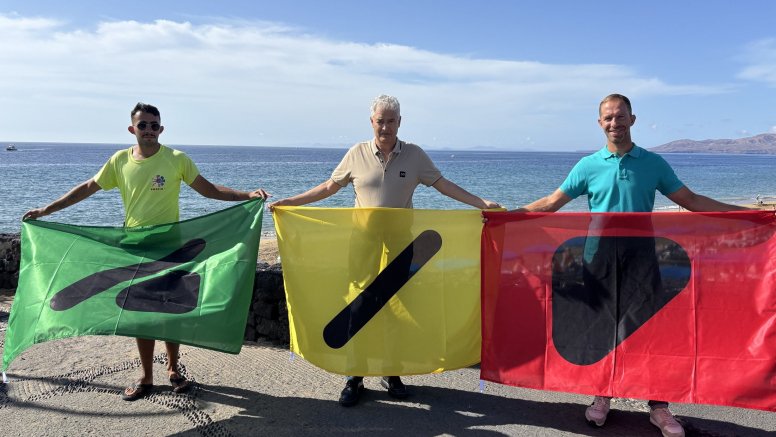
The Tías Town Council, through the Department of Beaches, has raised the flags this Tuesday on the four most important beaches of Puerto del Carmen, Playa Grande, Playa Chica, Matagorda and Pocillos, with pictograms specifically designed so that people with color blindness can identify the state of the sea.
The mayor of Tías, José Juan Cruz, and the councillor for Beaches, Christopher Notario, highlighted the importance of this initiative, a pioneer in Lanzarote, to "strengthen the City Council's commitment to inclusion, accessibility and safety"
"These are small steps we are taking towards inclusion, as these flags with symbols, compared to the common flags, will allow colorblind people to easily distinguish the water conditions and other warnings in the bathing area," declared José Juan Cruz.
Christopher Notario clarified that the Color ADD sign code system "is universal and is suitable for people with problems differentiating all or some colors (color blindness or dyschromatopsia)." The beaches of Puerto del Carmen are the first in Lanzarote to have this system among their services.
Notario added that "with this measure, we are taking another step towards accessible beaches for all. It's not just about having ramps, walkways or shaded areas, but also about ensuring that anyone, regardless of their visual abilities, can enjoy the sea safely and autonomously."
The councilor underscored the collaboration of the Beaches personnel and lifeguards in the implementation of the system, and emphasized that "this type of project brings us closer to a more inclusive and responsible tourism model, in which all visitors and residents feel welcome and cared for."
Color blindness is a visual alteration that affects the perception of colors. It is estimated that around 8% of men and 0.5% of women have some type of deficiency in color vision, which can make it difficult to identify signals based exclusively on colors.
Add La Voz de Lanzarote as a preferred Google source.
Stay informed with the latest current news.