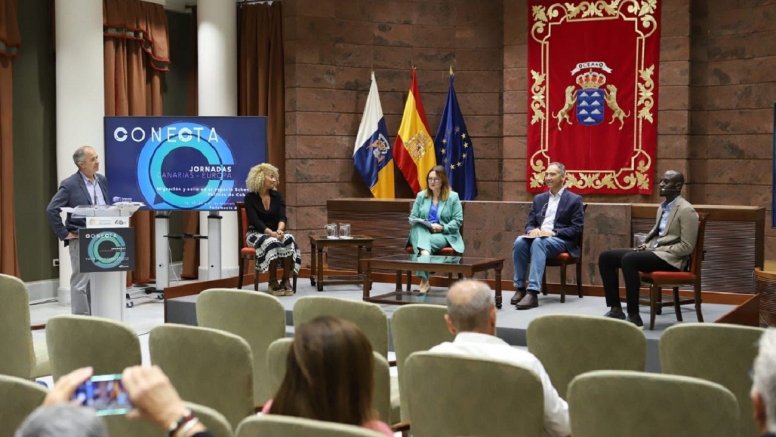
The 'Canarias-Europe Connect Days' continued this Tuesday, September 19, with the second session dedicated to migration and asylum. The Vice-President of the Bremen Parliament, in Germany, and speaker of the Opinion of the European Committee of the Regions (CoR) on the new pact on migration and asylum of the European Union, Antje Grotheer, spoke by videoconference from the German country and demanded "more solidarity and an equitable distribution of burdens to alleviate the pressure on front-line regions", such as the Canary Islands.
In his opinion, "the primary objective must be that local and regional realities are taken into account in the reform of the EU's migration and integration policy, given that the socio-economic impact of migration and the daily effort of reception and integration of migrants are strongly felt at local and regional level".
"Several of the recommendations of the European Committee of the Regions were included in reports of the European Parliament and should be reflected in the final EU legislation," Grotheer stressed. In his opinion, "the definition of migratory crisis must also be understood from a local and regional perspective, and the "Canary Islands are proof of why this is important".
In addition, "if the situation is observed at the national level, a sufficiently accurate picture of the seriousness of the regional situation is not obtained." "Local or regional governments are best placed to offer a coherent view of the situation and their needs, so they should participate more in the definition of migration policies in Europe".
For Antje Grotheer, "greater support for local and regional governments is needed, both political and financial, from the national and European level, in order to facilitate their work of receiving and integrating immigrants in a socially responsible manner and based on international law and European values".
The day started at nine in the morning with the opening by the president of the Social Rights Committee of the Parliament of the Canary Islands, Yonathan Martín Fumero, and a live connection with the Canarian MEP Juan Fernando López Aguilar, who stressed that the solution to avoid the loss of lives at sea is to "launch an EU rescue service that coordinates all European efforts, as well as an inclusion mechanism that respects European law".
"Launch an EU rescue service"
He announced that they are "working hard" to bring forward a "new pact on migration and asylum of the European Union", "which articulates a shared responsibility and binding solidarity, particularly in situations of emergency and crisis, and after rescue operations".
The territorial coordinator of the Spanish Commission for Refugee Aid (CEAR), Juan Carlos Lorenzo de Armas, then spoke to give a view of migration "from the south of the southern border" of Europe before the shared presentation on social inclusion models.
José María Zarraluqui Guillén, regional coordinator of the Red Cross of the Canary Islands, José Felix Hernández López, president of the El Buen Samaritano Canarian Foundation, Miguel Ángel Rojas Morales, regional director of the Don Bosco Salesianos Social Foundation of the Canary Islands, Ricardo Iglesias San Gil, secretary general of Cáritas Diocesana de Canarias, and Alfonso J. Roque Marrero, provincial director of the Nuevo Futuro Las Palmas Association, participated in this table.
After the connection with Antje Grotheer, the discussion table on migration in the Canary Islands was opened, moderated by José María Rodríguez, EFE delegate in the Canary Islands. Mame Cheikh Mbaye Seck, co-founder and president of the Canarian Reception Network and president of the Federation of African Associations in the Canary Islands, Loueila Mint El Mamy, lawyer, activist and member of the Canary Islands Free of Foreign Internment Centers, the Minister of Social Welfare of the Government of the Canary Islands, María Candelaria Delgado Toledo, and Vicente Manuel Zapata, academic director of the Immigration Observatory of Tenerife and professor of Human Geography at the University of La Laguna, participated.
This second day concluded with the presentation Entrepreneurship and innovation among the immigrant population in the tourism sector of the Canary Islands, by Pedro Calero, director of the course of 'University Expert in Intelligent and Innovative Business Management' and professor at the University School of Tourism of Lanzarote.
Wednesday's session
The 'Canarias-Europe Connect Days' will continue this Wednesday, September 20, with the sessions dedicated to cohesion policy in the EU. The second vice-president of the Parliament of the Canary Islands, Gustavo Matos, will speak in the first session. Pedro de Faria e Castro, member of the Commission for Territorial Cohesion Policy and EU Budget of the European Committee of the Regions and speaker of the Opinion on the Outermost Regions (ORs) of the aforementioned committee, and the MEP of the Group of the European People's Party Gabriel Mato, will be present via videoconference.
Subsequently, María del Pilar Almeida Trujillo, deputy director of Management of European Funds of the General Directorate of Planning and Budget of the Government of the Canary Islands, will speak about the "operational programs and their level of implementation in the Canary Islands". The evolution of GDP per capita will be the title of the talk by José Miguel González Hernández, economist and director of consulting at Corporación 5. Carlos Portugués Carrillo, expert in European affairs, will also speak to address the "differentiated application of cohesion policy in the Canary Islands as an outermost region".
Wednesday will also close with a discussion table on the future of the Canary Islands in the new cohesion period, moderated by Mayer Trujillo, in which Matilde Asián González, Minister of Finance and Relations with the European Union, José Luis Rivero Ceballos, Professor of Applied Economics at the University of La Laguna, and José Carlos Francisco, President of the Economic and Social Council of the Canary Islands, will participate.
Add La Voz de Lanzarote as a preferred Google source.
Stay informed with the latest current news.