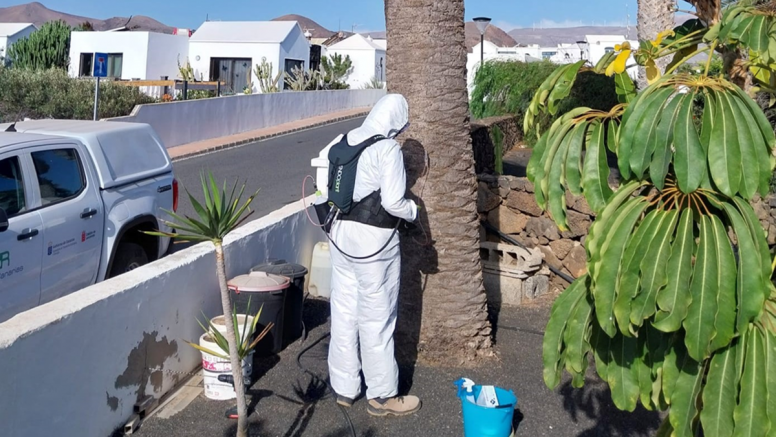
The Ministry of Ecological Transition and Energy of the Government of the Canary Islands, led by Mariano H. Zapata, is carrying out phytosanitary treatments through the endoterapy technique in a total of 1,697 palm trees in Lanzarote.
These works are part of the Plan for the Control and Eradication of Diocalandra frumenti in the palm trees of Lanzarote, developed by the Ministry and the Cabildo of Lanzarote, which in recent months have applied this measure in various points with greater impact from this plague on the island.
As explained by the counselor, Mariano H. Zapata, these works “are focused on increasing the areas free of plague and establishing phytosanitary measures that prevent reinfection from the most affected areas”.
“We have already applied this treatment to 1,697 palm trees and we will continue working in this direction, since the effectiveness of this method for the control of this type of plague has been demonstrated, which seriously damages the health of our palm groves”.
In this sense, Zapata stated that, given the effectiveness of these techniques, throughout the project they will continue to be given continuity, “as they represent a step forward so that, little by little, the palm trees of the island enjoy better health and we can definitively control the Diocalandra”.
For his part, Oswaldo Betancort, president of the Cabildo of Lanzarote, explained that the Plan for the Control and Eradication of Diocalandra frumenti “is a sign of our responsibility towards the natural heritage of Lanzarote. Through endoterapy, we managed to protect our palm trees, an emblematic symbol of the island, applying effective and sustainable methods”.
The president also stated that this joint effort between the Government of the Canary Islands and the Cabildo “reflects our commitment to the biodiversity and environmental health of Lanzarote for future generations”.
Samuel Martín, Minister of the Environment of the Cabildo of Lanzarote, highlighted that the use of endoterapy in the treatment of our palm trees “ensures phytosanitary management that minimizes the environmental impact and allows effective control of the plague”. According to him, this sustainable method reduces water consumption and avoids contamination, guaranteeing safety in urban areas. “We are determined to reinforce a conservation model that takes care of our environment and contributes to a more resilient and healthy Lanzarote”, he stated.
The actions in detail
The main technique used for the treatment of palm trees in Lanzarote is endoterapy, a treatment method consisting of the introduction, generally by injection, of an active substance in a solid or liquid state, into the vascular system of a plant. Only in those palm trees that due to their size and morphology cannot use endoterapy, the application of phytosanitary products is carried out by spraying.
Among the benefits of this method with respect to other types of techniques for applying phytosanitary products are mainly those of an environmental nature, since endoterapy reduces water consumption, since the volumes that are injected are minimal, and above all it is a technique that does not generate contamination to the environment, since it avoids drift when applying the phytosanitary product, which makes it an appropriate method in urban environments.
Finally, it should be noted that three different methods are being carried out of endoterapy in the treatment of palm trees in Lanzarote. These three correspond to the same techniques included in the study ‘Evaluation of the endoterapy technique for the control of Diocalandra frumenti (Fabricius) in Canary palm’, carried out by the General Directorate of Agriculture of the Government of the Canary Islands, ICIA (Canary Institute of Agricultural Research) and GMR Canarias.
Add La Voz de Lanzarote as a preferred Google source.
Stay informed with the latest current news.