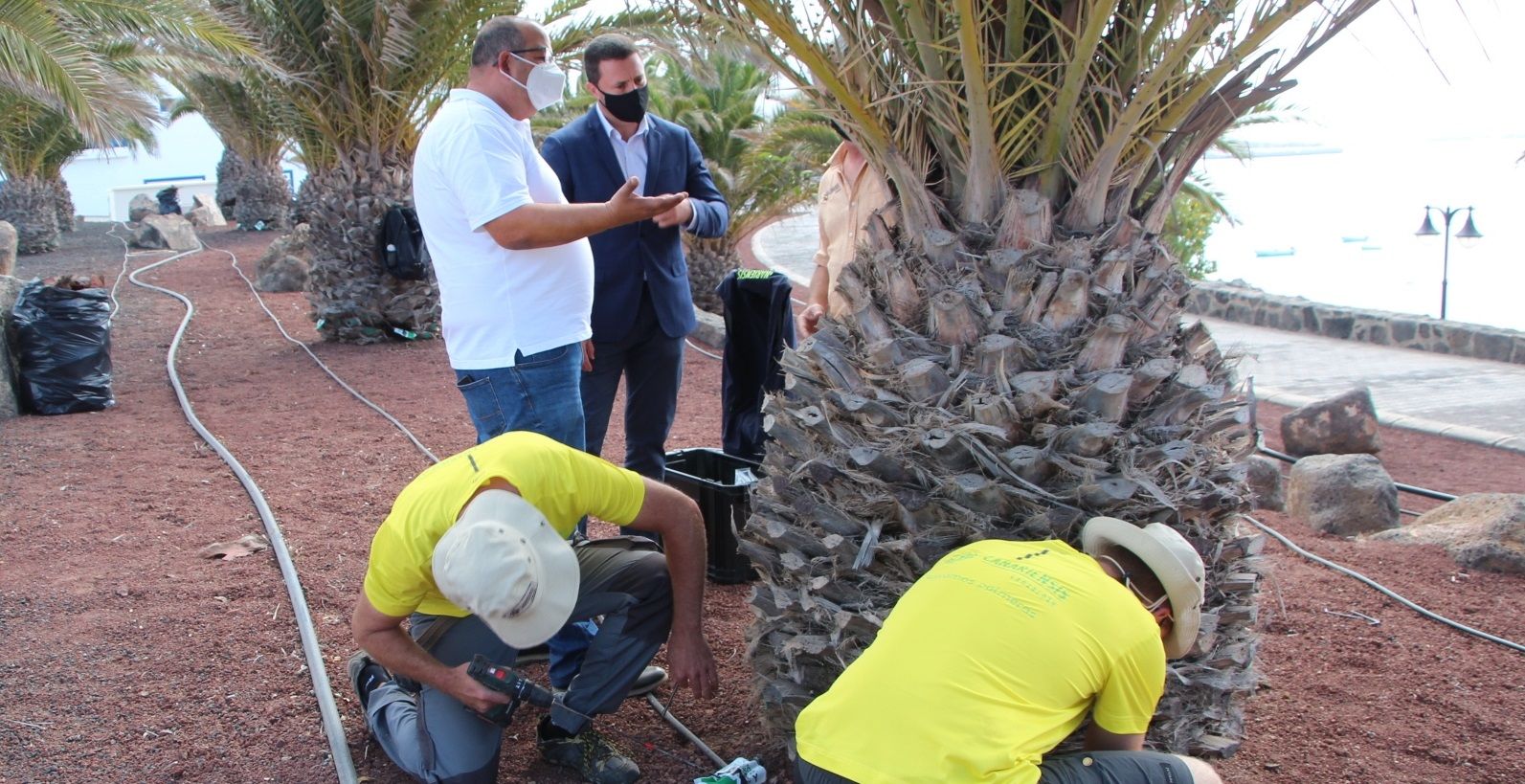
The Yaiza City Council began this Thursday in Playa Blanca its pilot test of low-pressure endotherapy treatment on 300 palm trees in the municipality against diocalandra frumenti "to protect the emblematic Canary plant species and control the expansion of the harmful beetle, popularly known as picudín, which affects almost half of the palm grove of Lanzarote." The mayor of Yaiza, Óscar Noda, explains that "the endotherapy treatment that we put into practice consists of injecting phytosanitary product into the trunk of the palm tree to kill the insect that causes its decline, which can even end up killing it."
Technicians point out that the plague, of Asian origin, was detected for the first time in the Islands two decades ago as a result of the trade in exotic plants in the Canary Islands. The insect uses the palm tree for its reproductive phase and eats its interior until it weakens it. "The insecticide that is applied is not only not dangerous for the population, because it is not necessary to fumigate, but its distribution is much more homogeneous and therefore more effective than normal sprays because it is injected into the trunk," they emphasize from the Consistory.
"The plague is very difficult to eradicate, especially in urban centers, but it is possible to control it and therefore we are advancing this experience with the company Canariensis Paisajes, with whom we have also carried out actions to install automated irrigation with solenoid valves in some municipal gardens," says the Councilor for Parks and Gardens, Rubén Arca.
The mayor and the councilor of the Area accompanied the technical team in the first endotherapy action carried out on the palm trees located in the vicinity of Limones street in Playa Blanca, near the southern port. Both highlight that Yaiza is the first institution on the Island to carry out a low-pressure endotherapy treatment, a Spanish patent product of research from the University of Córdoba.
Add La Voz de Lanzarote as a preferred Google source.
Stay informed with the latest current news.