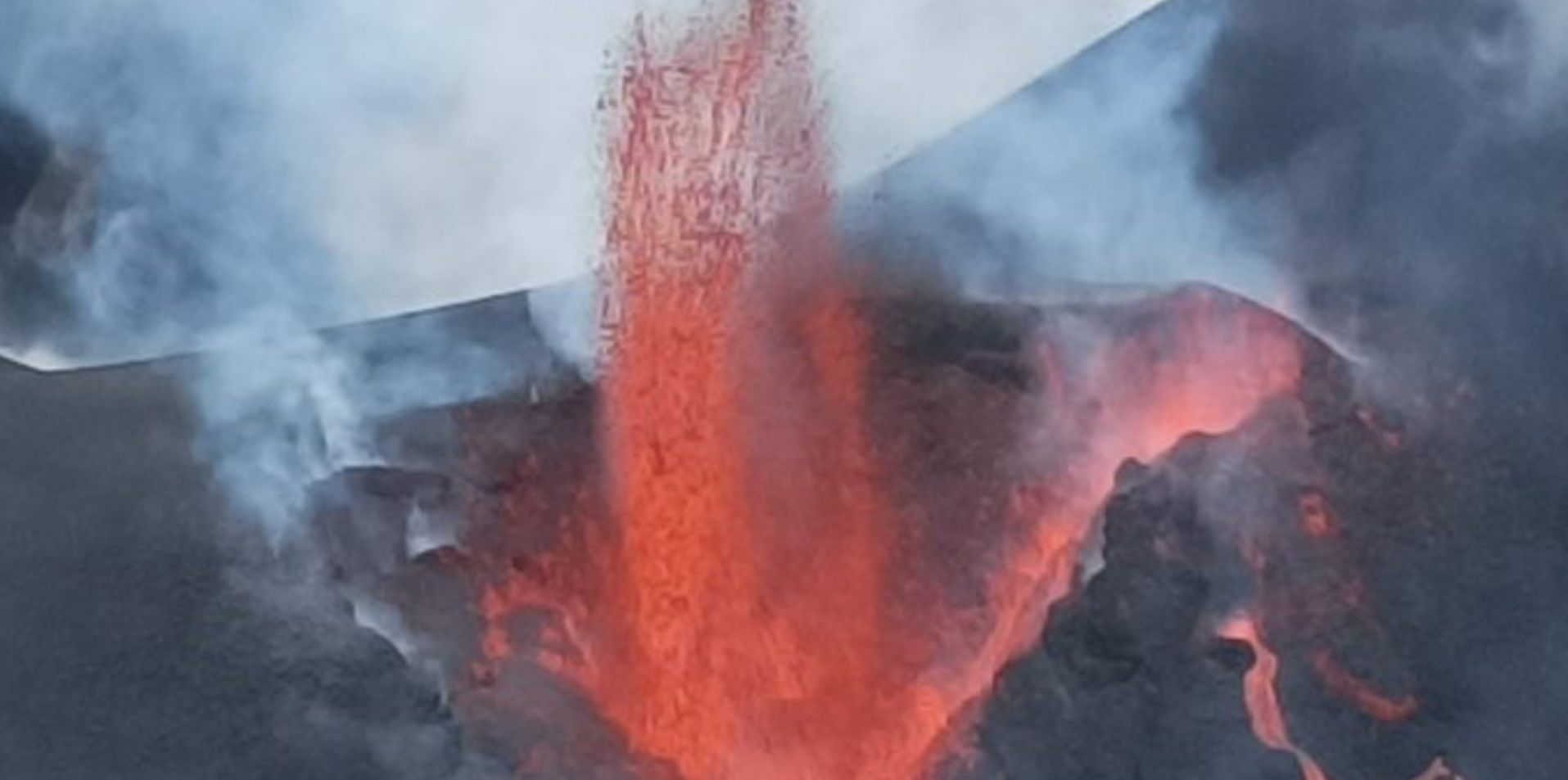
An international team of researchers has identified a new method to improve the prediction of volcanic eruptions by mathematically analyzing seismic signals, which allows detecting internal changes in a volcano's activity hours in advance, "changes in the voice" that open new avenues to improve prevention. The study, published in the scientific journal 'Journal of Volcanology and Geothermal Research', proposes an "innovative" approach based on information theory, applying parameters such as Shannon entropy, which evaluates the degree of uncertainty in a data set, to analyze the complexity and variability of seismic signals recorded before, during, and after an eruption.
The research, in which the Volcanological Institute of the Canary Islands (INVOLCAN) participates together with the University of Granada, the Institute of Technology and Renewable Energies (ITER) and other international universities, focused on the comparative study of two active volcanoes: the Tajogaite, in La Palma, which erupted in 2021, and the Colima volcano, in Mexico, with intermittent eruptive activity between 2013 and 2022.
The detailed analysis of the seismic records of both cases made it possible to verify that the volcano's "voice," that is, the way it vibrates and emits energy, changes progressively as an eruption approaches.
In the case of Tajogaite, researchers detected significant variations in seismic entropy at least nine hours before the start of the eruptive process.
According to the scientific team, these results could confirm that the parameters derived from that entropy allow distinguishing the different stages of a volcano's evolution and recognizing precursor signals that may go unnoticed by traditional monitoring methods.
According to the study, variations in entropy and other indicators of magmatic system complexity can be detected before an eruption and serve as an early warning signal to reinforce monitoring.
It also demonstrates that this mathematical approach is not only effective in characterizing the internal dynamics of volcanoes, but can also be applied quickly and automatically to large volumes of seismic data.
This would allow its real-time integration into volcanic monitoring systems, improving response capacity in the face of natural disasters. Involcan, through its social networks, has highlighted that this tool represents a relevant advance for volcanic surveillance in archipelagos such as the Canary Islands, where the early detection of changes in magmatic activity is essential for the safety of the population and emergency planning. The authors emphasize that, although the results are promising, the method must be validated in other volcanic environments before being generally applied, although the method can be easily incorporated into current monitoring systems, requires few resources, and offers rapid results in real time. "Each volcano presents unique seismic patterns, but the statistical analysis of its signals can reveal valuable information about the internal dynamics and the transitions between eruptive stages," the study notes.
Add La Voz de Lanzarote as a preferred Google source.
Stay informed with the latest current news.