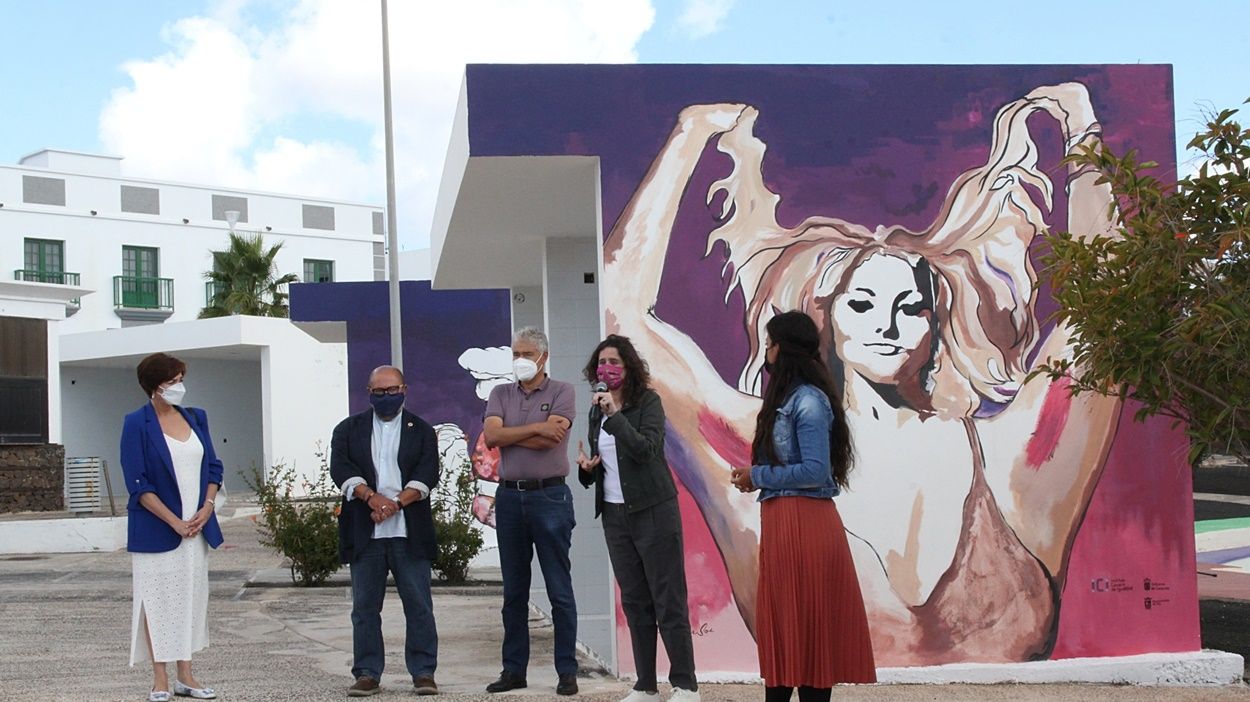
The director of the Canary Islands Institute of Equality (ICI), Kika Fumero, and the mayor of Tías, José Juan Cruz, inaugurated this Thursday the urban murals made by the artist Leticia Marsoc on fatphobia and aesthetic violence. The artistic intervention carried out in the municipality of Lanzarote is one of the actions prior to the second edition of the international conference on this issue, which, with one week to go before it begins, already has 1,212 people from 22 different countries.
The director of the ICI thanked the Tías City Council and its representatives for joining this activity and explained that this is a project that "wants to leave a seed of these conferences in each of the 8 islands." Last year murals were made in the two capital islands and this year it has already been done in Los Llanos (La Palma) in addition to the one inaugurated in Tías. The idea, according to the director, is that there will be a third edition of the conference and "we will complete murals in the rest of the islands."
Kika Fumero assured that "these conferences are part of a cry from the whole society that needs to talk about fatphobia and aesthetic violence, who want to vindicate the diversity of bodies" and explained that in this edition the conferences will be dedicated to health because "we want health in all sizes, not only in those accepted by hegemonic beauty standards."
"Almost 50% of the Canarian population is overweight, which translates into all those people being exposed to discrimination in all areas because of their body," said the director, who also clarified that "of the total number of people who suffer from eating disorders, about 90% are women," she added.
The mayor of Tías stated that "fatphobia exists and is real, and we cannot look the other way because it is a discrimination that can cause serious consequences for physical and emotional health." He also thanked the Government of the Canary Islands for choosing Tías for this presentation and start of the conference, while highlighting the involvement of the artist Leticia Marsoc.
The artist Leticia Marsoc described that these are three murals in which she reflects three relevant aspects for her. "The first is a strong woman, where it does not matter that she has hair on her armpits because she is still just as beautiful, it is a way of re-educating the viewer's gaze, the second is the same person kissing her supposed imperfections, forgiving herself for the harmful messages that we send ourselves on occasions and the third is a person very dear to me, who for many years did not go to the beach and it is the moment of self-acceptance, in which she feels full."
Also present at the event were the Councilor for Equality and Diversity, Nicolás Saavedra, and the Councilor for Culture, María José González.
Inscriptions
To date, 1,212 people from 22 different countries have already registered for this year's conference, which will be broadcast via streaming by the ICI. In this edition, three days (May 5, 6 and 7) will be dedicated to delving into the culture of diets and the consequences on the bodies and health of adults and girls.
Those interested in participating in the conference must register in advance at http://www.inscripcionjornadasgordofobia.com. There you can also consult the complete program.
The idea of organizing the first conference on fatphobia last year arose after the success of the publication of an ICI decalogue on body diversity, in May last year, with the aim of counteracting the pressure that women suffer on their bodies before the summer.
A tool to reflect on daily fatphobia
After the visit to the murals, located in the Plaza del Pavón in Tías, the Fatphobia Guide, prepared by Magdalena Pyñeiro, co-founder of the platform "Stop Fatphobia" and author of several books related to the subject, was presented.
Magdalena Pyñeiro expressed her wish that the guide become "a tool for reflection on a topic in which there is a need to talk, such as fatphobia." The author stated that it is "a basic guide" aimed at anyone and exposes "the problems that fatphobia generates in women, how to identify it and what to do to end discrimination." The guide includes at the end recommendations of books and films to delve deeper and a test to identify inner fatphobia. The guide is available for download on the ICI website https://www.gobiernodecanarias.org/icigualdad/
During the presentation of the guide, recently published, Piñeyro asked several questions: "Have you ever been sexually attracted to or fallen in love with a fat person? Do you choose your food not based on what feeds you, but based on what you think is fattening or not fattening? "How many times a day do you think about your weight, losing weight or modifying some part of your body to adapt to the prevailing aesthetic standards?".
The interventions of the II Conference scheduled for the month of May that will be broadcast live online, will be held in person at the Elder Museum, in Las Palmas de Gran Canaria.
Add La Voz de Lanzarote as a preferred Google source.
Stay informed with the latest current news.