Until just a few weeks ago, Nancy worked without papers caring for an elderly woman in Lanzarote. Her workday started at 9:00 AM and did not end until 8:00 PM, eleven hours later. All that effort for 800 euros a month and only one day off a week, Sundays. She arrived from Colombia three years ago and the approval of the extraordinary regularization has opened up for her as a halo of hope, after years of administrative slammed doors.
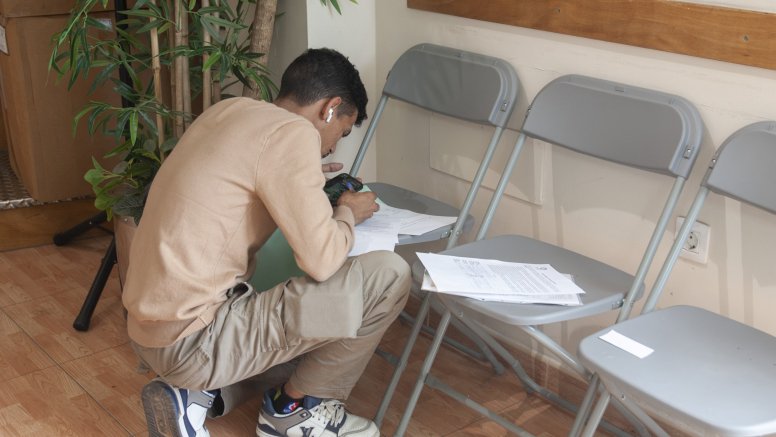
"I tried a thousand ways and they closed the doors on me," she says about her administrative process to try to obtain legal residency in Spain before this extraordinary regularization was approved. Nancy waits at the doors of the Federation of Migrants of Lanzarote (Fedemilanz), in Arrecife, one of the centers authorized by the Ministry of Inclusion, Social Security and Migration to issue vulnerability certificates and process regularization free of charge.
To be able to subsist in Lanzarote, Nancy ignores the back pain her job causes her, lifting the elderly people she cares for, she pays a rent of between 400 and 500 euros and what she can she sends to Cali (Colombia) to her mother. "I contribute what I can, because sometimes other colleagues cannot pay their share because they are unemployed," she narrates in a conversation with La Voz. This 65-year-old woman lives in a shared apartment with five other relatives, including a baby and another minor. With her regularization in Spain, she dreams of being able to access jobs that respect her labor rights.
Despite the difficulties she has experienced in Spain, Nancy prefers not to complain: "We have to leave because it is tough there, there is no employment or opportunities," she explains, although her situation is complicated, she prefers to look to the future with hope.
In Lanzarote, the seven town councils of the island, the Federation of Migrants of Lanzarote (Fedemilanz) and the organization United Actions are the authorized points to issue free of charge these vulnerability certificates, one of the requirements to be able to process regularization. Despite the fact that human rights defense associations have pointed out the contradiction of requesting a vulnerability certificate from people who, due to their administrative situation, are already vulnerable.
The Federation of Migrants of Lanzarote has enabled two days a week (Tuesdays and Thursdays from 5:00 PM) to issue these vulnerability certificates free of charge. The first day it opened to the public, this past Tuesday, the queue of interested people collapsed the center's capacity. "Due to the nervousness of the people who need to process their application, this collapsed on us," narrates the president of Fedemilanz, Daniel Vera.
With data from last Thursday morning, the association had initiated the procedures for 600 vulnerability files, only with those collected on Tuesday, which are added to 242 procedures to initiate the vulnerability application that are accumulating on the volunteers' desks. The deadline to submit applications opened last April 16 and will be open until next June 30.
Next to Nancy, another Colombian woman waits for her son to be able to submit his application. She already has legal residency in Spain, but her twenty-year-old son has been on the island for ten months, studying a course related to renewable energies, although the lack of papers will prevent him from doing his company internships. "He is going to lose the entire course for not being able to register with Social Security," says his mother in statements to La Voz, who hopes that this regularization will give her son the opportunity to train and work in Spain.
Regularization, an opportunity for decent work
In the same queue, between the narrow sidewalks of the streets in downtown Arrecife, three young Senegalese men wait to be able to fill out their authorization to obtain the vulnerability certificate. They will also return later at 5:00 PM, when they can process it, but the anxiety of being able to solve their situation has led them to get in line early to get ahead with the paperwork.
One of them, the woman of the group, is 30 years old and has been living in Lanzarote for six months, she flew from Senegal to Italy and then arrived on the island. Sukeina (fictitious name because she prefers to remain anonymous) has three children in Senegal, aged four, six, and eight, who have been left in the care of her husband.
This Senegalese woman lives in Playa Blanca with her sister, who took her in until she can get a work permit and earn enough money to reunite her family in Lanzarote. Her goal after her regularization application is admitted for processing is to start working as a cook in a restaurant on the island.
The data from the Active Population Survey (EPA) of the National Statistics Institute (INE) show that the hospitality sector, commerce, vehicle repair, jobs related to supply and waste management, as well as construction are those that concentrate a higher number of foreign affiliates.
Next to her, the most joking of the three, Abdou (fictitious name), a 23-year-old Senegalese youth, says he has been on the island for three years now. Like Sukeina, he arrived in Lanzarote by plane, where he lives with his brother in Playa Blanca, in the tourist town of Yaiza, who already lived on the island.
At the beginning of living in Lanzarote he was an asylum seeker and was able to work for a year and three months as a room attendant in two hotels. After his asylum protection was denied, his life was left in limbo and he decided to study online to become a bus driver, being able to finish his training depends on him managing to regularize his situation in Spain in order to obtain his driving license.
"We come here out of responsibility, to help our families," explains Abdou, who states that far from being driven by a dream, what led him to change his life and fly to the Canary Islands was the attempt to help his family.
The only one of the three who arrived in the Canary Islands via a precarious boat is Baba (fictitious name), who arrived in Tenerife in a colorful canoe two years ago after a week adrift at sea. The 24-year-old says that before embarking he did not tell anyone in his family that he was going to take the dinghy to the Canary Islands because he knew that some people died on the crossing. The migratory route to the Canary Islands is one of the deadliest in the world.
After arriving in Tenerife, Baba traveled to Lanzarote to reunite with his brother, who has given him shelter in his house in Arrecife. His goal when he manages to start the process is to become a room attendant in a hotel. Abdou rebukes him and insists that for him it is better to be a waiter in a restaurant.
The cumbersome role of administrations
The councilwoman for Social Welfare of Arrecife, Maite Corujo, the most populated municipality on the island, criticized this Thursday on Radio Lanzarote-Onda Cero that the Government of Spain has not offered them information or tools to better manage vulnerability certificates, a requirement that was included at the last minute in this extraordinary regularization and obliges the administration to reconcile their issuance with the other daily tasks of the area.
Among the documentation required by the Government of Spain to carry out this extraordinary regularization, is the issuance of a vulnerability certificate. Maite Corujo explained that in order not to saturate her Department, the city council is managing these certificates through municipal training courses, offering three training sessions a day with a maximum capacity of fifty people in each.
These courses serve the council to guide and screen who needs that certificate and who can apply for the procedure with other documents.
The certificate of vulnerability is intended for those persons in an irregular administrative situation who do not have demonstrable work experience in Spain, for example, those persons who, due to not having papers, have had to work without a contract. In addition, it is also requested from persons who do not have a family unit in the country, who are not responsible for minors, disabled adults, or responsible for caring for persons over 65 years of age.
In total, by early Thursday morning, 400 people had requested to enroll in these courses in Arrecife, which are a prerequisite for receiving appointments to obtain vulnerability certificates. "That has helped us to bring order and to calm people down," added the councilwoman.
Maite Corujo indicated that two people from the Social Welfare area are working entirely to move forward with this documentation, while appointments with the Social Work area continue to function for other consultations. "This is a specific regularization that contributes to the island's economy and that was necessary to do, what has not been is well organized," concluded the councilwoman.
Next to the two collaborating associations, the Arrecife Post Office is the only island point of the Government of Spain in Lanzarote to submit that registration. In addition, from the Cabildo de Lanzarote they are preparing vulnerability reports for people who go to Flora Acoge and the soup kitchens.
The work of the Federation of Migrants
The president of the Federation of Migrants of Lanzarote (FEDEMILANZ), Daniel Vera, explains during an interview with La Voz that the advisory work and the issuance of vulnerability certificates that this group of associations is doing is altruistic and is sustained by the work of volunteers. "We have not received governmental help to, at least, hire more staff," he adds.
The network relies on volunteers from different organizations and three lawyers from the island who provide their work selflessly, Loueila Sid Ahmed, Estela Fernández, and Karina Medina, to ensure that the documentation proceeds without errors. To carry out this work, the different groups that make up the Federation of Migrants of Lanzarote are working until eleven at night on weekends so that all documentation is processed correctly.
From the Federation they explain to La Voz that approximately 40% of the applications they have begun to process correspond to people from Morocco, followed by 30% from people from Colombia, while the rest come from diverse nationalities from Latin America and, to a lesser extent, from Senegal.
Meanwhile, Comisiones Obreras, UGT, and the PSOE of Lanzarote have offered to advise people who wish to initiate this process. For the moment, there are no official figures on how many people will manage to regularize themselves with this process, although estimates point to 40,000 people throughout the archipelago.
Add La Voz de Lanzarote as a preferred Google source.
Stay informed with the latest current news.