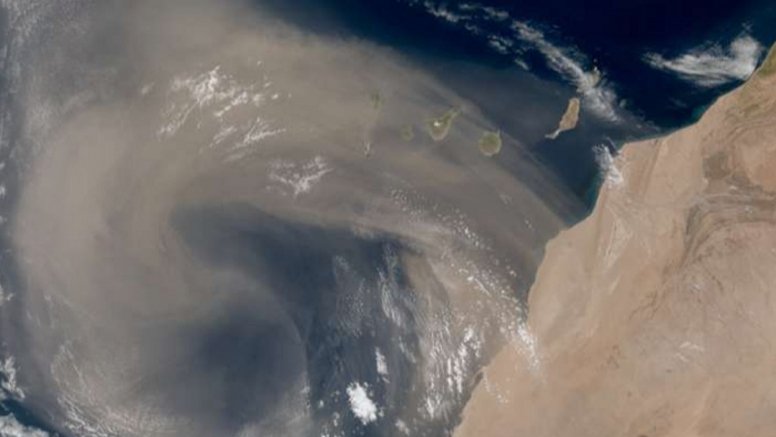
The air quality of Lanzarote has reached its worst measure and has been situated as "extremely unfavorable" during the strong episode of calima that is affecting the island since the afternoon of this past Monday.
According to the data collected by the stations of the Canary Islands Air Quality Control and Surveillance Network, on the night of this past Tuesday, most of Lanzarote's meters recorded a risk episode derived from the concentration of suspended dust from the Sahara.
Despite the situation having slightly improved, several stations have been located throughout the morning between the interval considered "very unfavorable" and "extremely unfavorable", which is the worst of the options, due to particles of less than ten micrograms per cubic meter.
According to these meters, the air quality due to suspended dust is in emergency conditions for public health, being able to "seriously" affect the entire population. Health recommendations in these types of cases indicate that it is better to avoid prolonged outdoor stays and consider performing physical activities indoors or postpone them until the situation improves.
Meanwhile, a quality of "regular" or "unfavorable" has also been registered in particles of less than 2.5 microns.
To the haze episode have also been added the problems in air quality derived from tropospheric ozone, a greenhouse gas that marks "regular" patterns on the island. This "bad" ozone and is formed by mixing pollution from motor vehicles with ultraviolet radiation. In these cases, it is also advised to reduce prolonged and strenuous outdoor activities among risk groups and monitor the appearance of symptoms such as coughing, throat irritation, shortness of breath, excessive fatigue or palpitations.
Add La Voz de Lanzarote as a preferred Google source.
Stay informed with the latest current news.