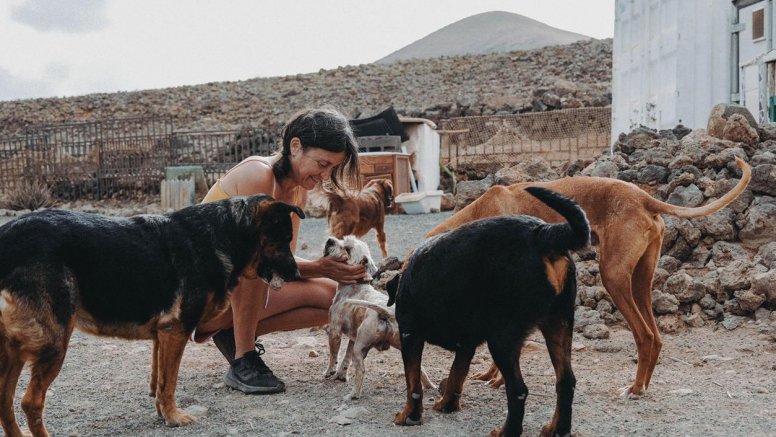
Hedgehogs, goats, dogs, cats, ducks, ferrets, are some of the animals that can be visited for adoption at the La Casa de las Estrellas shelter in Teguise. An innovative shelter run by Liala Miliardi, which opened three years ago, but it was by chance. "I never thought I was going to form a protectorate," revealed the caretaker residing in Lanzarote for years.
With its opening, La Casa de las Estrellas aims to offer support to non-domestic animals that are abandoned on the island. "There was not much support to help less domestic animals," Miliardi stressed. Its beginning was marked by the meeting of the Italian citizen with a goat, which she had found days ago forgotten in Lanzarote. "I decided to set up the shelter when I found a goat that was going to be sacrificed," she revealed.
Now, the protectorate has already expanded its services and welcomes animals of "all species", said its manager. With facilities located in the scattered Guatiza, municipality of Teguise and "lost in the middle of the desert", she said. La Casa de las Estrellas believes "strongly" in cooperation between all to save the animals. that they collect every day. The animals they manage to rescue do so through calls from the Police and Seprona, individuals, town councils, or animals that come to them that have been found abandoned on roads, etc. In addition, they have a great collaboration with other protectorates of Lanzarote, who come to their services when they cannot take care of all the animals.
The model in which they work in the shelter is through an American model without cages, a space in which animals can feel free during their stay. They do not have an established adoption fee, their philosophy is based on "not being able to set any price for animals", she said. "I have not been able to do it for my values," she added. The profits to keep the shelter afloat are obtained from donations, events, flea markets, among other activities. "I understand that other protectorates want to do it, but I prefer to continue with that method," she said.
"We have not been able to set any price for animals because of our values"
Regarding the employees and volunteers who come to collaborate at the shelter, its manager uses two employment platforms to get workers. "We have exposed the project so that they write to us for the selection process," she revealed. At the moment, they have nine volunteers staying at the shelter facilities, who in exchange for accommodation and food provide hours of work daily. "We do not have much help, we do not have much money to pay staff nor can we rely on full-time volunteers," she stressed.
From the shelter they have revealed that they do not have counted the number of animals living in the shelter. The main reason is the way in which the members of La Casa de las Estrellas value animals. "They are not a number for us," Miliardi said.
They care for and pamper the animals until the arrival of a new adoptive family, for which they carry out an exhaustive adoption process. They talk with him or the future adopters in the facilities, go to their home, and establish a pre-adoption of 15 days. "Once that time has passed, we visit the adopter again and see if it is a perfect match for the animal", she added.
"Once that time has passed, we visit the adopter again and see if it is a match perfect for the animal"
After reviewing the status of the animal and verifying that it is in good hands, "we understand that we have hit the nail on the head and we proceed to the final adoption," said the manager. Once the adoption has been formalized, they continue to maintain contact for some time with the owner, who sends them photographs and informs them about the follow-up of the animal.
La Casa de Las Estrellas also makes adoptions abroad, taking animals out of Spain, in countries where they directly look for a home in adoptive families. At the national level they have rescued several animals, also in the Canary Islands, in the islands of Fuertevenutra and Gran Canaria. The contacts are obtained through social networks such as Instagram and Facebook, in which they also look for adoptive families.
The detail that most characterizes the originality of this shelter is to welcome animals in special situations and that are part of the economy of Lanzarote. "We do not usually have animals that have a first chance, we focus on the less domestic and that have fewer opportunities", said Liala Miliardi. As is the case of hedgehogs, a species that is dedicated to rescuing, since the wildlife collection service of the Cabildo "does not act on rescue issues" with these animals, said the caretaker.
New life for the Canelo goat
The story of Canelo, a goat that was found in the trash has moved the island. From the protectorate ensure that its recovery, which is now responsible, has been a "miracle". "He was sick and very weak, he was almost dying when he arrived in Lanzarote," recalled the manager. After talking to six different veterinarians, who told them that the animal could not be saved, they have found a way for him to live his recovery. "They told us that it was complicated, that we had to end his suffering," revealed Miliardi.
The possibility of recovery was thanks to the perseverance and confidence of Miliardi. "There was something in the animal's eyes that told me that I had to wait and not give up", she stressed.
The animal has already managed to stand up and walk faster, all thanks to 24-hour care and medical sessions he receives. "He was paralyzed, he still can not jump completely, but he does it little by little," he said. In addition, the goat has managed to leave the shelter accompanying Miliardi in many of his daily errands. "We go to the flea market with him, he lives a normal and happy life, he does mischief, he eats the plants... you can tell that he is cheering up," he said.
"There was something in the animal's eyes that told me that I had to wait and not give up"
A lady was in charge of collecting the goat and donating it to the Casa de Las Estrellas, after being found in Fuerteventura. A farmer was responsible for it ending up in the trash, as it was an expense for him. The woman had the generosity to pick it up and "took it to her grandson in Tinajo," she recalled. Shortly after, they called the protectorate to help them "with his healing," concluded Miliardi.
Add La Voz de Lanzarote as a preferred Google source.
Stay informed with the latest current news.