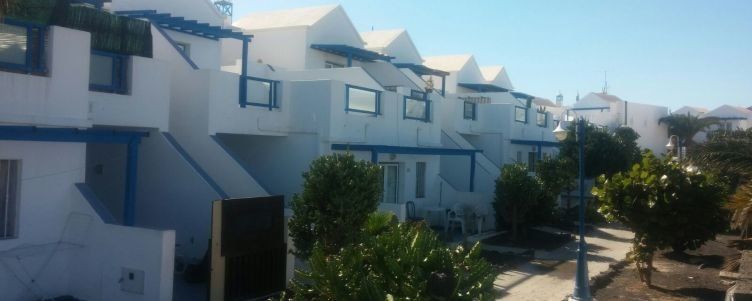
The owners of 7 homes in the Virginia Park urbanization of Playa Blanca are facing the mortgage foreclosure of their homes for loans they did not request. All of them bought their homes from the company Jupercava S.L. believing they were free of charges. However, this was not the case. Last August, the new owners of the houses began to receive mortgage foreclosure orders and thus discovered that there were unpaid loans of which they had no knowledge. The owners of at least 4 of these houses have denounced this alleged scam, and so has the notary who registered the sales. The Justice system is now investigating these 7 cases.
All the sales had a common denominator: in all cases, debts appeared in the Property Registry when the acquisition was made. Despite this, the company, through its various intermediaries, presented bank certifications to demonstrate that these mortgages had been canceled. These documents, however, were allegedly false.
It was these certificates that made the buyers "trust" that the loans were paid, says the notary of Playa Blanca, Javier Jiménez Cerrajeria. The 7 sales were registered in his notary's office, and he was the first to report the events to the National Police. The owners of the houses went to the notary's office after receiving the mortgage foreclosure orders with astonishment. A first visit from some buyers was what motivated Jiménez Cerrajeria to make some inquiries with the bank and that same afternoon report the 7 sales. This complaint is already in the courts and has been distributed to the Investigating Court number 3 of Arrecife.
A last attempt to sell
On the same day that the first buyers went to the notary's office with the foreclosure order, Jupercava S.L. had been about to sell another home in that same block. When they were carrying out the procedure, "a certification of ownership and charges appeared in the information issued by the Property Registry; these certifications are only issued when a mortgage foreclosure procedure is underway," explains Jiménez Cerrajeria.
This notice from the Registry caused the sale to be frustrated. The notary points out that he explained the situation to the buyer and "obviously nobody buys knowing that their house is going to be foreclosed." Hours later, a couple appeared at the notary's office with the foreclosure order that the Property Registry had just sent them. A year earlier, this couple had mortgaged themselves for 44,000 euros to buy their house. A few days later, all the buyers began to appear at the notary's office, "depending on how they were collecting those orders," recalls Jiménez Cerrajeria.
Different signatures and loans that don't fit
The notary affirms that he only saw the bank certification relating to one of the houses. With this document, he went to consult the attorneys of La Caixa in Playa Blanca. The suspicion was then confirmed: "When La Caixa told me that it was false (that certification), they gave me others that had arrived. And they tell me that they are also false."
According to this notary, the company itself or its intermediaries had presented these certifications to La Caixa to "request" the cancellation of the loans; "and in the Playa Blanca office they said that they did not cancel anything." Jiménez Cerrajeria explains that these certificates stated the name of an attorney of the entity in Madrid, but the office number actually corresponded to a branch of the bank in Huesca. Furthermore, although the certificates were supposedly signed by that same attorney, the signatures were "different."
Jiménez Cerrajeria only had knowledge of the foreclosure order for one of the 7 houses at that time, but with the information provided by the bank, he verified that "all those that referred to those homes were possibly false," he affirms. This is what led him to report the 7 sales he had made to the National Police.
At least in one of the cases, these certificates referred to a loan that did not exist, while another, unpaid, loan of which the buyers never had knowledge was omitted. This is the case of the certification with which the notary went to La Caixa. It stated two loans. The first mortgage was real and was canceled. The second loan was "put at random" and "did not correspond to anything" registered in La Caixa. However, there was a third loan associated with the house, which Jupercava contracted for 40,000 euros and of which the buyers never saw any document.
In the other cases, Jiménez Cerrajeria affirms that "he does not know" if the buyers saw these documents before acquiring the houses. In this regard, he assures that he presented "all the operations he had done with that company" to the Police "so that they would have personal data of possible affected parties with whom they could contact and have all the information that was necessary at their disposal from the notary's office." "I wanted them to act as quickly as possible."
"It is not strange to trust when seeing a bank certification"
Except for the case of the couple who mortgaged themselves, all the buyers invested amounts they had saved to acquire the houses (for a value of between 30,000 and 40,000 euros), without needing to request a mortgage. Thus, in these sales, there was no lawyer from a bank present, as was the case in the other case, and any verification of the documents would depend directly on the buyers.
"The normal thing is that the buyer, if he is not certain that the loan is paid or if a charge that he was unaware of appears in the registry information, does not buy," considers the notary. Jiménez Cerrajeria points out that "it is not frequent to buy homes with charges," although he emphasizes that "it is also not strange that in view of a bank certification the debtor trusts that the loan is paid."
The cancellation of the loans has three different phases, "the economic cancellation, which is what the bank certification would need, the notarial cancellation with the payment letter, in which the bank consents to cancel the mortgage and declares that it has received the money, and then the registration in the Registry of that cancellation, which is what removes the mortgage," explains Jiménez Cerrajeria. Thus, the fact that charges are recorded on a property in the Registry does not necessarily mean that the debt is not paid.
"A scam was not foreseen"
"It is a misfortune what has happened to these families," affirms Jiménez Cerrajeria, who points out that the neighbors could have "difficulty" recovering what they paid, since "the problem is if the company has no money."
The notary assures that he felt "disgusted and angry at the same time" when he discovered that the 7 sales made in his notary's office could have been a scam. "In each signature I strive to explain everything with the maximum clarity and simplicity and to give the maximum security to both contracting parties. Having said this, I would like to clarify that the buyers bought fully aware of the existence of the mortgage charge and put their trust in the intermediaries before the express warnings about the existence of the encumbrance made by me," he continues. In this sense, Jiménez Cerrajeria emphasizes that he made these "warnings" not only "by word, but expressly in the deed," something that the law obliges notaries to do.
Despite this, the notary of Playa Blanca emphasizes that it did not seem like an "abnormal situation" and "a scam was not foreseen." He recalls in this sense the case of another buyer who did not pay the full price of the home. This man requested a mortgage from Bankia to acquire the house, but the mortgage was not canceled and the entity refused to give him the loan. Jupercava S.L. and this buyer then "agreed" to a "sale with deferred payment." "He did not pay, gave the down payment and the seller agreed to sell it to him without receiving the price." In these cases, the remaining amount is paid "little by little" or "when the mortgage loan is canceled," he adds. Therefore, for Jiménez Cerrajeria "a scam was not foreseen, because they even agreed to things like this."
Add La Voz de Lanzarote as a preferred Google source.
Stay informed with the latest current news.