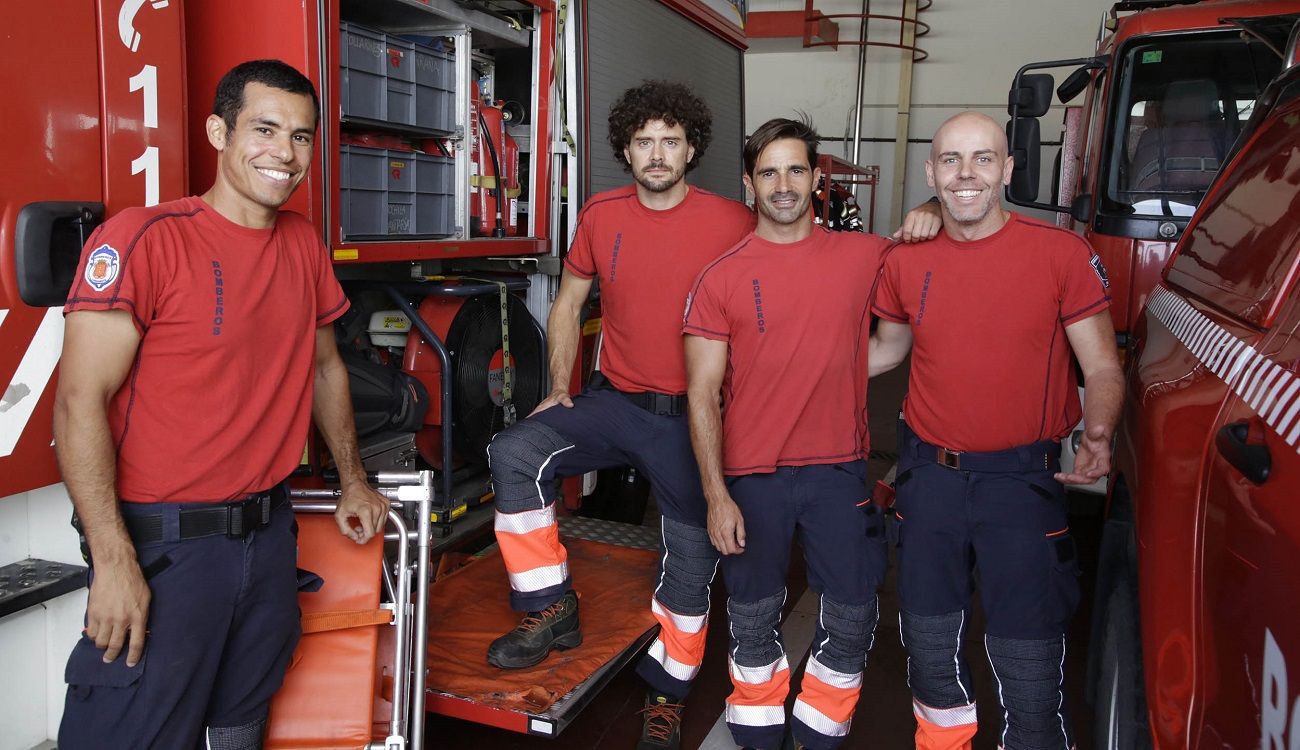
Lanzarote's firefighters have been "overwhelmed" in recent months on the island, especially since the start of the uncontrolled burning of containers and vehicles. La Voz has traveled to the fire station of the Security and Emergency Consortium to learn firsthand, not only how they are experiencing the situation, but also what the day-to-day is like in a job that has a great psychological burden.
The officers explain that being such a small place, some situations are more difficult to cope with, since there is a greater chance that an acquaintance is involved in the event.
"It's not easy, you go to an accident or fire and an acquaintance may be involved, it happened to me shortly after joining," says one of Lanzarote's firefighters.
Increase in incidents and lack of personnel
If Lanzarote already registers a "higher" number of incidents than many large cities in the country, now the difference has become even more noticeable.
"The burning of containers usually comes in waves, but in the years I've been here we've never experienced it like this," says Mingo Crespo, who has been a firefighter for 25 years. "The level of fires is already creating enormous insecurity on the island."
The officers confess to being concerned about the situation, especially in Arrecife, and not only because of the cost of the containers and vehicles, but also because of the pollution. "They are burning garbage and plastic that enters the neighbors' houses, in the end it is what we breathe," he adds.
In addition, it is increasingly common for officers to travel to an event and have to go to another emergency, even before finishing the intervention, returning to the place later. This is a consequence of the increase in incidents, but also of "the lack of personnel", points out Corporal Alexis Corujo.
"It is the great pending issue in all departments, whether police, civil guards, or others, but we understand that this is costly and not easy," he stresses.
Currently, the Arrecife Park has four firefighters and a corporal in 24-hour shifts, plus two or three in the Uga park. "In recent years, we have grown quite a bit, but we would like to set up another device in the north or in La Graciosa, but infrastructure and materials are needed, among other things," he adds.
From traffic accidents or fires to stuck rings
"Many people think that we don't work here because there is no forest, they tend to associate us with forest fires, but the reality is in Lanzarote we do everything, we go to the water, mountains, urban accidents, while in the cities they have specific teams," explains Alexis Corujo, one of the corporals who has been working for the Consortium for 25 years.
"We are not only limited to traffic accidents or fires, the Local Police may call us for a collaboration because a thief has escaped through a roof, or the health personnel because they need help to lower a patient through a narrow area, we also do animal rescues..." says Mingo Crespo, corporal of the Consortium.
In addition, they also experience really dangerous situations, especially those with a high thermal load. "I remember a fire in the basement of a hotel in Costa Teguise, with a brutal thermal load and pieces of the ceiling falling on us," says the corporal. "At that moment you think where am I, I didn't know if I was going to get out of there."
From time to time they also face more unusual situations, such as cutting handcuffs from a couple who "were playing", or removing a ring from an oversized finger, for example. "Generally, they call us because the affected or the hospital does not have the necessary tools to cut it, and we do," he says.
Mental health is constantly "at stake"
Some events are also traumatic experiences for many of the firefighters. "We are a bit like superheroes for the rest of the world, we are there when they need us for what they need us, but sometimes our mental health ends up being affected," confesses one of the officers. "Realize that this is a small island, there is a high probability that we know the victims."
"When you are working you don't think about it much, but when you get home it comes to you suddenly and over the years it weighs more and more. We don't always talk about these things when we get together, we make a joke to forget about the subject because it's not easy," explains Alexis Corujo.
Some say that the hardest moment was the first death they witnessed, but in the end "they are all sensitive, especially when there are children or elderly people involved."
"When you are new, you empathize more with the victims, you end up taking those problems home and it is not healthy. Over time you learn to stay out of it," says the corporal. "After that, it's like everything else in this life, the body and mind adapt, although there are always specific situations that have marked me in my day-to-day and that I will never forget."
In addition, some firefighters also remember that they are a somewhat stigmatized group in the eyes of many. "You always have to give the image that we have to be tough and keep our composure, that we cannot show weakness, but the reality is that under these uniforms we are people," they insist.
To deal with this situation, there is an option for post-intervention psychological assistance. "It is true that we are not yet very adapted to it, it is hardly requested, but it is a matter of time," says the corporal.
More "complicated" oppositions than normal
Being a firefighter in Lanzarote is "complicated", but so is getting there, since the oppositions require knowledge of many areas that are not required in other islands.
"The oppositions are complicated, there is more and more information and more and more people applying, and it is normal because in the end you have good shifts, you do a good job, it is a quite striking job, but we are always just right with the approved ones," explains Mingo Crespo.
In this last call, a total of 187 candidates applied for only three places, so the chances of getting in were quite low.
For this reason, the firefighters of the Consortium insist that "you have to be patient" because also "it is likely that you will not pass the first time". "You can be opposing for 10 years, it is a long-distance race," he adds. In addition, in Lanzarote there is an added handicap: specific qualifications.
"Fewer people apply here because we ask for a recreational boat qualification because we have aquatic services, we are the only service in the Canary Islands that uses it, and we also ask for a qualification for vehicles with trailers because we have zodiacs, among other things," explains the corporal. "You have to be very complete in everything."
However, the firefighters point out that many of the tests are somewhat obsolete. "You don't need to be a super athlete in the physical tests. You can run 100 meters in 12 seconds, okay, but put me 50 meters with an 80-kilo bag that simulates being a person, tests of vertigo or claustrophobia, those are the ones that really work," they insist.
At the moment, there is no female firefighter in Lanzarote, but the corporal believes that it is a matter of time before one passes the oppositions. "The girls who applied in this call were very close, it is likely that one will enter in the next one."
In constant training
After spending years training to enter the corps, the practices continue daily, since this is a job of "continuous recycling", as the corporal says.
"From Monday to Friday we have a calendar of practices, whether it is stretchers, jet skis, work at height with ropes and others," he explains.
"Our range of work is so wide that we can be good or not be good, but we want to be better," he adds. "The fresher we have the information, the better, because new materials or new techniques are also acquired and it is essential to be updated."
Likewise, he points out that it also helps them to work in a "more unified way", which translates into a more effective action.
In any case, everyone agrees that both the long and difficult training they receive, and the hours they spend on the street helping people, are worth it. "It is a very beautiful profession," insists one of them.
"Over the years you like the profession even more, because it is very satisfying. They always wait for us with joy because you are going to solve problems, we are well received wherever we go," they add.
Add La Voz de Lanzarote as a preferred Google source.
Stay informed with the latest current news.