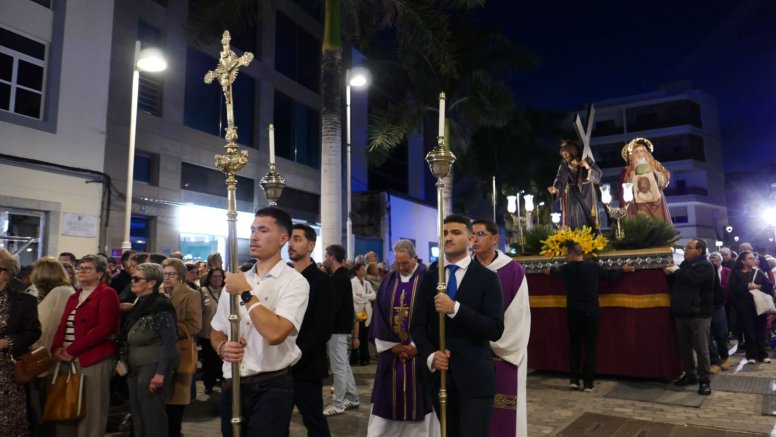
In the stillness of Holy Wednesday, when the afternoon began to surrender to the night, the main church of San Ginés Obispo, in Arrecife, opened its doors to one of those celebrations that transcend the everyday to delve into the depths of the soul. At 19:30 hours, the temple, filled in its three naves, hosted the Eucharist presided over by Don Jesús Sastre García, professor of Theology at the parish of Nuestra Señora del Pilar de Madrid, and concelebrated by the titular parish priest, Don Juan Carlos Medina.
The chords of the Parish Choir, blended with the sincere voices of the faithful, elevated the celebration to an atmosphere of communion and contemplation. Even outside the temple, in the Plaza de Las Palmas, numerous devotees followed the ceremony, as if the air itself was imbued with prayer.
At the end of the Eucharist, the Arrecife night transformed into the setting for one of the most awe-inspiring moments of Holy Week: the procession of the Holy Encounter. In an almost sacred silence, broken only by the rhythmic flow of the processional music, the throne of Jesus the Nazarene made its way, carrying the Cross, accompanied by the images of Veronica, Mary Magdalene, and Saint John. At the front, the Music Band La Unión Musical de Lanzarote, under the direction of maestro Pepe Artiles, marked the pulse of the contained emotion.
Minutes later, from another itinerary, the image of Our Lady of Sorrows made its departure, enveloped in the fervor of her faithful. Two paths, two sorrows, destined to meet.
And so, in La Plazuela, the most anticipated moment occurred. Time seemed to stop. Silence became absolute, profound, almost tangible. Mother and Son face to face: the Nazarene, overcome by the weight of the Cross; the Virgin, torn by her mother's pain. It was then that the voice of Don Juan Carlos Medina gently broke the stillness to guide the reflection, recalling the meaning of that encounter: sacrifice, infinite love, and shared pain that, for believers, holds the mystery of redemption.
That moment was not just contemplation; it was intimate communion between faith, tradition, and feeling. An entire city, in silence, became a witness to a wordless dialogue that crosses the centuries.
Finished the meditation, the images together undertook the path back to the temple, accompanied by the faithful and by the processional marches that, like a constant whisper, enveloped the night. The band remained in the square, enveloping with its music the last stretch, until the images crossed the portico of the church of San Ginés Obispo.
Thus closed a night marked by contemplation, recollection, and deep emotion. A night in which Arrecife not only remembered the Holy Encounter, but lived it intensely in every gaze, in every silence, and in every heartbeat.
Add La Voz de Lanzarote as a preferred Google source.
Stay informed with the latest current news.