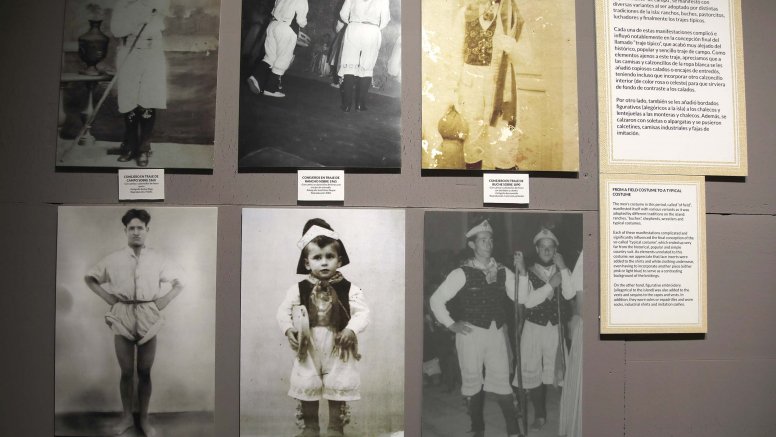
There are many ways to tell a story, and in this case, art curator Ricardo Reguera and the Malpaís de La Corona Folklore Group have found the most original one. In an exhibition organized by both, they have decided to collect the lingerie and underwear of the ancestors of Lanzarote to narrate in a different way what life was like in the past.
From December 16th of last year until February 10th, the exhibition Dressing White Clothes: An Inside Look can be enjoyed at La Casa Amarilla in Arrecife, the former headquarters of the Lanzarote Council.
Ricardo Reguera is one of the leading experts on traditional Canarian clothing and contributed 40% of the 150 garments in the collection. He stated this during an interview with La Voz. The rest of the clothing used has been temporarily provided by families, museums, churches, and private collections that preserve it.
For Reguera, one of the most complicated tasks in carrying out this exhibition was being able to obtain this material from diverse origins. At the same time, this expert shows that it is "one of the biggest attractions of the exhibition" since it has "a lot of original material from the island that people preserve".
As a result of a research project that the expert himself carried out years ago, he had already located most of the garments. In total, he searched for these materials for a month and then processed the necessary loan documents with each of the owners to be temporarily transferred.
"Underwear is a part of clothing that is not very worked on, very little worked on, but that, like outerwear, is loaded with ethnographic values that must be recognized," Reguera began. Thus, this underwear serves not only to analyze the design of the garments but also to learn more in-depth about what the people who used it were like. For example, it can be determined if a person was fashionable, careful, conservative, or what their economic level was.
The exhibition is divided into two periods, an older one from the late 18th and early 19th centuries and a more recent one from the 1920s of the last century. From the first stage, the only three shirts made by hand that are preserved from that period, made of linen, are on display.
The underwear of the ancestors of Lanzarote is "not so different" from that of the rest of the West. Thus, the exhibition begins with the raw materials: linen and cotton. "Cotton was produced, spun, and woven on the island," added the exhibition curator. At that time, underwear already followed the prevailing fashion in other parts of the West.
They also reflected poverty. So it was common for the less affluent social classes to use sugar sacks, which were made of cotton, to make underwear.
"In that era, the woman's body was intended to adapt to certain shapes or create certain volumes in the dresses," he indicated. For example, for corsets or girdles, people who could not afford to buy them adapted and took advantage of the sugar sacks that came from abroad. In the exhibition, you can see some garments made with these materials. "They were used to make any underwear, sheets, or anything that went with the typical canvas of that cotton sack," he explained.
The Industrial Revolution and the Change in Fashion
Regueras has reflected the importance of the industrial revolution and its reflection in fashion. In this period, the sewing machine or mechanical looms appeared. At that time, clothes sewn by hand and sewn on manual looms are put aside, and costs are reduced.
With the appearance of photographs and magazines, the way of dressing in other parts of the world arrives on the island, and with it, globalization. "Fashions appear and the change from the 18th to the 19th century was very big," he added.
Underwear was made at home by the women of the families. While in the 18th century underwear was "quite austere", from the 19th century, "more carvings, lace and more work" were perceived. The way of elaborating it reflected that it was done by the women themselves who wore them.
The prevailing fashions in Europe, the United States and Latin America were "practically" the same as in Lanzarote.
Add La Voz de Lanzarote as a preferred Google source.
Stay informed with the latest current news.