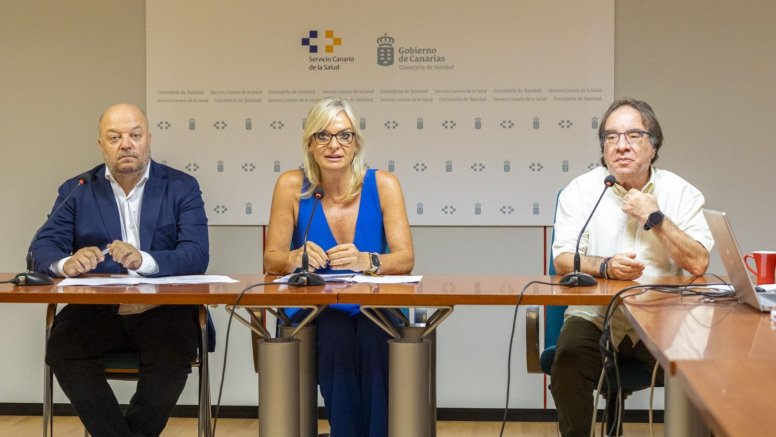
The Minister of Health of the Government of the Canary Islands, Esther Monzón, presented this Wednesday a vaccination campaign against influenza and COVID-19 for the 2023-24 season. It will begin next Monday, October 16 in all health centers of the Archipelago and incorporates "substantial novelties" with respect to previous campaigns.
Together with the Minister, the general director of Public Health of the Canary Islands Health Service (SCS), José Díaz-Flores, and the head of the Epidemiology service, Amós García, have detailed the planned operation, the different types of vaccines that will be available to face this season and the advertising campaign that will remind who should be vaccinated.
The Canary Islands has acquired a total of 335,000 doses of vaccine for this 2023-24 flu season, with a total investment of 2,989,000 euros.
Esther Monzón pointed out that "this year we continue in the situation of coexistence of COVID-19 with other seasonal pathologies such as influenza, so vaccination of the most vulnerable groups and essential professionals for the community continues to be essential."
In addition, she recalled that "by vaccinating the population at risk against influenza, we also avoid the coexistence of the two infections, influenza and COVID-19, in the same person, minimizing the severity of the disease in the patient and the stress on the health system."
For his part, José Díaz-Flores, explained that the information campaign will be disseminated in digital media, social networks, shift screens in hospitals and health centers, LED screens in the urban environment and radio stations, to remember which are the population groups that are at risk of suffering complications in case of contracting influenza or COVID-19, and that should be vaccinated.
In this sense, the general director of Public Health insisted that the vaccine is the most effective means to avoid contracting or transmitting influenza, especially in those people who are at risk of suffering complications in case of suffering the disease and in the personnel that is essential for the community such as health personnel and caregivers of the elderly or dependents.
In addition, the head of the Epidemiology service, Amós García, reported that to face this season there will be four types of vaccines aimed at:
- target population over 6 months. 100,000 doses have been acquired, which has meant an investment of 390,000 euros.
-
target population over 24 months. 180,000 doses have been acquired with a total amount of 1,386,000 euros.
-
institutionalized elderly population and bedridden elderly at home; over 60 years of age. 30,000 doses have been acquired, which has meant an investment of 750,000 euros.
-
boys and girls between two and five years of age (59 months) without underlying pathologies. It can also be used in patients between five and fourteen years of age, inclusive, with underlying pathology that does not have it contraindicated. 25,000 doses have been acquired for which 463,000 euros have been invested.
Seasonal vaccination recommendations 2023-2024
Each year, vaccination recommendations against influenza are established in autumn-winter for those population groups with a higher risk of complications in case of suffering the infection, and in people who can transmit the disease to others who have a high risk of complications. Since the 2021-2022 season, vaccination against influenza has coincided with vaccination against COVID-19.
The objective of vaccination against coronavirus is to reinforce the protection of the most vulnerable people and that of health and social health personnel to reduce morbidity and mortality from the SARS-CoV-2 virus and the impact of this disease on the capacity of health and social health care.
Influenza / COVID-19 vaccination
Taking into account the current epidemiological situation of COVID-19, vaccination during the autumn-winter season (2023-2024) is recommended for the following population groups:
Due to the higher risk of complications or severe conditions in case of suffering these infections.
- People 60 years of age or older.
- People five years of age or older, admitted to care centers for people with disabilities and nursing homes, as well as other people institutionalized for a long time and residents in closed institutions.
- People under 60 years of age with chronic diseases such as: 4. Pregnant women in any trimester of gestation and women during the puerperium (up to six months after delivery)
-
diabetes mellitus and Cushing's syndrome.
-
morbid obesity (body mass index ≥40 in adults, ≥35 in adolescents or ≥3 DS in childhood).
-
chronic cardiovascular, neurological or respiratory diseases, including broncho-pulmonary dysplasia, cystic fibrosis and asthma.
-
chronic kidney disease and nephrotic syndrome.
-
hemoglobinopathies and anemias or hemophilia, other coagulation disorders and chronic bleeding disorders, as well as recipients of blood products and multiple transfusions.
-
asplenia or severe splenic dysfunction.
-
chronic liver disease, including chronic alcoholism.
-
severe neuromuscular diseases.
-
immunosuppression.
-
cancer and malignant hemopathies.
-
cerebrospinal fluid fistula and cochlear implant or waiting for it.
-
celiac disease.
-
chronic inflammatory disease.
-
disorders and diseases that lead to cognitive dysfunction: Down syndrome, dementias and others.
-
4. Pregnant women in any trimester of gestation and women during the puerperium (up to six months after delivery)
5. Cohabitants with people with a high degree of immunosuppression, with people with other diseases of greater risk and with elderly people.
To reduce the impact and maintenance of critical and essential services to the community:
- Personnel of health centers and establishments (including pharmacies) and public and private social health centers (both health and non-health personnel).
- People who work in essential public services, with special emphasis on the following subgroups:
-
National, regional and local Security Forces and Corps.
-
Armed Forces.
-
Firefighters.
-
Civil Protection Services.
-
Vaccination against influenza
In addition to the previous groups, vaccination against influenza is also recommended for:
-
Children between six and 59 months (five years) of age.
-
People between five and 59 years of age with a higher risk of complications derived from influenza, such as those who are between five and 18 years of age and are in prolonged treatment with acetylsalicylic acid, or all smokers.
-
Students in internships in health centers and establishments (including pharmacies) and social health centers.
-
People with direct occupational exposure to animals or their secretions on farms or poultry, pig or mink farms or to wild fauna (birds, wild boars or mustelids), such as farmers, veterinarians, farm workers, hunters, ornithologists, environmental agents, zoo personnel, etc. The purpose of vaccination of these groups is to reduce the opportunity for concomitant infection of human and avian or swine virus, reducing the possibility of recombination or genetic exchange between both viruses.
Add La Voz de Lanzarote as a preferred Google source.
Stay informed with the latest current news.