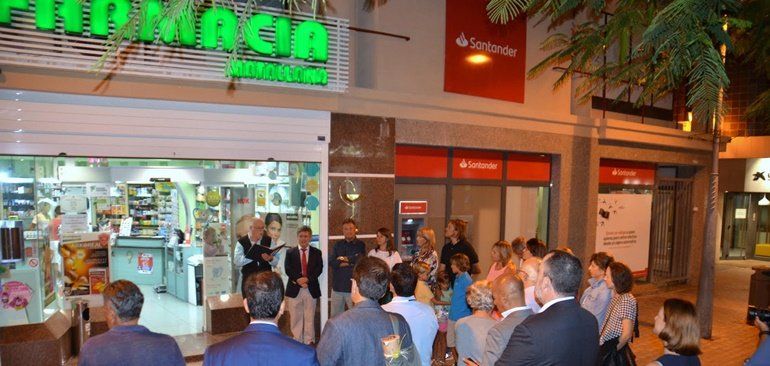
The general director of Public Health of the Ministry of Health of the Government of the Canary Islands, Concepción Gil Páez, presided this Thursday the commemoration of the World Pharmacist Day in Arrecife, where homage was paid to the centennial pharmacies of Francisco Matallana, Manuel Medina and Rogelio Tenorio, of which she highlighted their contribution, together with other medical professionals, to the development of public health in Lanzarote and the Canary Islands.
The event that was held at the Arrecife Yacht Club also brought together six pharmacists, the Minister of Finance of the Cabildo of Lanzarote, Isabel Martín Tenorio, the president of the Official College of Pharmacists of Las Palmas, Juan Ramón Santana Ayala, the head of the Pharmaceutical Regulation Service of the Canarian Health Service, Rodolfo Ríos Rull, the director of the Academy of Formulation and Individualized Medicines and president of the Association of Pharmacies of Santa Cruz de Tenerife, Manuel Díaz Feria, and the director of the Technical Services of the Council of Pharmaceutical Associations, Antonio Blanes.
"The presence of pharmacists and doctors at the beginning of the 20th century in Lanzarote and the Canary Islands gave a boost to public health and hygiene, marking the end of the cholera and yellow fever epidemics, which caused so much harm to our population, but above all, they were essential to reduce infant mortality and increase life expectancy," said the general director of Public Health.
In addition, on this World Pharmacist Day, she not only recognized the efforts of the first professionals on the island, "but also those of the owners and assistants who have maintained this professional health service to the population uninterruptedly and with the added difficulties of our double insularity."
The X Canarian Pharmaceutical Conferences will be held in Lanzarote
Concepción Gil Páez and Isabel Martín Tenorio closed the commemorative events with their speeches, which consisted of a guided tour by the chronicler of the Villa de Teguise, Francisco Hernández, to the centennial pharmacies of Matallana (1875), Medina (1901) and Tenorio (1912), and a colloquium entitled "Pharmacists facing the problems of the crisis of drug supply, analysis of the causes and professional alternatives".
The Minister of Finance of the Cabildo of Lanzarote announced the celebration of the X Canarian Pharmaceutical Conferences on May 7, 8 and 9 of next year in Lanzarote and thanked the Council of Pharmaceutical Associations of the Canary Islands for choosing the island.
The social work of pharmacies in non-capital cities
The president of the COF of Las Palmas explained that this year the World Pharmacist Day was celebrated outside the headquarters to underline the very important social work of rural pharmacies, neighborhoods, and non-capital cities "for a very close and permanent monitoring of the patient, which is fundamental for the sustainability of the planned pharmacy model." This model, with a ratio of one pharmacy per 2,500 inhabitants, the lowest in the world, and which he attributed to the Constitution and the health legislation of the last decades of the last century, is "admired internationally," he pointed out.
Juan Ramón Santana Ayala pointed out that "it is necessary to adapt to the current social needs of the 21st century, because from the chemical synthesis drugs of the 20th century we have moved to biological drugs and, logically, the role of the pharmacist has to evolve, orienting itself towards a more assistance work, with a dispensing accompanied by professional services related to the good use of the drug, with health care and disease prevention."
This social work, continued the president, "has a technological component in which the pharmacy in the Canary Islands is a leader, since it was the second autonomous community in which the electronic prescription was implemented ten years ago, and the first to launch the interoperable prescription system with Extremadura, all with a joint effort with the administrations of the Canary Islands, managing to be at the forefront of technology."
In this regard, Juan Ramón Santana Ayala stated that "technology is a useful tool to face the new challenges posed by the problem of drug supplies that mainly affects the user and that requires a solution to minimize its impact, and for this the General Council has launched the Information Center on Drug Supply (CISMED)."
CISMED, a project with a European vocation
In the colloquium it was revealed that the problem of lack of drug supply is a problem that began a decade ago and that in recent years has been increasing. This problem has had a response from the Interterritorial Council of Health expressed in the Drug Supply Guarantee Plan of the Spanish Agency of Medicines (AEMPS), and by the Council through CISMED, and in 90 percent of cases it is solved in the pharmacy office and in seven percent through foreign medicines.
The director of the Technical Services of the Council, Antonio Blanes, pointed out that "it is a problem that seems that it is not going to disappear and that it is important to try to get real information about the supply problem, which requires a notification and data availability, because at present if there is no communication from the laboratory there is no official supply problem."
To try to have "the real picture" of the situation, he explained that the Council has launched CISMED, although he considered that other additional measures are necessary in the policy of drug substitutions, in the master formulation through the autonomous agreements and, of course, have the information generated by community pharmacies from CISMED.
This project, as stated, has been seen with interest in the European sphere, so the Council's tool can become a "pilot" for a European information system, as the supply problem affects all countries.
For his part, Rodolfo Ríos stressed that there are multiple causes in the supply problems: price, little commercial interest, few raw material manufacturers, breaches of manufacturing standards, the inability of third parties to assume the market when the main supplier fails and globalization, and pointed out that foreign medication with the authorization of the Spanish Agency of Medicines is the solution when there is no other alternative.
The head of the Pharmaceutical Regulation Service placed the origin of this problem a decade ago and said that since then it has not stopped increasing considering that it is worrying that of 15,000 authorized drugs, 500 have supply problems at present. "Pharmacists, despite not being responsible for these supply shortages, are solving the problem with information to patients and alternatives, such as substitution when possible, or master formulation," it was indicated.
In this sense, Manuel Díaz Feria recalled that the master formula is a legally recognized drug and that it is a perfectly valid alternative as a solution in cases of urgency, not universal, and that it is being used in the face of supply problems.
He also indicated that "from the hospital pharmacy, doctors, and patients advised by doctors, are requesting in many cases information about the possibility of using the master formulation as an alternative, since there are active ingredients available because there is demand and because they have lost the patent, and if it is available any drug can be prepared, including Apocard." "We have demand for everything, and we prepare Pantomicina or even Caverjet, although for this case more specialization is required and having a clean room to prepare it," he specified.
Add La Voz de Lanzarote as a preferred Google source.
Stay informed with the latest current news.