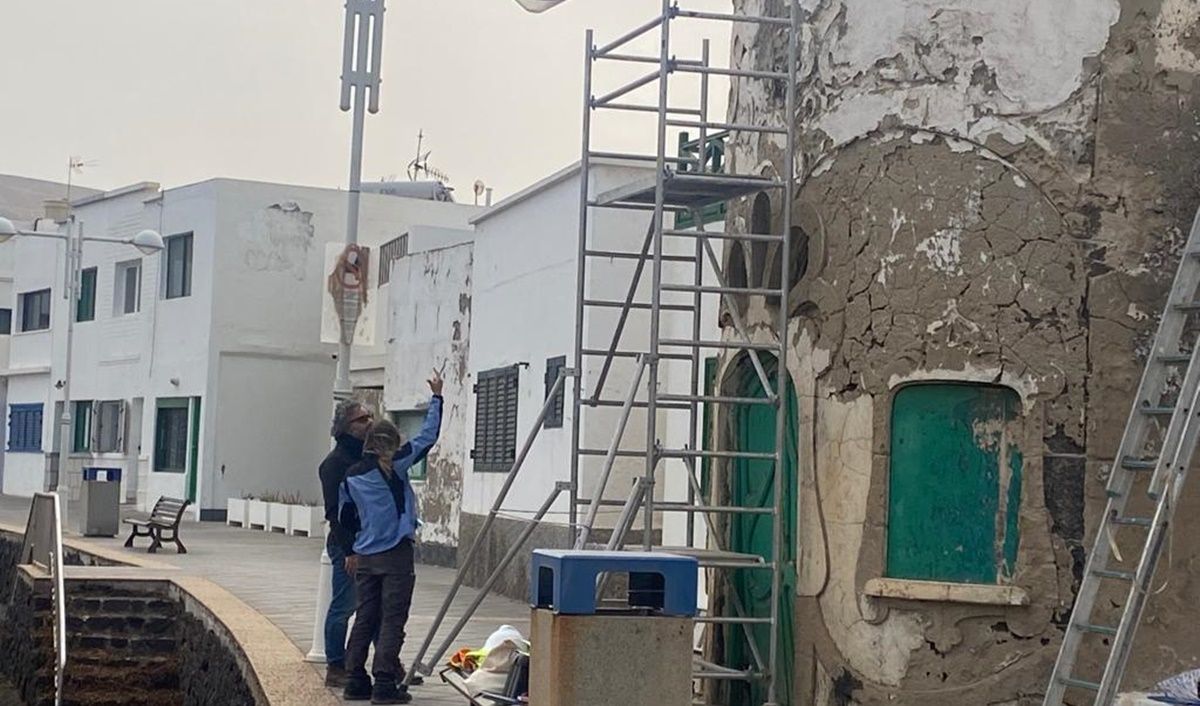
The Government of the Canary Islands has decided to take over the restoration of the modernist house in Famara, although only in relation to the facade, given the imminent risk of losing the values of this property owned by the Diocese of the Canary Islands.
“In general, the house is tremendously bad, on the verge of collapse and detachment of the facade,” explained the General Director of Cultural Heritage of the Government of the Canary Islands, Nona Perera, on Radio Lanzarote - Onda Cero. In fact, she has acknowledged that she doesn't know "if they will arrive on time", given the degree of deterioration it has. "It's now or never", Perera stressed, explaining why the regional Executive will finally take charge of this intervention.
“The facade is unique in Lanzarote as an example of modernist architecture, and unique in the Canary Islands for its decorative elements,” stressed the Director of Heritage, who affirms that they already have the approval of the Diocese of the Canary Islands to carry out this intervention.
“We have exclusively taken care of the facade, and for this we have carried out a project to collect samples and analyze them, to know, mapping the entire facade, the pathologies it has,” she detailed. According to her, the most affected area is the northwest facade, which is the most punished by the "prevailing winds", and the building has already lost the "turret" that gave light to the patio.
“I wish we could intervene with the necessary speed,” says Perera, who details that after knowing the results of the samples, which is expected to be throughout this month, the tender for the restoration of the facade will have to be put out to tender. “It is going to be tremendously delicate, if it doesn't fall before, because putting scaffolding there is very dangerous,” she warns.
Perera has detailed that throughout the history of the house of Luis Ramírez, which was bought in 1920 but underwent a reform in 1933, it has suffered many “harmful interventions” that have had an impact on the conservation of the property, and that make the team that has intervened in the analysis is "tremendously worried".
Apart from this specific action that the Government will assume, the Diocese of the Canary Islands must restore the rest of the property, which has been urged for years. For this, it already presented an intervention project to the Heritage area of the Cabildo of Lanzarote, but it was rejected. In this regard, the head of the area in the Island Corporation, Ariagona González, has explained on Radio Lanzarote that this project “did not meet the conditions” to have a favorable report from Heritage.
The councilor has also pointed out that they have required the Church to correct the project, although they have not yet received a response from the Diocese of the Canary Islands.
There must be a counterpart to intervene in private properties
The General Director of Heritage of the Government of the Canary Islands has also explained that they have not only intervened in the facade due to its “exceptionality” and the risk situation it is in, but also due to the agreement that exists between the Government of Spain and the Holy See to intervene in heritage assets that are of “public enjoyment”.
In relation to the possible intervention of the Government of the Canary Islands in historical properties of private ownership, Perera assures that there must always be “a counterpart” in order to act.
“There has to be a change of energy, otherwise it cannot be justified that the money of all people is invested in a private asset”, explained Perera, who gives as an example the intervention in a Convent in Tenerife, where they have restored the Church property and in return the Government of the Canary Islands has one of the rooms in the building.
The Diocese “has nothing clear” what to do with the property
Regarding the plans for future use of the house by the Diocese, Nona Perera assures that the Church “has nothing clear” what to do with the property.
“The last time I spoke with the previous Vicar, who is not the one who holds this ownership at present, what he wanted was to leave a public space for the citizens of Famara, as a center where they could meet”, Perera detailed. She also points out that in that idea of the Church, private instances were considered on the upper floor, and that the lower area would serve to make “some exhibition”.
Add La Voz de Lanzarote as a preferred Google source.
Stay informed with the latest current news.