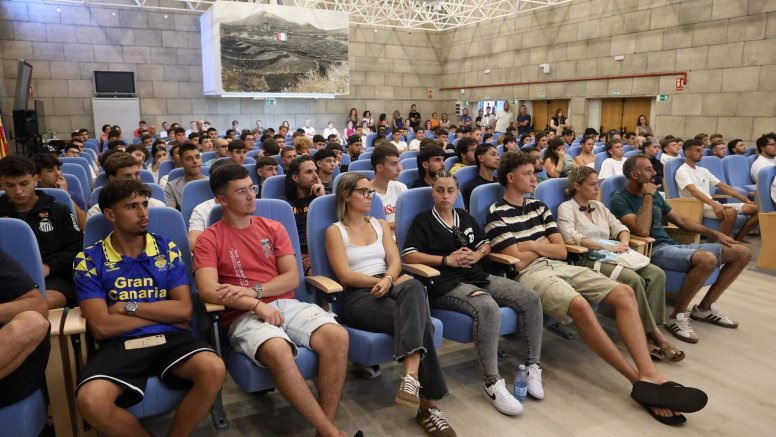
The Polytechnic Institute of Maritime-Fisheries Vocational Training of Lanzarote, better known as the Arrecife Fishing School, has inaugurated its 2025/2026 academic year this Tuesday with more than 200 students enrolled.
The event was attended by the president of the Cabildo of Lanzarote, Oswaldo Betancort; the island councilor for Fisheries, Samuel Martín; the general director of Fisheries of the Government of the Canary Islands, Esteban Reyes Hernández; the councilor for Fisheries of the Arrecife City Council, Cathaysa Suárez, and the director of the Polytechnic Institute, Carmen Déniz, who agreed to highlight the relevance of this center as an engine of knowledge, employment and modernization of the primary sector in the archipelago.
In his speech, the Lanzarote president Oswaldo Betancort stressed the historical and social value of this center. “Today we are starting a new course in a house that is the living history of Lanzarote. The Arrecife Fishing School has been, for decades, a beacon of practical knowledge, sea culture and social mobility for many families on the island and the archipelago. “Looking to the future”, added Betacnort, “we have taken a fundamental step with the proposal to implement the Degree in Nautical and Maritime Transport in this school, a historic leap that diversifies the economy and opens new opportunities for the youth of Lanzarote and the Canary Islands.”
A commitment to generational change and the blue economy
For their part, both the island councilor for Fisheries, Samuel Martín, and the general director of Fisheries of the Government of the Canary Islands, Esteban Reyes Hernández, agreed to emphasize the importance of maintaining quality training to guarantee the continuity of the sector. “The generational change will only be possible if we offer our young people modern, practical training connected to the reality of the labor market. This school combines tradition and avant-garde, and that is what ensures that the Canary Islands continue to have highly qualified professionals in a strategic sector”, Reyes stressed.
With 77 years of experience, the Fishing School has established itself as a national benchmark in maritime-fishing training. It currently teaches six Vocational Training cycles —three Higher Level (Aquaculture, Machinery and Bridge) and three Intermediate Level (Diving, Machinery and Bridge)—, in addition to more than 25 professional courses approved by the International Maritime Organization (IMO), as reported by the director of the Polytechnic Institute of Maritime-Fisheries Vocational Training of Lanzarote, Carmen Déniz.
The 2025/2026 academic year thus begins with the renewed commitment of institutions, teachers and students to continue promoting maritime-fishing training as a lever for employment, innovation and sustainability for Lanzarote and the Canary Islands.
Add La Voz de Lanzarote as a preferred Google source.
Stay informed with the latest current news.