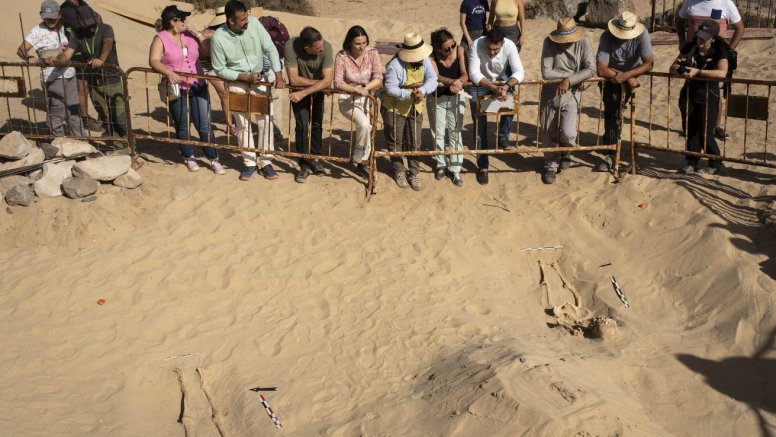
The last archaeological season in San Marcial de Rubicón in Yaiza has closed with the discovery of a necropolis with ten corpses from the 15th century. The archaeologists from the Canarian universities Esther Chávez and Macri González, from the University of La Laguna and Las Palmas de Gran Canaria, respectively, are co-directing it jointly to discover what life was like in the first European settlement in the Canary Islands.
On the occasion of the end of the campaign, Esther Chávez answers questions from La Voz de Lanzarote. "Now we have covered everything, we have left it as if we had not been there, we have only put an anti-grass mesh and the jable on top," she narrates. When leaving, the objective is that there is no identifying element that shows where the dead were or where the walls come out. In addition, an inventory of the tools is made so that everything is clean and everything is stored for the next campaign.
This campaign has been atypical for two reasons: the discovery of a dozen corpses that they did not expect to be in that area and the number of visitors that the discovery has brought. "It has been quite stressful because of the response from the people. We have been excavating for four years and we had not had that many people admiring the results," Chávez asserts. In the different periods of work at the San Marcial de Rubicón site, remains of rammed earth walls were found, the first to be archaeologically documented in the islands, houses with pavements and holes to place posts and thus support the roof, remains of ceramics, animals, garbage dumps or coins, but nothing aroused as much interest as the bodies.
"It has been very interesting because of the flood of people, which is very good that they are interested in the heritage that is part of everyone, but it has been a constant legion for the course of the excavation," she testifies.
This enclave, located in the south of the island, is the scene of the first contacts between European culture and the indigenous culture of the Canary Islands. Thus, among the dozen skeletal remains located, the discovery of three babies and a child has stood out, but where it cannot yet be assured what their origin is. It is unknown whether they are European colonizers, Majos (aborigines) or mestizos.
In this fourth year discovering the history of the conquest of Lanzarote and the relationship between Europeans and aborigines, Esther Chávez explains that they have worked in several parts of the site, where they have also been able to document the living spaces. Likewise, the team of archaeologists from both public universities finishes the campaign "happy with the results" and exhausted by the overexposure.
However, the work has only just begun. Now it remains to analyze the findings of the material. Also the DNA of the human remains to be able to define kinship relationships, as well as to know if they are indigenous or colonists. In addition to whether there are mixtures between the two in the children, as will probably happen. "All this is going to provide us with a lot of information about the diet, pathologies, possible traumas they suffered in life and an end of information that we now have to discover little by little," explains the co-director of the excavation.
The discovery of these corpses was not expected in the area where the excavation was being carried out. "It has not come out next to the church, which was where it was expected and we know that there is a necropolis because the Serra brothers excavated a couple of tombs there," she begins. The appearance of these remains occurred in an unexpected location.
"We started working in that area because an anomaly in the geophysical analysis of the terrain caught our attention, so we wanted to check it," adds Esther Chávez. From that verification came the most unexpected discovery of the season. What at first were skeletal remains of two people ended up adding up to a dozen. This amount allows us to study the patterns and guidelines in the burials. "The way to place the body inside the graves is face up with the arms crossed over the pelvis, the stomach or on the chest and it is a common way of burying in Christian cemeteries," the researcher anticipates.
Now we will have to wait until the 2024 campaign to learn more information about the land of the cemetery, discover its limits and its distribution. This project takes place from mid-September to the end of October for five weeks.
The archaeologist concludes the campaign stating that: "Each time we see that it is much larger than what was thought, because the site is delimited by some stones that were placed in the 90s to prevent road traffic from passing to the beach because people arrive with caravans to the beach or park on the wells, but we have already excavated the area outside those stones and there is still a site and as it is so covered with sand it prevents you from seeing if there are stones that could give an indication".
Under the meters and cubic meters of sand lie the remains of the history of the conquest of the Canary Islands. "The first dead that appeared were between 40 and 50 centimeters from the surface, but in those spaces you may have opened an anchorage that is 10 meters long by five wide, so that's 50 cubic meters of sand. "Before reaching any place we have to move a large volume of sand," begins the professor of Archeology.
The San Marcial de Rubicón site was the place where the conquerors arrived. From the south of Lanzarote, the conquest of the Canary Islands began in a process that later affected all the islands. "For Lanzarote it is obviously important because it was here on the beaches of the island that they chose to install a first camp that makes us a city and because it will serve as a point to jump to Fuerteventura, which will be the next to be colonized," explains Esther Chávez. In addition, the history of the conquest of the Canary Islands has accounts of the conquerors themselves through the campaign diary Le Canarien.
An archaeological investigation
Not only the co-directors of the project participate in these works, but also groups of students from the two universities of the Archipelago. "One of the objectives of the project is, in addition to increasing knowledge about the site, that it is also a training space for students from the Canarian universities," explains the professor of archeology at the University of La Laguna.
On this occasion, seven students from the ULPGC and six from the ULL have participated, in this way they have been alternating every two weeks between September 18 and October 20 to facilitate the logistics of the excavation, but also to take advantage of the fact that prices are "a little" lower. "We have certain difficulties to stay here in Yaiza and the prices are exorbitant so we can rent two houses and two cars which means that there are ten people" who can be simultaneously. "All the archaeological work is closely linked to the economic capacity to respond to all those expenses," she points out.
The research projects extend over time and therefore periods of excavation on the ground alternate with others of findings of the analyses. In addition, the teachers must return to their jobs in their respective faculties.
"Then we have to process it in the laboratory and we have to clean all the material, we have to study it and put an identification number on each piece found, we have to select material for drawing, for photography, another that has to go to the laboratories to have the corresponding analyses done and all that is a process that takes time," reveals the co-director.
Add La Voz de Lanzarote as a preferred Google source.
Stay informed with the latest current news.