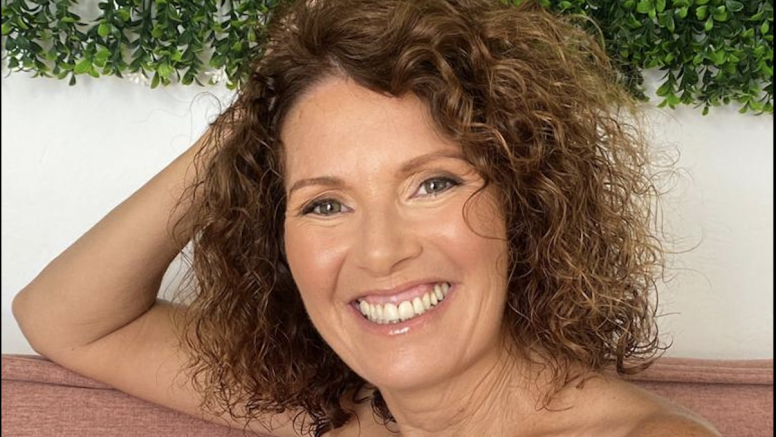
The life of the Lanzarote native María Hernández was marked by her education. She always thought she needed the protection of a man to be able to live, because that's what her mother had taught her since childhood. In her romantic relationships, she found a way to escape from her family home.
From her first relationship with a man, her eldest daughter was born. She was only 19 years old then and still lived with her family when she had to tell them she was expecting a baby. "Appearances are fundamental in my family, so when I told my mother I was pregnant, she acted like the girl from the exorcist," María Hernández tells La Voz from the other side of the phone.
From the announcement of her pregnancy, life at home went from bad to worse. "I was constantly humiliated, I was the whore, it was an incredible suffering for me, that's why I wanted to escape from them all the time," she explains. The relationship with her daughter's father didn't work out, and they raised their daughter separately.
Some time later, María Hernández met another man and saw him as a lifeline. Although he was eleven years older than her, she decided to move to La Palma, where he lived, and take her daughter with her. During the time she was with him, she was diagnosed with depression and anorexia, two diseases that were encouraged by a toxic environment. His boyfriend's daughter and she did not maintain a good relationship.
"At first, it was very nice. You are very beautiful, you are very good, it was like the woman of his dreams and then I became the witch. Literally things like: you are stupid, you don't know what you want, don't be stupid, you are worthless," she says.
Helpline for women victims of gender violence 016
At that moment, the situation in La Palma became so twisted that María was not in a good state of mental health and her daughter had to return to Lanzarote without her. Some time later, María's sister went to get her and brought her to Lanzarote. "They wanted me to stop, but I didn't have the strength to stop," she says.
Her parents took her back home and after two and a half years back on the island, she started working at Lanzarote Airport, in a handling company. There she met the man who seven months later would become her husband. "I didn't want to disappoint my family again, but he met my girl and a connection arose between them and he won her over. I was filled with hope thinking that he would be a father to her," explains María.
At that moment, her third boyfriend promised her that he was going to protect them. Until the first episode of violence occurred. During a trip to Santander, which started to meet her partner's family, was the first time he yelled at her. After that, on October 29, 2000, she got married and her hell began.
"When I got married I had a terrible depression. People told me, but are you going to get married? because I was super sad," she says, "that is the biggest mistake you can make, not knowing what is the real reason why you get married."
After that, maintaining a marriage without knowing the reason why you don't get divorced is for María Hernández "the biggest hell that anyone can be in because it kills their children in life, it marks their lives forever, but forever."
Her relationship with her husband was "an abusive relationship from the first moment," says María after years of therapy and training. Added to this was that her mother and her ex-husband fought to maintain control over her.
As a result of the conflicts between her husband and her mother, they moved to the north of the island and it was the way to distance her from her environment. Once they moved in together, he began to establish a series of rules in the house, to control his daughter's behavior. "There he subtly began to generate violence, to control our lives," she says now after years of therapy.
WhatsApp support 600 000 016
In that second coexistence, jealousy with the father of her eldest daughter was maintained, the dispute because she called him dad. In that time, María had up to two abortions, pressured by her then partner, who threatened to abandon her if she did not interrupt her pregnancy.
"The issue of abortions, when they are not voluntary, usually takes a very large toll on women, with the added burden of guilt that it carries. It was not a decision made by me," says María. These abortions caused her much pain and impotence.
Then, he changed his mind and begged her to have a baby. "We think that he is going to protect us in reality and what he really does is show you how far you are willing to go to sink and want to die for something that is not worth it," explains this survivor, "you are smart enough to get ahead, alone, you don't have to be in a marriage that only gives you crumbs."
In that period, María was beaten on several occasions, humiliated and even thrown to the ground by her husband. For years she left and returned to her home, because she could not emotionally detach herself from that relationship. "No one knew how to see that I was in an abusive situation, it was all my fault and I was the ignorant and the idiot," recalls María Hernández.
When her second daughter was born, the baby wouldn't stop crying, but her husband only had "compassion" during the first night. After months of hell, she decided to leave home and was taken in by a family that took care of her youngest daughter. At that moment she discovered that her husband was cheating on her and sought advice to get divorced.
"I looked for so many alternatives that psychologists say that even vitamin B12 was worn out. In that physical and mental effort I exhausted myself and that's why I fell into a loop," recalls Hernández.
María was accompanied by the Mararía Association in the first years after leaving the abuse. Later she trained as a mentoring therapist and in Positive Psychology. "I mortgaged myself in my life because I decided to get out of all that and I began to discover a world," she explains to La Voz.
This training helped her to get out of the hole and understand what were the patterns of behavior of the men in her life, as well as her own. "I hit myself, I didn't love myself," she says. Now, María Hernández has found her way, was able to get out of the abusive situation with her ex-husband and has managed to find a way to heal her family relationships.
She has explained all this in her novel Returning to myself. In it, the characters appear anonymized in order to avoid possible lawsuits.
Add La Voz de Lanzarote as a preferred Google source.
Stay informed with the latest current news.