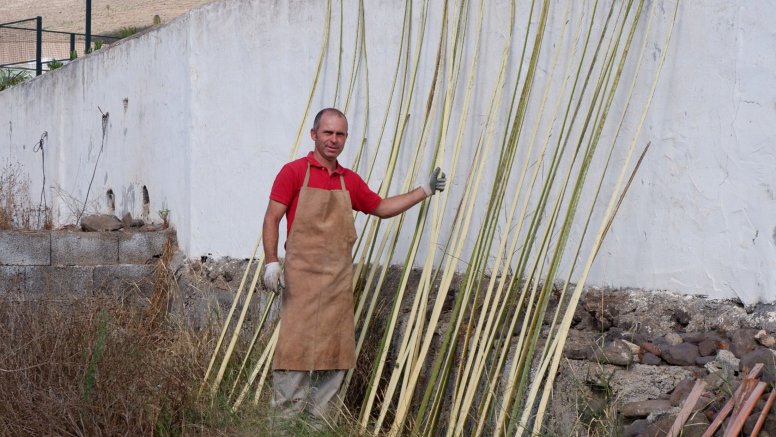
Pírgano baskets are one of the many objects that characterize the Canary Islands and that have served throughout the centuries to help in the daily tasks of the islanders, whether for collecting fruits and vegetables or carrying bread or fish. Currently, in Lanzarote very few artisans remain who are dedicated to their manufacture. One of them is Ruymán de León (Los Valles, 1982), who has found a gap in his work at the Teguise City Council to dedicate it to pírgano basketry and prevent its disappearance.
His journey as a basket weaver began in late 2019 at the Haría Market, where Ruymán de León had a traditional pastry stand. Between chats, from the Haría City Council they conveyed their concern about the danger of disappearance that pírgano basketry faces in Lanzarote to the point that there are no artisans who work it or, at least, disseminate it. "They proposed that I talk to Eulogio Concepción and that he teach me, and so it was, I went to his workshop and talking we became friends and the free time I had I spent with him helping him prepare the material for two years," he says.
In this way, the bond between de León and Concepción was forged in a fusion of help in exchange for artisanal knowledge, something that made the basket maker learn the pírgano basketry of Lanzarote from the greatest master. However, Ruymán recognizes that his role is that of disseminator and conservator of this traditional Canarian craft. "I don't dedicate myself to it, I learned so it wouldn't be lost and I do some things at home, but as a hobby," he points out.
The good rapport with Eulogio Concepción, whom he already knew previously, was felt from the very first moment upon starting to work as an apprentice alongside him. "I can't say anything other than have words of gratitude towards him because he taught me everything he knows and experience is acquired with experience and years," he reveals.
Eulogio Concepción is the last great basketry artisan of Lanzarote remaining on the island, who has dedicated more than sixty years to this craft. He was distinguished by the Cabildo de Lanzarote as Artisan of the Year. For its part, the Order of the Canarian Cachorro distinguished him with the Cachorro de Honor and the Haría City Council awarded him the highest honor with the Haría 2015 Award. Furthermore, this town honored him in 2019 with a sculpture, which reflects the importance of this artisan for the island.
The diocalandra, a pest that further complicates pirgano basketry
Raw material is indispensable for artisans to be able to make baskets and other objects. The Canary palm has been affected for years by the pest of the diocalandra frumenti, which ends up killing the tree and destroying with it the material for basketry.
In the case of Haría, due to the importance of its large palm grove, the authorities prohibited introducing material from outside the municipality, but rather palm leaves cut in the town itself to prevent the spread of this plague. "This limits you a bit because you depend on the City Council or some private individual pruning the private palm trees so that they let you take the leaves to extract the pírganos," explains the artisan.
The rachis is the central vein of the palm leaf and undergoes a process from when the tree is pruned until it reaches the artisan ready for use. "Normally, on the day of pruning or the day after, the leaves are removed with a knife, leaving only the central vein," indicates the artisan. This central vein is split in half and left to dry for at least one month or a month and a half. Once dry, the material is stored and later the different parts are elaborated. The vein is divided into the heart, the husk, and the bark.
In this process, Ruymán de León points out that many times the material introduced into water is left the night before or the first hours of the day are taken advantage of so that it is very flexible and can be worked. This is done so that the pírgano is soft, which is why ambient humidity is vital. "On hot days it cannot be worked because it breaks", he explains.
A very hard elaboration
The making of baskets is currently done for aesthetics and not so much for the practical use it was given in ancient times. "Before, we worked in a rougher way with the hardest parts of the palm tree so that the basketry would last longer, but nowadays everything is oriented towards decoration so we try to make the aesthetic beautiful," he asserts.
It is a hard job and where great strength is required because "you are all day working with knives, you cut yourself and you hurt your hands". "There are people who have tried it, especially women, and they leave it because you destroy your hands", assures de León.
For their part, not only are baskets made, but also lamps, wine racks or decorative baskets for storing clothes. However, because small pieces are made with dwarf palm, a very limited material, "that material is not available to make smaller pieces, as it has to be very flexible. This means that usually only medium and large pieces are made."
This elaboration does not have a determined time, but rather depends on the amount of material one has. "If today you are weaving elaborating the frame of the basket, you dedicate yourself to weaving, and another day you dedicate yourself to finishing, so in that way you dedicate yourself to progressing," he indicates. In case of having availability, the artisan is capable of completing it in a day and a half, but depends on factors such as environmental humidity or the existence of material.
Ruymán de León explains that he does not work on demand, but rather makes pieces and "the people who come adapt to what has been made".
A trade on the verge of disappearance
Pírgano basketry is currently at a high risk of disappearance due to the complexity of obtaining the raw material and the lack of generational replacement. According to the artisan, this craft "is destined to disappear and if it hasn't yet, it's because of the the work of public administrations to keep it going by giving you material".
Regarding the possibility of giving workshops and spreading pírgano basketry, the artisan indicates that "he wouldn't mind", but details that for this he must have time and raw material. "This is not learned in a week, this is trial and error, and it is learned by making pieces and improving", he concludes.
Add La Voz de Lanzarote as a preferred Google source.
Stay informed with the latest current news.