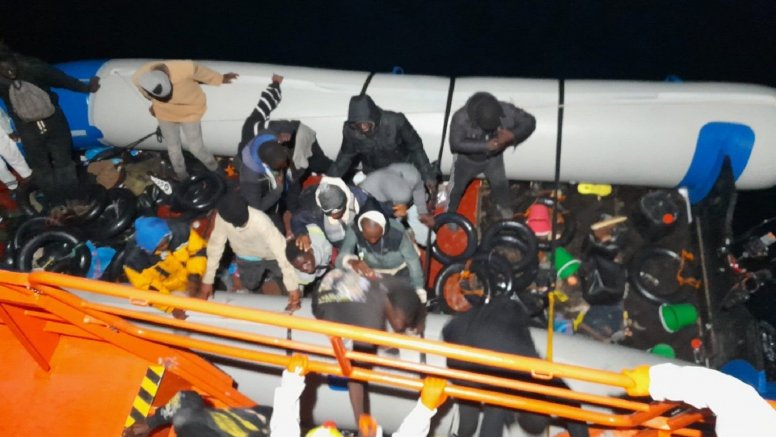
The persecution of black people, mass arrests against migrants and detentions without receiving food, beatings and even torture are used by the security forces of Mauritania to prevent people from embarking precariously from this West African country to the Canary Islands. This is denounced by a report by Human Rights Watch, published this past Wednesday, which highlights that these control forces receive funding and materials from the European Union and Spain to contain migratory flows to the continent, despite the fact that they continue to "violate human rights" and the Canary Islands are their main entry route.
Between January and August 15 of this year, a total of 22,040 migrants arrived in Spain in precarious boats, a decrease of 29.3% compared to the previous year, when 31,155 people arrived in the Canary Islands. The largest drop in the country, 46.7%, occurs on the Canary Island migration route, with 11,883 arrivals this 2025, compared to 22,304 last year, according to data from the Ministry of the Interior.
Mauritania is located on the southern border of the Western Sahara, occupied by Morocco, bordering Algeria to the northeast, Mali to the east and a section to the south with Senegal. Due to its geographical location, Mauritania is a transit country for migrants departing from Central Africa, also for asylum seekers and refugees, mostly Malians fleeing the armed conflict that has been escalating for years in the country.
Usually, the colorful canoes and pateras leave from the Mauritanian cities of Nouadhibou, very close to the Western Sahara, or Nouakchott, the capital of the country. To prevent their departure from the country, in 2024, the European Union gave 210 million euros to the government of Mauritania to contain migration, as part of its plan to externalize European borders and move them to third countries. With a practice that has already been carried out with other countries such as Turkey or Morocco. At the beginning of 2025, the non-governmental organization points to an increase in mass detentions and expulsions of migrants from Mauritania to the border countries of Senegal and Mali.
However, repression in Mauritanian territory has existed since before that agreement was sealed. Proof of this is that Human Rights Watch has documented between 2020 and 2025 different human rights violations exercised against adults and children who arrive from other African countries to embark to Europe.
Violations, arrests and mass detentions by Mauritanian forces
"They stripped me naked and beat me. They gave me electric shocks," one of the survivors told Human Rights Watch. "They said I was helping people go to Spain," he continued.
The organization denounces that migrants who take refuge in the country suffer torture, rape, sexual harassment, detentions, arbitrary arrests and mass expulsions by police officers, coast guards, marines or gendarmes.
Thus, it points out that the people interviewed reported that they suffered racial discrimination in the process and that the country's security forces raped, tortured and beat at least 43 people.
Mass expulsions of people "are prohibited by international and regional African law," the group recalls. Despite this, it denounces that in Mauritania they frequently occur without attending to individual cases or ensuring a process with guarantees. "They can violate the right to seek asylum and the right to leave any country," the report continues. At the same time, it points out that there are people who have been incriminated with "false charges" accused of smuggling migrants.
In addition to this, white Mauritanians, descendants of Arabs and Berbers, continue to occupy security and power positions in the government, while continuing to discriminate against black people, including Haratins and Afro-Mauritanians.
Human Rights Watch has denounced that people detained in Mauritania have been expelled to "remote areas" along the borders with Mali and Senegal, where aid is limited. In addition to this, the armed conflict in Mali has put them at risk.
More than 147,000 migrants in four years, on the deadliest route
Between the years 2020 and 2024, around 147,000 migrants have arrived in the Canary Islands in inflatable boats, pateras and canoes. In addition to this, another 11,300 people have arrived in precarious boats in the first half of 2025.
Meanwhile, estimates of how many people have lost their lives during these years place the figures of deaths between 4,300 and 24,800. In addition to this, there are tens of thousands of people who have been blocked by the Mauritanian, Moroccan, Senegalese or Gambian forces, financed by foundations of the European Union and with the help of Spanish patrols deployed to Senegal and Mauritania.
To stop the arrivals, the Government of Spain has also deployed a hundred members of the National Police and the Civil Guard in three African countries: Mauritania, Senegal and Gambia.
Add La Voz de Lanzarote as a preferred Google source.
Stay informed with the latest current news.