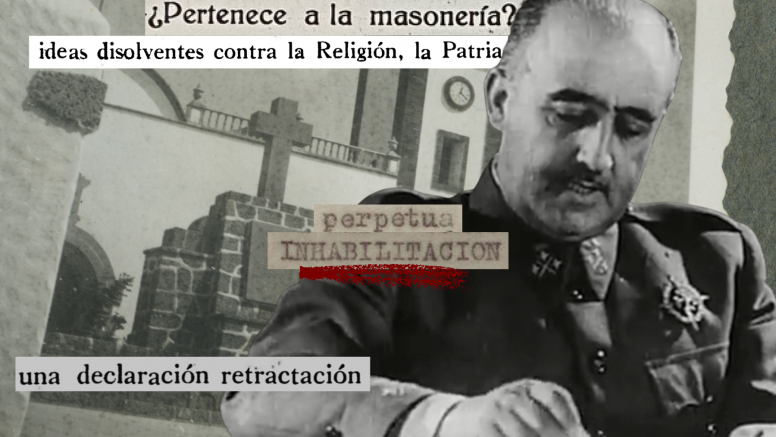
The Francoist dictatorship tried to bring to trial the Lanzarote native Aquilino Fernández after he was dead. Fernández was mayor of Arrecife (1920-1922), businessman and member of Freemasonry. He died in 1934, during the Second Spanish Republic, due to a cerebral hemorrhage after suffering a traffic accident in Teguise. During the Civil War (1936-1939), Francisco Franco's regime discovered that he had been a Freemason and tried to judicially seize his properties; for this purpose, it opened a judicial procedure against him, even though he was already dead.
In an interview with La Voz, his grandson, Antonio Márquez tells how Freemasonry was the best-kept secret of his grandfather to avoid being judged and condemned by Francoism, something they almost achieved post mortem. Precisely this secret origin of Freemasonry and its clear gnostic stance has caused speculation and conspiracy theories to grow like wildfire around it.
But, what is Freemasonry really? It is an association born in France and extended throughout the planet, whose members are hierarchically divided into lodges and practice philanthropy, defending the thought of rationalist philosophy and the values of liberty, equality, and fraternity. Among its ideals, they promote an openly secular stance.
Masonic organizations arrived in Lanzarote at the end of the 19th century at the hands of the bourgeois classes from North Africa, influenced by the French currents settled in Fez (Morocco). Before arriving in Lanzarote masonic organizations had already been introduced in islands such as Tenerife and La Palma.
Their lodges became the place where historical figures from Lanzarote converged who, due to their economic position, could afford to dedicate time to thinking in an era where the island was plunged into poverty. Among them, Blas Cabrera y Felipe, the prestigious scientist from Arrecife and the philanthropist from San Bartolomé Luis Ramírez González (1884-1950) belonged to Freemasonry. This is narrated by Silvano Corujo, president of the Majadas de Mina association, who has fought to preserve the legacy of both on the island.
The mail boats, one of the points where they were initiated into freemasonry
Before the creation of the first lodge of Lanzarote Atlántida 92, in the correíllos (boats that sailed between the islands) many people used to be introduced into this organization. “The officers of these boats used to be Masons and as they went from island to island they initiated people into Freemasonry, they formed a workshop inside a cabin or wherever it might be”, says Márquez. In fact, his grandfather Aquilino Fernández entered in this way in 1920 by the captain of a correíllo.
At the end of the 19th century, the first lodge to be founded in Lanzarote was the Atlántida 92, which came to have, at least, thirty members. Since its emergence, the Catholic Church had openly shown its opposition to Freemasonry due to its secular stance. For example, in Lanzarote, during the first years of the last century, priests refused to bury Freemasons in the island's public cemeteries or forced them to openly renounce Freemasonry in order to get married.
"The basic principle of the Masons is deus sive natura, from Latin god is nature", explains Silvano Corujo, who explains that Masons reject the control exercised by the clergy and traditional sacraments and defend that "to know nature is to know god". Freemasonry became one of the enemies to be defeated by the Catholic Church because if its thought spread the power of the Vatican would diminish. "The layman does not have to answer to anyone. There is no sin or sacraments, it eliminates the role of the parish priest", Corujo continues.
In this context of enmity with Catholicism, at the beginning of the 20th century, several Masons emigrated from Lanzarote to Venezuela. Among them, the residents of Haría Andrés Cruz Villalba and Agustín Cruz Villalba, and the son of the latter Andrés Cruz Villalba Lasso. In their case, they founded a lodge in the Latin American country and achieved a high position in it. Agustín Cruz left behind his two daughters, who remained in Lanzarote, where they started a family.
"He lived with the heartbreak of not having been able to return to Haría and of seeing his sister", narrates one of the relatives of Andrés Cruz Villalba Lasso in an interview with La Voz. His father Agustín Cruz did return to Haría, where he founded a soap factory in the forties and where he lived with his wife Juliana Lasso Rodríguez.
Meanwhile, the Lanzarote native Andrés Cruz Villalba created a soap factory in Venezuela and died without returning to his homeland. From the Caribbean country, his grandson Vladimir Villalba recalls that his grandfather did not return to Lanzarote for fear of being arrested for being a Freemason by Franco's regime and his family suspects that his children did not inherit the surname Cruz so that reprisals would not fall upon them.
Freemasonry: an "enemy" for the Catholic Church and Francoism
Since September 1936, the recently established Francoist regime, with a national-Catholic stance, began a witch hunt against Freemasons, whom it considered rebels. Before this legislation, many Freemasons had already been shot, especially in the summer when the war started. From the first months of the dictatorship, the looting and expropriation of Freemasons' properties were allowed.
In 1940, the Francoist regime approved the Law for the Repression of Masonry and Communism. Such was the hatred of the Francoist regime (1936-1975) against the Masons, that the caudillo himself Francisco Franco published a book under the pseudonym Jakim Boor that compiled hundreds of articles that he himself had been publishing in the press against this association. "Masons in Spain mean this: treason to the homeland and the threat to religion," he warned in the prologue of the work Masonería (1952), published by the dictator.
The dictator accused the Masons of being, along with the communists, the origin of "all the misfortunes" of Spain and of being "the greatest enemy of democratic principles". In this work, he assured that the Masons were the "sponsors of all betrayals" and those who "had opened the doors of the Homeland to the communist invasion". During the forty years of dictatorship, Freemasonry was persecuted for defending values such as democracy, free thought, secularism and freedom of education, something that the regime condemned with prison or, even, with the death penalty. The leader took his personal battle against Freemasonry until his last public speech.
Luis Ramírez González, the philanthropist
Silvano Corujo explains that during the Francoist regime the Freemasons of the island had three paths: emigrate to other Canary Islands, exile or hide their ideals. Those who, like the Lanzarote philanthropist Luis Ramírez González, advocated for staying on the island had to protect themselves from being singled out by the regime.
Ramírez entered Freemasonry through his family. Born in San Bartolomé, he was orphaned very young and had to be raised by his grandparents. "It was they, who had connections with the Gnostic and Masonic world of Italy, who sent him to study with the Salesians in that country," narrates Corujo, who was a beneficiary of one of Luis Ramírez González's scholarships. Raised in La Florida, Ramírez was mayor of San Bartolomé (1930-1931), but later replaced by a Catholic parish priest.
"The clergy of Lanzarote does not like Luis Ramírez because of his Masonic origins," adds Silvano Corujo, who explains that Ramírez was removed from political life due to his connection to this organization. Following the Francoist laws against Freemasonry, the philanthropist dedicated himself to associating with Salesian cooperators, attended mass, and gave gifts to the parish priests, but withdrew those offerings when they offended him.
Blas Cabrera y Felipe, persecuted and exiled
The Lanzarotean Blas Cabrera y Felipe (1878-1945), considered the father of Spanish physics and also a Freemason, contributed great advances to science, such as for example in the study of the magnetic properties of matter or in design. During his life, he surrounded himself with great scientists such as Albert Einstein, Erwin Schrödinger or Santiago Ramón y Cajal. The latter was "like a father, he guided him in what he should study and they met many afternoons at Café Suizo, a very historic discussion café in Madrid", says Corujo.
After the outbreak of the Spanish Civil War, Blas Cabrera had to go into exile from Spain due to the political situation and went to the city of Paris. However, the invasion of the Nazis in 1940 of the French capital made the physicist have to flee again. "When the Germans invaded France, Franco managed to have his job taken away from him," he points out. After finding himself unemployed and persecuted, the native of Lanzarote went into exile again to Mexico with the support of the scientist and also friend Erwin Schrödinger. In the Central American country he lived the rest of his life until his death.
The persecution by Francoism was such that in 1939, the regime stripped him of his professorship and his academic positions in Spain and he was expelled from the Real Academia de Ciencias Exactas, Físicas y Naturales. Furthermore, the Centro de Química y Física de España, which bore his name, was changed to that of Rocasolano by the dictator. It was not until 2022 when the name of Blas Cabrera y Felipe was returned to the Centro de Química y Física de España. Likewise, in the year 2023 he was recognized again as professor and rector.
The Lanzarotean masons disqualified
Facing cases like that of Blas Cabrera, who died in exile, those who remained in the country and were discovered, then faced Francoist repression. Such was the case of the Arrecife native Manuel Miranda Benítez, captain of the merchant navy and born in Arrecife, who was vice-secretary of Izquierda Republicana and a freemason.
Miranda Benítez reached one of the high ranks within the lodge and was disqualified for ten years by the Tribunal for the Repression of Masonry and Communism in 1945 and declared firm by the Francoist Council of Ministers, according to communications between the Civil Government of Las Palmas and the Tribunal against Masonry and Communism which this media outlet has been able to access.
The Lanzarotean was condemned by article eight of freemasonry which highlighted that those who did not retract their involvement in freemasonry would be separated "definitively" and disqualified "perpetually". However, he was able to cancel his sentence in 1949 and return to work at the port because he had been falsely accused of participating in the assault in La Isleta, in Gran Canaria, in 1936.
The Francoist machinery used the membership lists of the Masonic lodges of the island to persecute its members. Lanzarote Masons like Antonio Medina Mesa, known as Trosky, or José María Rocha Topham, under the nickname of Prim, were then disqualified. The first was removed from his profession as captain of a mail boat and the second removed from his work as a port worker.
The dictatorship judged and condemned more severely freemasons depending on the ranks they held within the organization. “In Freemasonry there are several rites, the most used is the Rito Escocés Antiguo y Aceptado and it goes from degree 1 to 33. Depending on the degree you had, they would give you a greater penalty,” says Antonio Márquez.
The fear of being singled out and arrested by the regime increased the secrecy that existed at the time about Freemasonry and many Masons opted to live their ideology intimately. Even there were members of the same family who were Masons, but they did not comment on it among themselves.
For centuries Freemasonry was Lanzarote's best-kept secret. As has been confirmed in the documentation accessed by La Voz, dozens of Freemasons emigrated to other islands or went into exile in America fleeing the repression of the Catholic Church and then the forty years of Francoist dictatorship. Faced with this, those who stayed had to live with their backs to their ideals so as not to be arrested and dispossessed, making their families make an unbreakable pact of silence to save the lives of their children, siblings, grandchildren, or nephews and nieces.
With the support of:
Add La Voz de Lanzarote as a preferred Google source.
Stay informed with the latest current news.