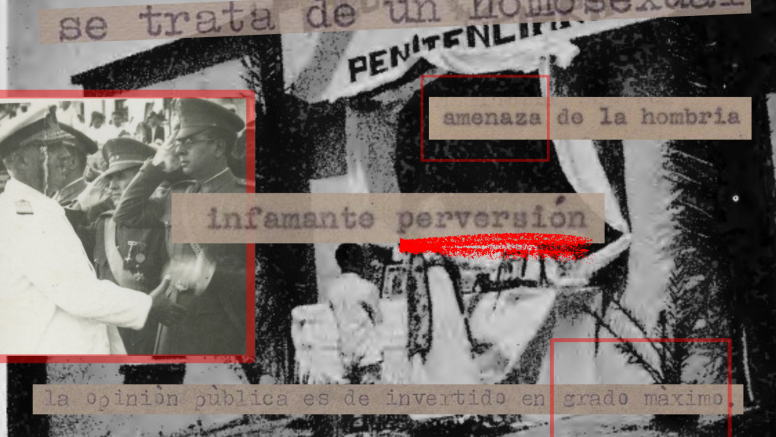
A truck unloaded Octavio García Hernández (1931-2018) with other prisoners in the middle of a vast jable field. Lined up and exposed to the strong wind, he paraded alongside other inmates on that piece of desert. Before arriving, they were left tied up for hours exposed to the sun at the port, then they were covered with a tarp and driven around several times to disorient them. His crime: being homosexual; his sentence: to pick stones, every day, until the sun went down, to make fruits sprout from that land and to endure the beatings and insults of the guards.
The Agricultural Penitentiary Colony of Tefía, in Fuerteventura, was one of the concentration camps that housed the horrors of the Francoist repression in the Canary Islands. Along with common criminals, some political prisoners and "socially dangerous" individuals, the regime persecuted and imprisoned homosexual and transgender people. It is estimated that of the thousand prisoners who were held in Tefía, between 300 and 350 were imprisoned for their sexual orientation or identity. However, it was not until the 21st century that two survivors, Canarians Octavio García and Juan Curbelo, were able to publicly denounce the horror.
Octavio García was one of the first victims to make his testimony public. He was arrested in Gran Canaria in 1954 and sentenced without trial for being homosexual to forced labor in the Fuerteventura concentration camp. He compared that place to the Nazi concentration camps, but without a crematorium, according to researcher Miguel Ángel Sosa. Like him, from the beginning of the Franco dictatorship, people from the LGTBI community were persecuted, repressed, and imprisoned, although not all of them ended up in Tefía.
Among the prisoners who were sent to Tefía for being homosexual, the testimony of Juan Curbelo (1939-2004) also endures, known as Juanito El Pionero for his strong connection to the Canary Islands Carnival, who was the first to tell of the repression he suffered in that concentration camp without walls. Curbelo was imprisoned at sixteen years old, when he was still a minor and even though the law did not allow it. Both Curbelo and García recounted that, in addition to the abuse and beatings they received from the guards, the hunger they endured was added. They even went so far as to eat goat droppings.
Octavio García narrated how they handcuffed him like the rest of the prisoners for his sexual orientation and paraded him through the street with chains on for all citizens to see. In addition to the humiliation and mistreatment, "the mere fact of being locked up in a place for being homosexual was in itself a humiliation," highlights Víctor M. Ramírez, a researcher of the memory of sex-gender dissidences in the Canary Islands and author of the book Dangerous and Revolutionary.
A State-Funded Model of Persecution
"They were starving, they beat them, they humiliated them, they made them break rocks, carry buckets of water," explains Miguel Ángel Sosa, writer and author of the work Viaje al centro de la Infamia (2006), where he collects the testimonies of Juan Curbelo and Octavio García and which served as a starting point for the series Las noches de Tefía (2023), in an interview with this outlet.
The arrests against people from the collective by the regime's forces were based on laws such as article 431 of the Penal Code, which was approved in 1944 and opened the door to penalizing those who offended "modesty or good customs with acts of serious scandal or significance". In 1953, a court for Vagrants and Ruffians was created in Gran Canaria with the capacity to resolve cases detected throughout the archipelago. That year, the Franco regime opened the Agricultural Colony of Tefía, in Fuerteventura, to force prisoners into forced labor.
Subsequently, in 1954, the Government modified the Law on Vagrants and Ruffians, approved during the Second Republic to pursue delinquency, and openly included the criminalization of homosexuality, equating homosexual persons with "hooligans and pimps".
In this reform of the law, the dictator Francisco Franco dictated that homosexual men could not be interned in the same prisons as the rest and that they should be "absolutely separated". The condemned had to be interned in labor camps or in "agricultural colonies".
In 1955, the civil governor of La Palmas, Santiago Guillén, requested the names of all the people who had been filed against in the Canary Islands for being considered "inverts". Among the files that this outlet has been able to access, kept in the Historical Archive of Las Palmas, not only were those who had been arrested at some point by the Francoist police identified, but "public rumor" was also used as an argument to accuse them if there were no prior records.
Police reports described homosexual people with terms such as "inverts of the highest degree," opened investigations into their behavior for not "associating with women," and noted their "accentuated effeminacy."
Even, a group of Law graduates from Las Palmas asked the Ministry of Justice to harden the persecution of homosexual people due to the "imminent danger of perversion of youth". They pointed to homosexuals as "agents of destruction" of "moral values" and as "a threat to manhood and the healthy mind". Furthermore, they requested "severe sanctions" for them for "the propagation of evil".
People convicted of homosexuality were also sent to the prisons of Gran Canaria, Tenerife, and La Palma, but Tefía became a symbol of the repression against the community thanks to the testimonies of Octavio García and Juan Curbelo.
The barracks where common criminals slept were separated from homosexual prisoners after two inmates were discovered having sex. As punishment, both received a severe beating. The inmates had to sleep on the floor, sometimes on a mat and other times, in the open. In addition, they could only wash once a week, following the time marked by a stopwatch. When time ran out, they had to leave the showers or they would be beaten.
The Tefía Agricultural Penitentiary Colony was open from 1953 to 1966, but the Social Danger Law continued to persecute homosexuality in the Canary Islands.
The detainees had to face behavioral reports, after a year, they went to a sentence review trial and a court decided whether they were released or not. The return home after confinement led people like Octavio García to leave their homes, while other prisoners were lucky enough to find support in their families. However, their criminal records made it difficult for them to find legal employment again, pushing them into marginality.
"In addition to the agricultural colony, dungeons, prisons, small barracks, and even families themselves could also be small Tefías," explains the writer Miguel Ángel Sosa, in reference to the social discrimination that existed towards people of the collective. This social repression caused the majority of the testimonies to die with their victims.
A kiosk vendor from Arrecife, called "effeminate" and homosexual
The testimonies of Juan Curbelo and Octavio García have opened the door to knowing about Francoist repression in the Canary Islands against people from the LGTBI collective. The Tefía concentration camp, now a symbol of sexual repression in the Canary Islands, is close to being declared a Place of Democratic Memory, but it was not the only place that hid violence against people from the collective.
The researcher Víctor M. Ramírez delved into the files against homosexual people opened in the Court of Vagrants and Ruffians of Las Palmas. Although they were opened for homosexuality, they were actually files against sexual dissidents, a kind of catch-all drawer where transgender people were collected, "like a kind of maximum-grade homosexuality," Ramírez points out.
Not all those investigated ended up in concentration camps or imprisoned, but they were indeed singled out by the Francoist regime for their sexual orientation or identity. Such was the persecution that the dictatorship created an archive of "inverts" where a list of homosexual people was collected. Most of those registered in the Canary Islands, occurred in Gran Canaria, a total of 161, and followed by Tenerife, with 28. Which shows that the regime's repression was not equal on all islands. In Lanzarote, Ramírez found three open files.
One of the files that remain in the archives of the Court of Vagrants and Ruffians for homosexuality in Lanzarote, the content of which La Voz has been able to access, dates back to 1967. This file shows the case of a 26-year-old young man, born in Arrecife and employed in a kiosk, who was processed for homosexuality. After being denounced by the father of an 18-year-old young man, a minor at the time, with whom he allegedly maintained a relationship, the Francoist authorities stated that the young man had "a reputation for being a pervert".
In the file itself, the Lanzaroteño denied being homosexual, but assured he had an "inverted tendency," and that he had always "tried to hide it" to "avoid scandals." Before the Court, he had to admit he had "somewhat effeminate mannerisms" and the Prosecutor's Office requested that he be declared a "social danger." The accused was even subjected to a forensic report to determine if he was homosexual. The result of that report stated that he had "effeminate manners and voice," but that there were no "stigmata or evident signs of homosexual perversion." Finally, he avoided being declared a social danger because he had no prior record and had a job.
The rumor of being homosexual and social control
The simple fact of being effeminate caused many men to be condemned. "The rumor of being homosexual was enough to be pointed out, to open a file and watch him to see if it was true and, even, to send him to court. The mere suspicion was enough to be considered a dissident person and therefore to be considered dangerous to society," explains researcher Víctor M. Ramírez.
The author of Dangerous and Revolutionary explains that the opening of more files in Gran Canaria than in other islands has an explanation. "Las Palmas [de Gran Canaria] was a very dynamic, very cosmopolitan city, ships from all over the world came. The Port was an important entry point for diversity," adds Ramírez. The boom in tourism in the archipelago from the sixties onwards also meant the entry to the neighboring island of "a slightly more open vision," he adds. This greater visibility on the island implied greater social and institutional control and, "therefore, more arrests."
Alongside the repression of the Franco regime's forces, fear became another tool alongside the law. "When a homosexual was arrested and tried, their circle knew about it, and that was also a mechanism of deterrence for the rest of the community," explains Ramírez.
The majority of open files are mainly directed at men, although there are also women singled out for homosexuality. "In the Canary Islands, the Law of Social Dangerousness was not applied to women; they suffered more repression through other channels," adds Ramírez. Along these lines, this researcher explains that if women "deviated too much," they ended up at the Patronato de Protección a la Mujer (Women's Protection Board), a group of centers managed by religious congregations and used to confine those who did not meet the prototype required by the regime.
Law of Social Dangerousness and the decriminalization in 1978
In 1970, the Law on Vagrants and Ruffians was replaced by the Law on Dangerousness and Social Rehabilitation. In it, homosexual people were grouped with beggars, "hooligans", "ruffians and pimps", clandestine migrants, people who prostituted themselves or who suffered from mental illnesses, alcoholics and drug addicts. The law branded people from the group as dangerous and required their internment in a re-education center. Francoism prohibited homosexual people from residing in a certain place, visiting public places, and subjected them to the surveillance of regime agents.
It was not until 1978, three years after the death of dictator Francisco Franco (1892-1975) that homosexuality was decriminalized in Spain after modifying the Law on Social Dangerousness and Social Rehabilitation. Although only the consideration of homosexual behaviors as criminal behaviors was eliminated, it was not until 1995 that the rule was totally repealed.
The repression of the LGTBI collective in Lanzarote
In the mid-seventies, raids were carried out on the islands in nightclubs and bars in search of homosexual people. In the Arrecife Historical Archive, most of the fines imposed in the years following the entry into force of the reform of the Law on Vagrants and Ruffians are based on offenses against public order or morals. Bakers, day laborers, and fishermen accumulate hundreds of fines in the registry for having disturbed public order and morality. In some cases, they were sanctioned for participating in brawls, but in many of these files, the acts committed by the fined individuals are not explained.
These economic sanctions were then used in the files of "invertidos" accumulated in the Civil Government to indicate that those investigated had been fined for "moral offenses".
The first trans woman from Lanzarote
The lack of openness in Lanzarote forced people from the community to choose between three paths: hide their reality and live an unhappy life, accept their sexuality or identity and live it in secret, or migrate to other territories with more openness, but also, more dangers.
This is the case of Dulce Suárez Morales (1957-2020), who was born in the Titerroy neighborhood, in Lanzarote, and was the first trans woman with her own identity document in Lanzarote. She came from a family of fishermen and worked as a cannery worker in a factory in Arrecife. The woman from Lanzarote lived with her parents and under the care of her sisters in a small official dwelling in the Valterra neighborhood. In the seventies, she fled a black and white island at the age of eighteen, towards Gran Canaria and settled, like many other people from Lanzarote, in the La Isleta neighborhood.
"There he met the one who would later become his second family, all those trans women and men, who were condemned to marginality," recounted his nephew Francisco Vega six years ago in an interview with the Government of the Canary Islands. Vega still remembers his aunt Dulce with pain for the suffering she experienced. "It's a story that still touches my soul," he lamented in words to La Voz.
Dulce Suárez's life in Las Palmas de Gran Canaria also turned into a hell. The persecution of trans people and prostitutes in the capital made the woman from Lanzarote spend many nights in dungeons and end up imprisoned. "She had a really bad time because they raped her, mistreated her, and humiliated her by spitting on her and urinating on her," her nephew recalled.
During her stay in Gran Canaria, Dulce lived in destitution and with only the support of trans friends with whom she shared a single work outlet: prostitution. "That's where she began to socialize and find her place, they were her second family because she felt protected," stated Francisco Vega. Prostitution brought with it aggressions from clients, she contracted AIDS, and it led her to drug use.
In the nineties, Dulce returned to Lanzarote to say goodbye to her sick father, despite not having felt her parents' support throughout her life. Upon returning, she decided to settle permanently on the island again, where years later she took care of her cousin with cerebral palsy and her mother. "If it had been someone else, I would have told them 'rot there, I suffered enough in this house', but she didn't and she didn't hold a grudge, that's why I feel so much devotion," her nephew recalled.
Despite the fact that people from the LGTBI collective were singled out, persecuted, imprisoned, and even tortured for their identity and sexual orientation, it was not until 2022, with the Law of Democratic Memory, that they were recognized as victims.
The testimony of Octavio García Hernández can be consulted publicly thanks to the Digital Memory archive of the University of Las Palmas de Gran Canaria, to the writer Miguel Ángel Sosa, who managed to compile it along with that of Juan Curbelo, and above all, to the bravery of Octavio García and Juan Curbelo for wanting to publicly denounce what both and hundreds more people suffered in Tefía.
Thanks to the Historical Archive of Arrecife, to the Historical Archive of Las Palmas, to the researchers and writers Víctor M. Ramírez and Miguel Ángel Sosa, as well as to Francisco Vega for allowing us to approach the history of sexual repression in Lanzarote and the rest of the Canary Islands.
With the support of the Ministry of Territorial Policy and Democratic Memory
Add La Voz de Lanzarote as a preferred Google source.
Stay informed with the latest current news.