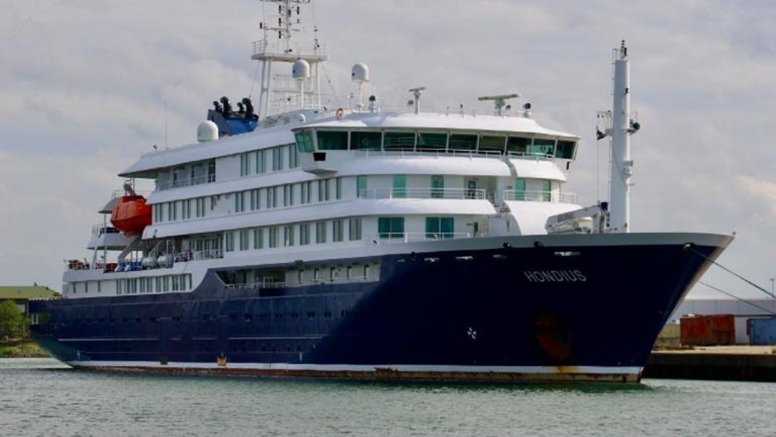
With the Andes hantavirus outbreak unleashed on the cruise ship MV Hondius and which has so far left nine cases (three deceased and six suspected of being infected), many doubts assail the population about its contagion and whether it could be the start of a new pandemic.
Justo Menéndez, a doctor specializing in tropical diseases and travel medicine at the HM Sanchinarro University Hospital, has explained to La Voz and Radio Lanzarote-Onda Cero how this virus acts, its contagion, and other details about this endemic variant in the Southern Cone, meaning in countries like Chile, Argentina, Uruguay, Paraguay, and Antarctica. It is the only one transmissible between humans.
The doctor has explained that hantavirus "is nothing more than a genus of virus that has between 24 and 28 species that can affect humans". In this regard, he pointed out that "there are others that do not affect humans and hantavirus is just one more virus among the many viruses that have been known for a long time".
"What is happening in this outbreak that we are having on board this this cruise ship is that this variant called Andes has produced illness in one or two people who were a couple, but this virus is very poorly transmissible and requires a series of circumstances to be contagious," he continued.
For this reason, he has categorically denied that the docking of the cruise ship in the port of Granadilla de Abona had posed a risk to the population, not only because of its form of contagion, but also because of the sanitary measures for the isolation of the sick.
Main route of contagion
From the first moment, it has been known that hantavirus is transmitted through rodents, specifically the long-tailed mouse found in South America. In the case of Spain and the rest of Europe, it is transmitted through field voles and other rodents.
"Mice expel the virus in their feces, urine and saliva, and it is normal that on the ground where they live these viruses can exist and can last there for up to two months more or less," he detailed. This transmission to humans occurs when small particles are inhaled when they are inhaled when, for example, a person "enters a warehouse, a shed or a pen where there are mouse droppings and breathes it in."
The specialist explains that "this is the usual mechanism of contagion in the south of America" which occurs when cleaning, sweeping a space, a patio, a shed or any place where there are residues of these rodents". However, hantavirus can also be contracted through the bite of an infected rodent.
The doctor recalls that the transmission of hantavirus is not the same as that of Covid. "The contagion of Covid was very easy, it was transmitted rapidly and it is a virus that reproduces a lot in the body and that is eliminated and transmitted easily by air, just like the flu or other respiratory viruses and that have high transmissibility, but in the case of hantavirus it is not because this transmissibility is very low," he said.
On the other hand, it is believed that the couple who became infected did so during an excursion through South America and then boarded the cruise ship, so they could have boarded the ship being asymptomatic. This transmission, indicates Menéndez, "most likely it is an airborne transmission because the virus travels in aerosols, but it can also be by contact with secretions if that person then touches their mouth or nose".
A variant of hantavirus also exists in Europe
The scientific community has known for many years about the Andes variant of hantavirus, which in countries like Argentina, Chile, Brazil, and Bolivia produced between 60 and 80 cases last year. "There are few cases because the transmission mechanism is not very efficient to produce high transmissibility," the expert has emphasized.
Despite the fact that many people may think that hantavirus only exists in South America, the reality is that Europe also has one of the variants of this disease. "There is one specifically in the northern part of Europe in countries like Germany, Belgium, Finland, Russia or Sweden called puumala virus," he explained.
This virus "produces very similar conditions, but in this case the European and Asian variant, instead of producing this typical respiratory condition of the variant of South American species, produces more hemorrhagic fevers and kidney involvement". For years, between 1,500 and 3,000 cases have been detected in Europe.
Another pandemic soon, but it will not be caused by hantavirus
One of the greatest fears of the population is the possibility that hantavirus is the beginning of a new pandemic. However, Justo Menéndez completely dismisses this idea. "This virus is not the one that will produce another pandemic, at all, because there would have to be a mutation or a set of very large mutations of the virus for it to acquire much more transmissibility, but there are many other viruses that can cause a pandemic," he warns.
"I think we are going to have another pandemic not too long from now, but it will probably be due to some variant of the influenza virus, which is a virus that is indeed very transmissible and is a disease that we generally pay little attention to," he continued. In fact, according to data from the National Statistics Institute (INE), in Spain the flu kills an average of more than 1,600 people per year.
Do you usually read us to find out what's happening in Lanzarote? Choose La Voz de Lanzarote as one of your preferred sources on Google
Add La Voz de Lanzarote as a preferred Google source.
Stay informed with the latest current news.