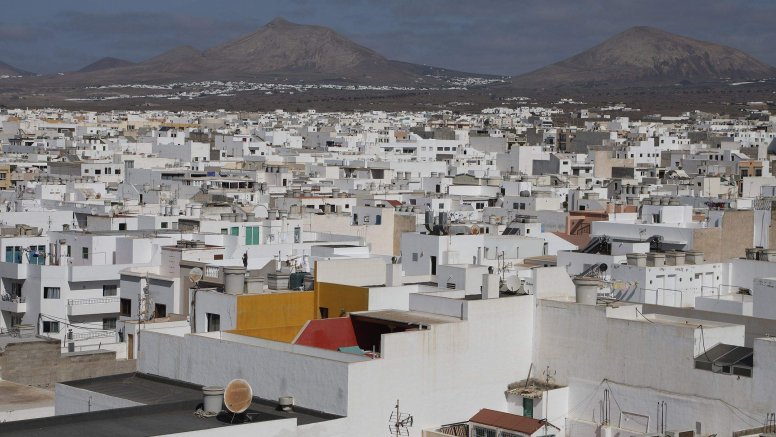
Guillermo Morales Matos, Professor of Geography and expert in studying overpopulation in the Canary Islands, reveals that "if in the Canary Islands we continue to grow at the rate of the last 20 years, in 2050 the panorama may collapse." At this point, in the particular case of Lanzarote, he assures that the population "will continue to increase, but at lower rates than Tenerife or Gran Canaria."
"What worries me is not the population that exists now, which is already out of balance between resources and the population itself, but that it is growing at a rate that is almost Asian and in an archipelagic territory, that is, where there are eight islands and with different rates on each of the islands, so that all eight have a different behavior," says Morales Matos.
In any case, "the islands are all equally fragile, the more population there is, any demographic pressure can do a lot of damage, because the system is seriously affected," he attests. Despite being a worrying situation, he points out that there is no monitoring or control beyond the statistical.
"There are many elements to study and then control. Those that deserve more attention from me as a scholar are the consequences of continuing the frenetic growth of the Canarian population, which are just as powerful in Lanzarote, Gran Canaria or La Graciosa." An example of this uncontrolled demographic increase is reflected in how on islands like La Graciosa, of just over 25 square kilometers, the use of private vehicles has been established, he assures.
The origin of population growth
For this expert it is important to pay attention to the expectations generated by the current population density in the face of the future demographic growth of the Archipelago. Currently, in the Canary Islands fewer boys and girls are born per 1,000 inhabitants than the people who die, which is known as negative vegetative growth. However, the population continues to grow.
"Our growth has come from abroad from various countries," points out the doctor in Geography from the University of Oviedo, an expert in Canarian demography. The professor points out that the arrival of migrants from North Africa who arrive to the islands in pateras, cayucos or inflatable boats "is the most insignificant thing there is" in terms of its effect on population growth. In his case, he does not point to the people who arrived in pateras as the engine of that growth. At the same time, he does consider that migratory movements to the Canary Islands from European and American countries "are structural" and "affect the entire population."
Slowing down population growth
For this expert who works at the Carlos III University of Madrid, the response in the Canary Islands must involve slowing down the rates of growth. "Never stop. I never say go back, I say that we have to slow down, that this growth is sustainable," he adds. "Many people come to live in the Canary Islands attracted by the climate to work in the Archipelago without realizing that there is a structural fact that is unemployment, which is above 20% of the population," he adds. In the case of Lanzarote, unemployment in June 2023 was 12% of the active population, below the Canary Islands average.
Morales Matos points to the arrival of visitors from new issuing countries and assures that they compete with the local population for jobs. "The problem comes with the arrival of visitors from more countries than before, which almost always has to do with the salaried population, who do not come on vacation, but to work and become competitors of the local workforce."
In the field of acting before the possibility of irreversibly damaging the natural environment and with it, life, the professor of Geography reveals that "there is a tendency to contain people who have the intention or the influence to improve this phenomenon in saying that not growing is bad for the economy, for the market and society. I am often labeled as xenophobic," he assures.
"If these rates continue to be maintained, there will be consequences in the short and medium term. Curiously, the only islands that are in a sustained population are the three westernmost (El Hierro, La Gomera and La Palma), where sun and beach tourism has not progressed as much as in the four largest islands."
The pressure of tourism on the population
"Last year we exceeded 16 million tourists and I have heard politicians say that we can continue to grow to 23. It seems barbaric to me because we are betting on quantity tourism and not quality tourism, which does more damage to an island like Lanzarote, which is more precarious than Tenerife or Gran Canaria, where there has been urban and productive development for a long time," he reveals. In this sense, the conejera island received a total of 2.8 million tourists in 2022.
"In the case of Lanzarote it is more worrying, because from the landscape point of view it is the one that has the most to lose if it continues to grow like this."
Likewise, the island is already at 156,000 inhabitants and the professor of Geography "fears" that in "a few years" 200,000 residents will be reached if this growth is not intervened. "I want to see myself in a 2050 scenario without intervening in which the foreign population from any country in the world that wants to come, because in the Canary Islands you live wonderfully, well, come freely and not only come, that can be done without problems, but settle down, become a permanent resident. Then that is the problem because then that is already a double pressure."
The growth of tourism
Lanzarote is the third most visited island in the Canary Islands by tourists. "I remember when I was a young student and they took us to Lanzarote to Timanfaya National Park, at no time was there a queue. What it used to cost me to go see Timanfaya National Park one morning, now I lose approximately two hours in the trip and in the waits," adds the scholar.
Likewise, although the Tourist Centers of Lanzarote are designed to welcome visitors, they suffer increasing pressure. "More and more tourists are arriving," he attributes. He also points out that natural spaces such as El Golfo withstand the tourist pressure of visitors worse. "What I want to say, ladies and gentlemen, is that all these phenomena must be in the cocktail shaker and create preventive measures. If we continue like this, it will not be the first example of an island saturated with tourism. We must be careful with the islands, especially with one as small as Lanzarote, which is already saturated."
However, this professor is not negative in all senses and points out that the improvement in the quality of life in Lanzarote is remarkable. Although he insists on the importance of "being careful with the pressure that our activity, tourism, exerts on our environment."
"I don't want our visitors to become an inconvenience and not only an inconvenience, but also an obstacle to good quality tourism growth," he confesses.
To curb this massive consumption of resources, Morales Matos cites the cases of Malta or Menorca, where entries to the islands are controlled. "You cannot enter by vehicle, you have to use the plane or the boat. In Menorca it was said that they did not want so many people and I don't know how they manage but the island is beautiful and probably because there are only three or four population centers," he exemplifies.
He also points to self-consumption and self-production as measures to encourage local products. "We must encourage potatoes, onions, fruits. In addition to bananas or tomatoes." In this sense, he emphasizes that "our rural environment, for the most part, is being dedicated to residential use in the homes that were dedicated to peasants, to day laborers."
To change the course of things, Matos assures that the goal is to "gradually implement measures, because you cannot suddenly create a law and say these are the measures. We must analyze the phenomenon and intervene progressively," he advises.
"Someone has dedicated the compliment of apocalyptic to me, with someone I mean some politician from Gran Canaria, one of the most affected islands, but we must intervene and we must do it urgently, with a head and without fear. We cannot give future generations a model that is on the verge of disappearing," assures the professor.
Add La Voz de Lanzarote as a preferred Google source.
Stay informed with the latest current news.