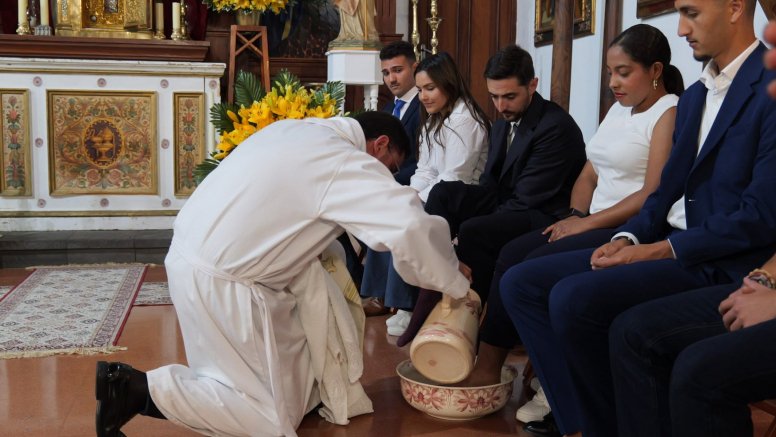
With the celebration of the Holy Thursday acts, the solemn Paschal Triduum begins, the heart of Christian liturgy, in which the mysteries of the Last Supper, the washing of the feet, and the institution of the Eucharist and the priesthood are commemorated, a day also known as the Day of Fraternal Love.
At 7:30 p.m., and with the temple's capacity completely covered, the celebration of the Eucharist began, presided over by the titular parish priest of San Ginés Obispo, Don Juan Carlos Medina. The ceremony, marked by deep contemplation and participation, featured the musical accompaniment of the Parish Choir, directed by Professor Héctor Araya Alarcón, whose voices were enriched by the active participation of the parishioners, who joined in unison in each of the programmed liturgical hymns.
The Liturgy of the Word unfolded with the proclamation of the first reading, taken from the book of Exodus; the second, from the First letter of the apostle Saint Paul to the Corinthians: and the Holy Gospel according to Saint John. in the homily, the parish priest focused his reflection on the profound meaning of the Last Supper, a moment in which Jesus shares the bread and wine with his apostles, thus instituting the Eucharist, while performing the gesture of the washing of the feet as a symbol of humility, dedication, and service to one's neighbor.
After the homily, one of the most significant moments of the celebration took place; the washing of the feet, which the parish priest carried out with twelve young people, among boys and girls from the parish community. The gesture, laden with symbolism, culminated in an emotional embrace between the participants and the celebrant, a reflection of the spirit of fraternity that characterizes this day.
The celebration continued with the Eucharistic liturgy, in which the bread and wine were consecrated, subsequently distributed among the faithful present. Next, the procession of the Blessed Sacrament under a canopy took place inside the church, led by the acolytes, followed by the bearers and, under it, the celebrating priest carrying the ciborium with the consecrated hosts. The procession culminated in the Eucharistic Monument, an altar specially arranged and adorned for the reservation of the Blessed Sacrament in the tabernacle.
Once the procession concluded, parishioners slowly and silently left the temple, maintaining the atmosphere of recollection characteristic of the day. However, many of them later returned to participate in the Holy Hour, a space of prayer and contemplation that invites believers to deepen their intimacy with God and to reflect on the immense love of Jesus Christ, manifested in the institution of the Eucharist and in the beginning of His Passion.
In this way, the parish community lived intensely one of the most significant celebrations of the liturgical calendar, marked by faith, participation, and the spirit of fraternal communion.
Add La Voz de Lanzarote as a preferred Google source.
Stay informed with the latest current news.