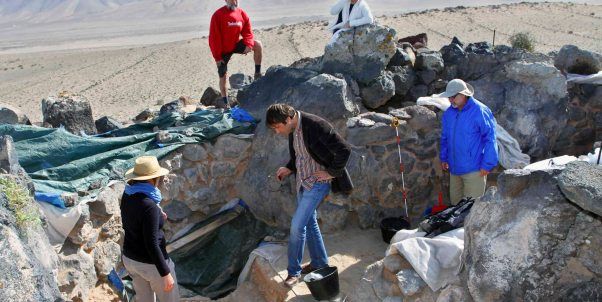
The past of Lanzarote has come to light again in a new archaeological site in Fiquinineo. It is one of the most emblematic sites of Lanzarote and representative of the Lanzarote culture of El Jable. The remains of the past found in this excavation date from the aboriginal era of the Majos, from the year 100 before the current era to the 17th century. The site is located in the central part of El Jable de Arriba, in the municipality of Teguise, an area also known as Peña de las Cucharas.
The Cabildo intends to enhance this site from next year and give it a use so that it can be visited by the resident and tourist population, as well as by researchers, teachers, students and schoolchildren, among others. To this end, it has received various subsidies from the Ministry of the Environment and the Government of the Canary Islands to enable a path, which will start from the town of Soo and, as it passes through the Fiquinineo site, will reach the town of Teguise.
In this way, the old road will be recovered. The project has an allocation of funds from the Cabildo of about 15,000 euros, to which would be added the amounts contributed by the Ministry and the Government of the Canary Islands to enable this interpretive trail. According to the Heritage Councilor, Juan Antonio de la Hoz, this excavation will make it possible to publicize "the island's past through the town found in this site in which they were living from Majos, Moors, Portuguese to Castilians."
Application for subsidies to continue the campaign
In recent days, the team of researchers and specialists led by Efraim Marrero Salas and Ithaisa Abreu Hernández began the sixth archaeological campaign at this site. This campaign is financed with funds from the Cabildo, through the Historical Heritage Service.
The total duration of the work being carried out at this site is three weeks. The team of specialists and archaeologists hopes that the next campaigns necessary to continue the work will be financed with European funds and the Government of the Canary Islands, for which different subsidy applications have already been processed. The Teguise City Council, for its part, has also collaborated in previous campaigns carried out at this site, owned by the Cabildo de Lanzarote.
The president of the Cabildo, Pedro San Ginés, accompanied by the Councilor for Historical Heritage of the Corporation, Juan Antonio de la Hoz, and the head of the Heritage Service, María Antonia Perera, visited the site to learn first-hand from the management and work team about the development of this present campaign and the new findings found, the results of which will be announced soon, once the investigations are completed.
The site
The Cabildo has explained through a statement that this site has a "long period of use and exploitation over at least 17 centuries" and is an excavation of "reference of this particular ecosystem of Lanzarote." "In addition to being configured as a fertile soil from an agronomic point of view, it preserves a unique imprint due to the character of its soil and becomes a central axis to understand the occupation of the Moorish culture of Lanzarote, once the Norman conquest of the island and its submission to the Crown of Castile is completed", according to the Cabildo.
The current campaign that is being developed these days focuses on the northern area of the interior of the architectural structures that are located on the same rock and that have been the subject of investigation in the last campaigns that have been carried out in this enclave of the municipality of Teguise. The wall structures found respond to a residential functionality and were the subject of extensive restoration in the past campaign developed in 2012.
The objectives for this year are focused on the conservation of the aforementioned northern phase and the occupation floor strictly belonging to the aboriginal period has begun to be excavated.
Recovered objects
From the previous campaigns, the Cabildo highlights the recovery of a grain of barley subjected to fire that served to obtain an absolute chronology of the 17th century. Specifically from 1650, this level in which the seed was collected being contemporary, with the soil in which a ceramic container and import vessel was located, made on a lathe in the Seville potteries. This piece has its glazed interior and was intended for storage and transport of liquids (oil or wine).
Likewise, a set of pieces has been exhumed, among which stands out a dagger hilt, made of bone provided with a decoration with circular motifs; four fragments of a metal sword; a thimble, Portuguese coins, various decorative and ornamental objects made of different materials, such as gold, silver, jet, coral or turquoise. Also noteworthy is a lamp dated in the 17th century, similar to another piece excavated in the Cueva Pintada, in Gáldar, Gran Canaria.
With respect to the material belonging to the aboriginal culture, the presence of a punch made with a bone piece of goat that preserves part of its collagen stands out, and from which a chronology could be obtained, yielding the date of 1290. In addition, various pieces made of chalcedony stone have been excavated. Of these, the presence of the entire manufacturing operating chain also stands out, since fully finished pieces have already been excavated, others that have a complete polishing phase, or the raw material is found without being subjected to any manipulation.
The work team led by Efraim Marrero Salas and Ithaisa Abreu Hernandez is made up of several specialists. José de León Hernández is in charge of the territorial study of the jable from a vision of global understanding of this ecosystem; Moisés Tejera Tejera, in addition to the strictly archaeological research work, is responsible for the ethnoarchaeological nature; Gabriel Monzón Batista, a restoration specialist, is in charge of the work aimed at the maintenance and conservation of the stone architectural structures that occupy, for now, the central part of the rock and that have not been fully excavated.
Add La Voz de Lanzarote as a preferred Google source.
Stay informed with the latest current news.