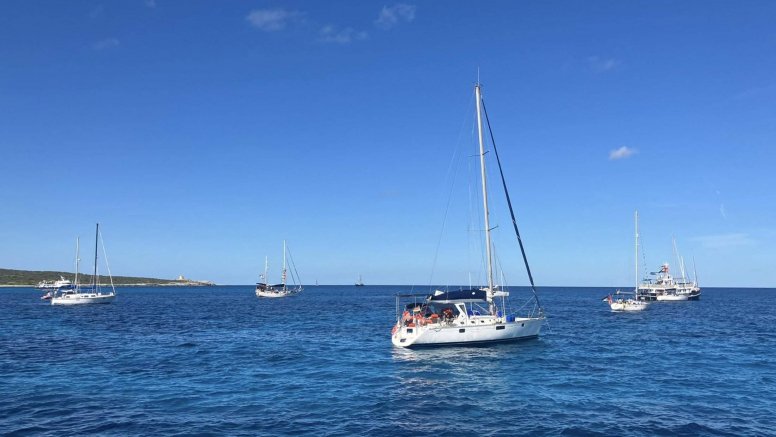
Activist Goretti Sarasibar, a resident of Lanzarote, set sail for Gaza on September 6 to deliver humanitarian aid to the Palestinians who are suffering from Israeli bombings. In an interview with La Voz, the activist says that she decided to join the flotilla because she has been following the conflict in Palestine for years and "we were reaching a limit in which, if no one did anything, they are going to exterminate the Palestinian people."
"We have spent many years mourning the Jewish holocaust, and what we cannot do now is watch another genocide on television and do absolutely nothing," she continues. The activist was selected from among 30,000 people to be part of the flotilla, which suggests it was because of "her experience in the maritime environment."
The massacre in Gaza has already claimed the lives of more than 67,000 people and 10,000 have disappeared since October 2023. These deaths are not only due to the bombings that the area is suffering at the hands of Israel, but are also caused by starvation due to the lack of food and drinking water. Added to this is the closure of humanitarian corridors motivated by the Hebrew country.
Sarasibar says that they could only get within 42 miles of the Gazan coast, at which point the Israeli army approached the flotilla. Among the resources they were carrying were medicines and powdered milk for children. "What was on my boat was rice, semolina, oats, legumes, and some canned goods, non-perishable food in general," he says.
After approaching within 40 miles of the coast, the night before the day the first ships of the flotilla were supposed to arrive in Gaza, they warned that the radars were detecting large ships, between ten and twelve.
"When they got a little closer, they tried to contact them and have them identify themselves, but they didn't respond, so we imagined it was the army," he says. "We knew they weren't going to let us get there, they had already warned us, and the night before a couple of large warships came and were approaching us quickly, which caused waves... they did it to scare us," he continues. In addition, he recalls that they saw a submarine because the water was illuminated from below.
### ### Israeli Army Assault on the Flotilla
After that, the Israeli army began raiding some vessels until it was the turn of the one on which Goretti Sarasibar was traveling. "Some of the Israeli ships had water cannons and we saw how they began to shoot water at the sailboats in the distance, so we protected ourselves with a canvas and took out the waterproof clothing so as not to get wet and not be in damp clothes all night," she says.
Amid megaphone announcements warning them that they were entering illegally and to stop the engine, the ship's crew were eventually forced to raise their arms as blinding spotlights were shone on them, although the Israeli military did not board the ship at that time. They did so later.
"They told us that they were going to assault the ship, that we should all go to the bow with our hands up, and we stayed there waiting until they entered. They searched us, frisked everyone, and put us on the deck. They took command of the ship and we went to the port in Israel," he explains.
During the journey to Israeli lands, Sarasibar points out that the soldiers were "almost cordial, considering they were heavily armed and hooded."
However, the treatment did worsen upon arrival at the port in Israel. "They shoved me off the boat and other kids were taken off very badly, I even think one person's arm was broken," she says. During their stay at the port, she and her companions were forced to lie on the ground in a prayer position without raising their heads.
Initially, he states that they were exposed to the sun for more than an hour and "they took our clothes off and stole my fanny pack, they didn't want to give it back to me with everything that was inside."
```html
Treatment by the military
```
Upon being registered and searched, she assures that the attitude of the military personnel was humiliating and very rude. "I tried to grab my lip balm because my lips were destroyed from being in the sun so much, and the female soldier wouldn't let me, saying it was makeup. I argued with her, and in the end, they didn't let me use it," she recounts.
"The Israeli soldiers were trying to humiliate you all the time, and if they could screw you over in some way, they would," he continues.
After being identified and going through the bureaucratic process, they were transferred to a prison where they were questioned. "They asked me why I had entered Israel illegally, and I told them that I was in international waters carrying out humanitarian aid work, that my ship had been attacked, and that they had brought me to Israel without my consent," he says.
"They put us in very narrow cells with two or three people, that was the most overwhelming thing, and they would turn off the air conditioning during the day with the lights off, and when night came, they would turn the lights on and blast the air conditioning," he says.
In this sense, he assures that "there was mistreatment, especially many threats and intimidation... On many occasions we were sleeping and they would come several times at night, open the cell door making a lot of noise, wake you up, and do a headcount," he emphasizes.
Also, "they refused to give medication to people who had cardiac pathologies or, for example, to a woman who had asthma, and her colleagues said that they thought she was dying until she stood at the window and they saw that she couldn't breathe, that's when they gave her the nebulizer."
During the statement, the Israeli army told him that the humanitarian aid could be given to them to distribute. "I told them that, considering we had to go because they weren't allowing anything into the country, it would be inconsistent to give it to them because they weren't going to distribute it," he says.
Furthermore, she claims that the police even asked her if she spoke Arabic, to which the activist replied no. "They told me they didn't understand why I wanted to go to Gaza if I didn't speak Arabic," she recalls. She also emphasizes that many Israelis think that "we deny the Nazi Holocaust." "People are brainwashed, no one denies the Holocaust except Nazi-sympathizing groups... they have an amazing persecution complex," she points out.
Vuelta a España
After being detained in Israel for four days, the army gave Goretti the option to sign the direct deportation order, which she accepted due to the need to return to Spain for personal matters.
"I signed, but I wrote on the paper that I had been assaulted in international waters while carrying out peaceful humanitarian work and that I had not asked at any time to go to Israel, they had taken me against my will, that the assault violated international maritime law that establishes free transit for internationals, and that I did not recognize any crime," she clarifies.
Add La Voz de Lanzarote as a preferred Google source.
Stay informed with the latest current news.