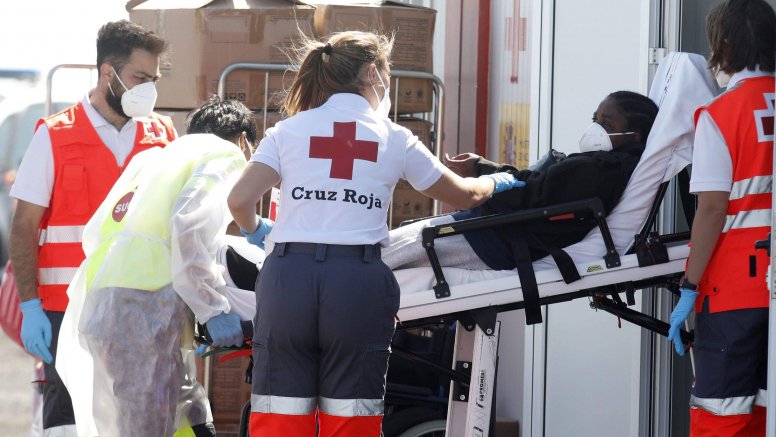
The Canary Islands have received half the number of immigrants who arrived on their coasts in the same period of 2022 in the first four months of the year. However, the changes that have occurred in the Atlantic Route have concentrated the flows on one island, Lanzarote, which is already in higher figures than a year ago, despite the general decreasing trend of arrivals.
According to the count as of April 30 published this Wednesday by the Ministry of the Interior, so far this year, 3,211 immigrants have been rescued in the Canary Islands in 73 boats, 51.52% less than in the first four months of the previous year.
The Interior Ministry does not provide figures broken down by islands, so there is no "official" data for each of them, but the Red Cross, which assists immigrants in all landings, does its own detailed monitoring of the evolution of the Canary Route and this reveals that Lanzarote already represents 50.55% of the landings.
According to Red Cross data accessed by EFE, which usually has a discrepancy of a few dozen with those of the Interior Ministry, Lanzarote has received 1,729 immigrants since January 1, 219 more than in the same period of 2022, which means that flows have grown by 14.50% towards the coasts of Lanzarote.
On some occasions, with up to five boats rescued in a single day, "something that has caused tensions in its first reception network," according to Efe. In this sense, it recalls that last year several dozen people slept outdoors on the Arrecife dock after getting off a Maritime Rescue boat, waiting to be assigned a place to stay. This scene was repeated last week in Fuerteventura due to the lack of transport to divert the new arrivals. Likewise, the arrivals to the island have also been made visible in changes in the port of disembarkation to redirect rescues to Fuerteventura, for logistical reasons.
In turn, Fuerteventura has received 762 immigrants in the first four months, 22.50 percent of the total. The sum of the traffic of both islands reveals that at this time three out of four rescues are made in the maritime strip of the Canary Islands closest to Africa, in the space between Lanzarote and Tarfaya (south of Morocco) and Fuerteventura and El Aaiún (north of the Sahara), in journeys of just over 100 kilometers that in most cases are carried out by inflatable boats.
In contrast, Gran Canaria, which was the main recipient during the first years of reactivation of the Canary Route, now represents only 23.47% of the rescues, with 803 people from January to April.
The Red Cross statistics are completed by Tenerife, with 76 people rescued (2.22%), and El Hierro, with nine (0.26%).
The data from these last two islands are consistent with another trend that has been consolidated for months on the Canary Route: long-distance expeditions in canoes from southern Mauritania or Senegal have almost disappeared, which usually headed for Tenerife (on the most direct route for departures so far south) or ended up in El Hierro if they deviated to the west.
Add La Voz de Lanzarote as a preferred Google source.
Stay informed with the latest current news.