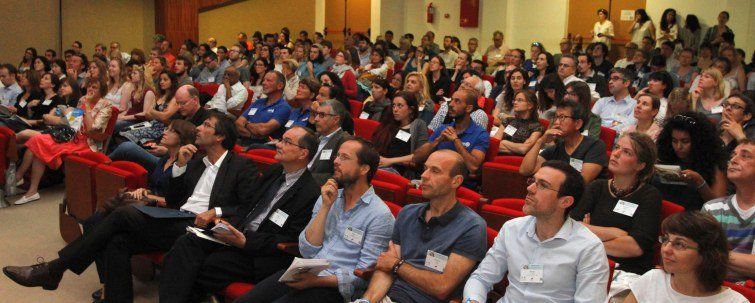
Nearly 300 people, of whom more than 250 represent the scientific and research community, are meeting at the International Congress on Microplastics, which is being held at the Cabildo of Lanzarote from this Wednesday until Friday, the 27th. This has been considered "the first international conference to be held on microplastics in marine ecosystems and the open sea," explains the Cabildo.
This series of conferences, whose official language is English, was inaugurated this Wednesday by the President of the Cabildo of Lanzarote, Pedro San Ginés, and the Mayor of Arrecife, Eva de Anta, who were also accompanied by the Head of the MaB Program section of UNESCO, Miguel Clüsener-Godt; and the coordinator of the Scientific Committee of Micro2016, Juan Baztán.
The President of the Cabildo of Lanzarote thanked all those present for their attendance and congratulated the network of researchers from Marine Sciences For Society and all the staff of the Lanzarote Biosphere Reserve Office (mainly the management and training staff who are finishing their grant these days), for the organization of this International Congress, which is being held until next Friday with the collaboration of UNESCO, the Spanish Agency for International Development Cooperation, the European Commission and more than 25 Universities and research centers from around the world.
San Ginés also wanted to acknowledge the work carried out by the Scientific Committee that has been part of this international symposium, made up of 47 members belonging to 30 different scientific organizations and the 632 researchers who have participated and contributed with nearly 200 papers, presentations and communications on this topic.
A 'Lanzarote Declaration' as a commitment from the scientific community
Pedro San Ginés hopes that as a result of the Congress, an international commitment will be obtained with the 'Lanzarote Declaration', "a scientific and social diagnosis that commits the scientific community and identifies possible solutions to this global problem in which the Cabildo of Lanzarote has been working for some time through its Biosphere Reserve and the 'Zero Plastic' campaign."
This scientific Congress is part of the actions of the Lanzarote 2020 Strategy that coordinates the action of the Island Government, and is developed within the project and fight against plastic carried out by the Biosphere Reserve Office through its 'Zero Plastic' campaign to disseminate and raise awareness of this problem, the correct treatment of this highly polluting waste and its impact on the environment.
"For the Cabildo of Lanzarote, it is a privilege to host the celebration of this international event, not only for the projection that a scientific Congress of these characteristics will have for the island, but it will also be an opportunity for the Biosphere Reserve of Lanzarote, and others in the Canary Islands, to share knowledge and studies carried out by the main universities and the international scientific community, in order to identify the new reality about this global problem and develop protocols and institutional commitments to implement possible solutions in this regard," said the President of the Cabildo during the opening ceremony of this Congress.
For three days, these conferences will address the processes of weathering and fragmentation of plastics into microplastics; the origin and distribution of microplastics in freshwater areas, coastal areas and the open ocean; the impacts of microplastics on marine life; biological and chemical pollutants; and - among others - the socioeconomic impacts of microplastics. The concepts of dissemination, education and awareness will also be addressed, as well as the importance of communication as one of the solutions to reduce the use of this material in daily habits and give them correct treatment as highly polluting waste.
Parallel actions
Within the program of the Congress, which has been divided into 13 working sessions spread over the three days of celebration, three parallel actions have been organized, including an event open to the entire population of Lanzarote and La Graciosa with the representation in Spanish of the play 'Turtle and the Sea'. A 50-minute production by the company Losotroh and the Society for the Study of Cetaceans in the Canary Archipelago (SECAC), aimed at all audiences, which will be staged this Wednesday, May 25, at 9:00 p.m., at the El Salinero Theater (Arrecife), under the script, original idea and direction of Salvador Leal.
Two other workshops have also been organized, aimed at the scientific community and congress participants on education and research and society. One of these workshops, also open to the interested public, will be given by the specialist in the marine environment and technician of the 'Zero Plastic Lanzarote' campaign, Rafael Mesa.
Among other actions, students from primary and secondary schools on the island are also invited to participate in the conferences, workshops and the exhibition of 82 posters with the communications and presentations emanating from this International Congress.
The problem of plastic
Today, plastic is involved in almost all our actions and its production has increased significantly in recent decades. Plastic is used for almost everything due to its great versatility, it is light, durable and above all cheap.
These same qualities cause it to travel through the seas and oceans, if we do not handle it carefully. The consequence is that plastic is becoming a growing and unsustainable problem due to its cheap production, its toxic potential and its universal presence. Plastics are persistent materials that tend to accumulate in the marine environment from the coasts to the open sea.
Microplastics (MPs) are defined as plastic particles of less than 5mm and come from two sources: the primary one that includes industrial abrasives, exfoliants, cosmetics and pre-production plastics and secondary ones that are produced by the fragmentation of plastic.
Microplastics can contain additives such as UV stabilizers, colorants, flame retardants, plasticizers that are transported and are likely to be assimilated by living organisms.
These plastics can accumulate persistent organic pollutants (POPs) from the environment and facilitate their transfer to the marine food chain. They can also be a vector of invasive species and harmful pathogens.
Although the impact of microplastics on marine ecosystems has been discussed since the 1970s, many questions remain to be answered.
MICRO 2016 in Lanzarote is an opportunity to share knowledge, identify new questions and research and development needs to implement solutions.
Organizers and Collaborators
UNESCO, through the Man and Biosphere Program (MaB); the Observatory of the University of Versailles; University of Plymouth; the CNRS; the University of Las Palmas; the Higher Council for Scientific Research (CSIC); IFREMER; the University of Moncton; University of Cádiz; Institute for Agriculture and Fisheries Research; National Institute of Chemistry; the Free University of Brussels; the Alfred Wegener Institute; the University of Maine; the Federal University of Pernambuco; University of Siena; the Foundation for Science and Industrial Research; the National Ocean and Atmosphere; the UNESCO Oceanographic Commission and the European Commission, among others, collaborate with the Cabildo of Lanzarote and the network of researchers Marine Sciences For Society in the organization of 'Micro 2016'.
Add La Voz de Lanzarote as a preferred Google source.
Stay informed with the latest current news.