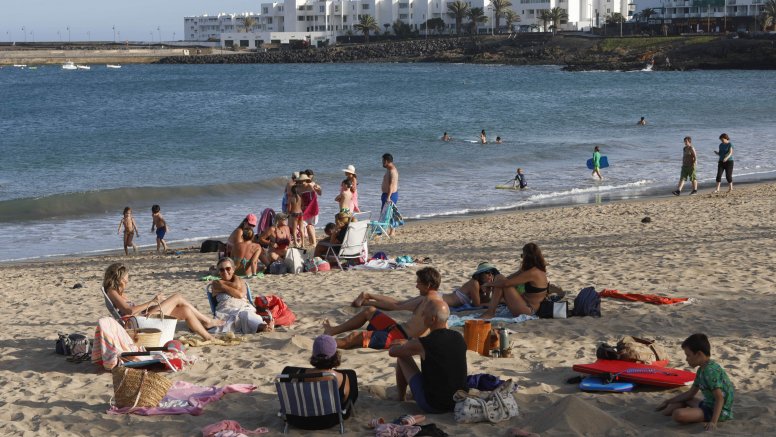
The Ministry of Health of the Government of the Canary Islands, through the General Directorate of Public Health of the Canarian Health Service (SCS), coordinates the Plan of Preventive Actions against Ultraviolet Radiation in Health, which establishes a series of recommendations to reduce the health effects on people associated with ultraviolet (UV) radiation according to the different levels established in this Plan.
In accordance with this Plan, the General Directorate of Public Health reports that, according to data provided by the State Meteorological Agency, and the indicators established by this Plan, currently the risk due to ultraviolet radiation in the Canary Islands is very high on all islands and extreme in Fuerteventura, Lanzarote and Gran Canaria, with the exception of the municipalities of Arrecife, in Lanzarote, and La Aldea de San Nicolás, Agaete and Gáldar, in Gran Canaria, which are at very high risk.
Public Health reminds that protecting oneself from the sun is a responsibility that must be maintained not only in summer, but throughout the year, even on cloudy days. When the health risk due to exposure to solar radiation reaches this threshold (very high and extreme), it is advisable to emphasize the daily use of sun protection (SPF 50 or more), stay in shaded areas during the central hours of the day, wear wide-brimmed hats and clothing that covers arms and legs, use appropriate sunglasses and protect oneself from the sun, both adults and minors.
Furthermore, the technicians of the General Directorate of Public Health insist that sun damage is cumulative and that excessive exposure and sunburns in childhood increase the risk of some types of skin cancer many years, or even decades later. Likewise, it must be remembered that, on cloudy days, solar rays filter equally through the clouds, although the sensation of heat may be lower, which also happens when there is a breeze.
Canary Islands is the region of Spain with the highest level of UV radiation throughout the year, according to data provided by the State Meteorological Agency (AEMET). UV radiation is a form of radiation emitted by the sun and by artificial sources, such as tanning beds, and which is part of the non-visible spectrum of sunlight.
Risk levels
The Preventive Action Plan against Ultraviolet Radiation establishes five risk levels (low, moderate, high, very high, and extreme) to which a series of protection recommendations for citizens are associated according to the health risks that each of the levels entails.
On a weekly basis, the Directorate General of Public Health of the SCS publishes a map of the archipelago with the risk level according to the indicators established by AEMET.
Risks of UV radiation
The acute effects of UV radiation can be varied: damage to DNA, sunburn, phototoxic and photoallergic reactions, and immunosuppression, which can be considered a risk factor for cancer and lead to the reactivation of viruses, such as the cold sore virus.
Overexposure to UV radiation can also cause serious health problems, including skin cancer: the best known and most serious being melanoma, basal cell carcinoma, and squamous cell carcinoma. Furthermore, exposure to UV radiation increases the risk of various eye conditions such as conjunctivitis or cataracts, if adequate eye protection is not used.
Radiation affects all people, but the risks increase for the population that:
• Is exposed to the sun for many hours a day (either for work or leisure) or has had repeated episodes of sunburn throughout their lives.
• Has light skin, hair, and eyes.
• Takes certain oral and topical medications, such as antibiotics, birth control pills, or products containing benzoyl peroxide; similarly, some cosmetics could increase the sensitivity of the skin and eyes to UV radiation in all skin types.
• Has a family member with skin cancer.
• Is over fifty years old.
How to protect yourself from UV radiation in case of high risk
The Directorate General of Public Health therefore recalls the main recommendations for adequate protection from UV radiation given the current very high and extreme level in the Canary Islands:
- Preferably stay in the shade, especially during the hours around noon, between 11:00 AM and 5:00 PM.
- Wear clothing that covers arms and legs.
- Never expose infants under one year of age directly to the sun, as their skin is very vulnerable and they cannot use photoprotective creams.
- Wear a cap or a wide-brimmed hat that covers the face, head, ears, and neck.
- Use approved sunglasses that block both UVA and UVB rays.
- Use sunscreen with a sun protection factor (SPF) of 50 or higher that protects against both UVA and UVB rays. It is important to remember that sunscreens have an expiration date.
For more information on ultraviolet radiation in Spain, you can consult this link: https://bit.ly/AEMET-radiacion.
Add La Voz de Lanzarote as a preferred Google source.
Stay informed with the latest current news.