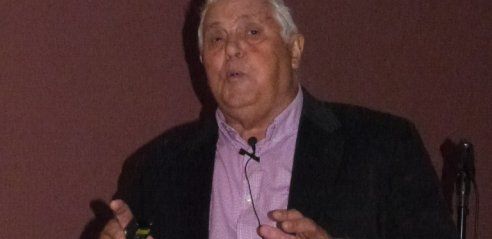
"Personal sketch of Don José María Gil Santana." That is the title of the lecture given by José Ferrer Perdomo, a full member of the Academy of Sciences, Engineering and Humanities of Lanzarote, last Wednesday in the assembly hall of the Tanit Museum in San Bartolomé. Ferrer explained a part unknown to many until now, since everyone who knew him only associated him with the Ajei Folk Group. In great detail, the speaker commented at the same time that he showed on a large screen dates and more personal data of Don José María Gil.
Born on June 8, 1887 in the city of Gáldar, in Gran Canaria, his father was a sailor, globetrotter and cambullonero, a tireless worker who struggled to get the family ahead. In the year 1896, his older brother Antonio is appointed coadjutor of the church of Guadalupe in Teguise and Don José María also comes with him to Lanzarote, with only 9 years. Thirteen years later, while his brother the priest was officiating mass in Haría, the devastating fire occurred that destroyed, according to historians, the most beautiful church in the Canary Islands, which reopened for worship in 1915, when Don José María Gil was 14 years old.
The Gran Canarian returned to Galdar again due to an illness. A lump on his back caused him strong, constant pain and for which he could not find any solution here in Lanzarote. Although he had been assured that in Gran Canaria he would have more possibilities to heal, Gil got worse and 4 years later, when he was barely of age, he became paralyzed from the waist down, in addition to being hunched over. However, with his great willpower and the help of his family, they visited everyone who could relieve him, until in one of so many visits they advised him to buy a kilo of beef marrow and boil it. Once boiled, he had to leave it. It was then converted into a kind of cream with which he had to spread himself so that the pain would disappear.
From that moment on, a new life begins for him. His concern leads him to become interested in the trades of esterero, tinsmith, silversmith, watchmaker, also learning solfeggio and so on. He also had great interest in learning to play the violin, an instrument that would end up accompanying him throughout his life, forming a small musical formation and thus earning a few coins playing in the famous ballroom dances of that time. It was precisely like this that Gil Santana met his wife, a young woman from the town of Guatiza, María Cejudo, whom he married and had five children.
Then he rented a place on Fajardo Street in Arrecife, to work as a watchmaker, and also traveled to Barcelona to obtain his driver's license. In 1936 he was appointed mayor of San Bartolomé and, as in those years a mayor not only did not earn anything, but, on the contrary, the position could cost him a few pesetas, after three years he asked to be dismissed.
Among other achievements, the former mayor, together with the parish priest Don Víctor San Martín, initiates the first contacts to buy the land and years later build the Sociedad El Porvenir de San Bartolomé and was also president of the Sociedad Democracia in Arrecife. In 1953, his eldest son, Juan Gil Cejudo, finishes his career as a doctor and the whole family moves to Mancha Blanca to give thanks to the Virgen de Los Dolores, something very common in those times.
Although many only associate him with the Ajei Folk Group, Don José María Gil Santana, very skilled and willing to lend himself to all kinds of initiatives, never had time to get bored. He died in San Bartolomé in 1981 at the age of 93 and both San Bartolomé and Gáldar dedicated a street to his name. Once the conference was over, Tito Perera, the director of the Guadarfia Group who learned to play the mandolin with Don Jose María, surprised José Ferrer Perdomo by appearing in the hall with some playing and singing friends, giving him several Canarian songs.
Add La Voz de Lanzarote as a preferred Google source.
Stay informed with the latest current news.