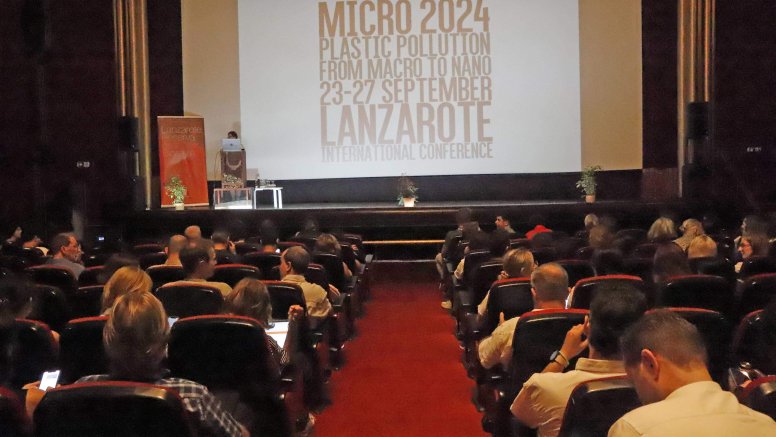
From the early hours of last Monday morning, the lobby of the Multicines Atlántida del Charco de San Ginés was a hive of people installing supports to hang scientific posters, placing accreditations, loading lecterns, or claiming glass pitchers... On the outside staircase, a huge map of the area already showed the establishments adhering to MICRO 2024 in their desire to remove single-use plastics and dispense tap water to anyone who requests it. And in front, the Voices of the Territory room was putting the finishing touches to exhibit and call for action on plastic spills and citizen initiatives on the island for their eradication.
Lanzarote will be a nerve center for scientific discussion throughout the week on the impacts and responsibilities of the massive presence of this material in the environment, in its macro, micro, and nano sizes. This is a "pioneering" concern, as contacts between the Marine Sciences For Society organization and the island's administrations regarding microplastic pollution began as early as Christmas 2008-2009.
That meeting marked the beginning of a long journey of sampling and the subsequent celebration of the MICRO 2014 workshop (Plouzané-France), the seed of the first edition of the international conference MICRO 2016 in Lanzarote, which has been followed by four more until the present.
As Bethany Jorgensen, a member of the MICRO Scientific Committee and Marine Sciences For Society, pointed out in her welcoming remarks, the objective of this international meeting is to facilitate free access to extensive emerging research; identify frontiers and challenges in the fight against plastic waste; and contribute with a collaborative effort to respond to the challenge of its elimination from planetary ecosystems.
"As a result of the increase in the amount of plastics accumulated in the environment, we have an obligation to share studies and expand our research horizons. For that we need collaboration and cooperation, at all scales, from local to global, and between all sectors and disciplines, to improve knowledge, education, and awareness. These processes should not delay action," she said.
For his part, the Councilor of the Biosphere Reserve of Lanzarote, Samuel Martín, an area that co-organizes the conference, thanked the thousand participants, "the world's leading researchers in plastic pollution, for sharing their theses and conclusions about this material so harmful to human and environmental health: Their work paves the way for a paradigm shift towards more sustainable behaviors with the territory." He also invited them to get to know the island during their stay in Lanzarote.
One of the promoters of the Voices of the Territory room, which accompanies and illustrates scientific reflection on plastic pollution, Gara Goñi, informed those gathered in the theater room about the purpose and actions contained in the exhibition, "which has been created not only to inform, but also to awaken an emotional response and an active commitment. Every detail has been conceived to amplify the cry of those who, day after day, face environmental challenges on the island." And she added: "We want you to know some of the formulas used by the local community to address this very serious problem. A space dedicated to illustrating the fragility of our island environment in the face of a global problem and the initiatives to counteract it."
Add La Voz de Lanzarote as a preferred Google source.
Stay informed with the latest current news.