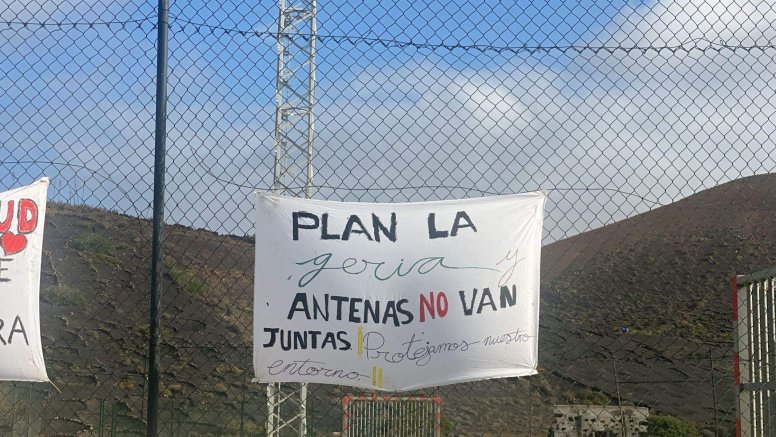
Ecologistas en Acción and Ben Magec have publicly denounced the installation of telecommunications antennas in sensitive areas of Lanzarote and Fuerteventura, without precautionary measures being taken or guaranteeing the participation of affected citizens.
Specifically, they point to the cases of Masdache, in Lanzarote, and Antigua, in Fuerteventura, where, they say, action has been taken without any caution or real evaluation of the possible impacts on health and the environment. The organizations criticize the defenselessness of the residents, who have not been properly informed or consulted.
Legislation based on questioned criteria
The ecologists recall that Spanish legislation on exposure to electromagnetic fields is based on the limits proposed by the so-called International Commission on Non-Ionizing Radiation Protection (ICNIRP), a private entity that advises the WHO. However, this organization has been questioned for its closeness to the interests of the technology industry, its limited focus on the study of acute thermal effects, and for ignoring the long-term biological effects that have been documented in numerous scientific studies.
In fact, various scientific institutions and experts in bioelectromagnetism —authors of more than 2,000 publications in this field— have publicly criticized the lack of rigor of the ICNIRP. In 2011, the Council of Europe itself recommended reducing exposure levels to radio frequencies up to a thousand times below current levels, with the aim of also considering non-thermal effects.
Health effects: growing scientific evidence
A comprehensive review of the scientific literature published in 2022 on the effects of base station antennas concluded that nearly 75% of studies detect negative impacts on human health. Among the symptoms observed are those associated with the so-called “radio frequency sickness”: headaches, sleep disturbances, irritability, memory loss, fatigue, nausea, or difficulty concentrating.
In addition, alterations in biochemical parameters —such as increased glycosylated hemoglobin, related to diabetes— and changes in the levels of free radicals and antioxidants have been detected, with implications in the appearance of certain types of cancer. Despite this, they denounce that diseases linked to electromagnetic exposure continue to be undervalued, misdiagnosed, and excluded from healthcare.
The role of the CCARS and the lack of an independent commission
Ecologistas en Acción, through its group in Lanzarote, denounces that, despite being required by law for more than 11 years, a Commission on Radio Frequencies and Health has not yet been established to guarantee ethical criteria of independence, transparency, and participation.
Instead, institutional decisions are de facto based on the recommendations of the Scientific Advisory Committee on Radio Frequencies and Health (CCARS), linked to the Official College of Telecommunications Engineers and with evident conflicts of interest due to its relationship with large technology companies. According to the report presented by Ecologistas en Acción to the Ministry of Health in 2024, the CCARS responds to a model of action identified by the European Environment Agency (EEA) as a “business strategy to delay the application of the Precautionary Principle.”
The conclusions of the CCARS have been questioned for their lack of scientific rigor and their systematic denial of the risks documented in the scientific literature. This has allowed —according to their denunciation— the massive deployment of 5G networks without attending to the legal guarantees of public health protection included in the General Telecommunications Law itself.
Claims to the Ministry of Health and the Ombudsman
In 2024, Ecologistas en Acción sent a report to the Ministry of Health where it analyzes and concludes that the CCARS of the College of Telecommunications clearly falls within this model of business action identified by the EEA, to delay/avoid the application of the Precautionary Principle in the face of early warnings of emerging problems. The conclusions of the CCARS reports, questioned for poor scientific practice and 'denial' of the abundant scientific literature, have enabled successive deployments, especially of 5G technology, without attending to the legal health guarantees contemplated in the telecommunications law itself. The two environmental groups recall the requests made by Ecologistas en Acción to the Ministry of Health in 2024 and 2025 (recusal of one of its representatives in the coordination of the Strategic Health and Environment Plan due to conflict of interest, initiating the process of creating the legally contemplated Commission on Radio Frequencies and Health, applying the precautionary recommendations on radio frequencies from European institutions and scientific societies, as well as attending to the recommendations on the use of screens in childhood and adolescence from the Spanish Association of Pediatrics) and the new complaint sent to the current Ombudsman in May 2025 for the non-constitution of the Commission on Radio Frequencies and Health legally contemplated and questioning its positioning with the CCARS of the College of Telecommunications.
Add La Voz de Lanzarote as a preferred Google source.
Stay informed with the latest current news.