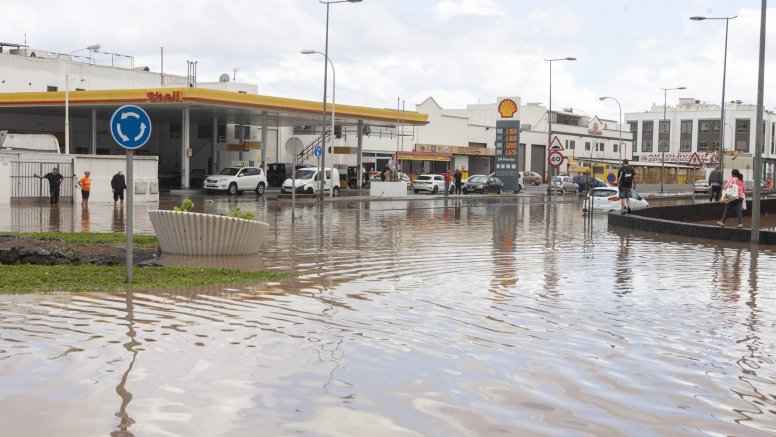
Lanzarote became national news due to the floods that affected two municipalities on April 12. Despite being a territory where it does not rain frequently, Arrecife, the island's capital, usually floods once or twice a year.
"It has flooded because nature is following its course and we have put ourselves in the middle in a very clumsy way," says urban planner and architect Juan Palop-Casado during an interview with La Voz, who explains that these phenomena "are going to be more virulent and intense every day" due to climate change.
Faced with this reality, cities must rethink themselves, as is already happening in areas of Asia or in Spanish areas such as Barcelona. Sponge cities seek to take advantage of green spaces to save water, reduce flooding and have a more sustainable relationship with space.
Palop was the author of the project Arrecife. Capital of the Biosphere Reserve, an initiative financed by the Biosphere Reserve Office and published in 2021 and that, despite obtaining financing from the Government of the Canary Islands, was left gathering dust in the corridors of institutional offices, but that could be recovered.
This project aims to turn the capital of Lanzarote into a green space and tackle substantial problems such as flood risks and mobility dependent on private vehicles, but also to turn the city into a space worthy of leading a Biosphere Reserve.
"Arrecife is what a Biosphere Reserve city should not be," Palop begins on the other end of the phone, "it is not compatible," but also "it should be an example to follow for the rest of the municipalities of the Canary Islands," he continues.
For the expert in green cities, the capital of Lanzarote "has a dilemma and that is whether to opt for the military urban planning of control and domination of nature or the ecosystemic urban planning of incorporating nature into the solutions."
A project to dignify Arrecife and return it to nature
To achieve a more futuristic and climate change-adapted proposal, this urban planner walked the city for 12 hours a day from Friday to Sunday for a period of two and a half months, under the mandate of the Biosphere Reserve Office. On the journey he learned about "all the cisterns" of the capital, spoke with residents and learned about the old runoff, now crossed by buildings, to discover where the problem was and where the floods were generated.
"I discovered that the city had some disconnected ditches, which were the old drainage," so he created the Water Paths, a project made up of four linear parks that seeks to "connect those ditches that already exist," either "naturalizing them or channeling them to build large sponge parks."
The Water Paths seek to remove urban traffic from the city, in line with other European cities and decarbonization objectives, while promoting eco-social neighborhoods, where "local urban services, community facilities, inclusive streets and the improvement of public space" are promoted. Among other points, it contemplated the creation of green infrastructures with clean energy, urban gardens and natural purification to treat black and gray water and recycle urban waste.
Among these Water Paths, he proposed creating one between the Argana neighborhood and the Charco de San Ginés, in the Cuatro Esquinas area. This route would include gardens, pedestrian walkways, bicycle lanes and recreational spaces.
"We must be more and more sophisticated in the way we inhabit nature, we have gone from damaging it in a significant way to it starting to generate vital risks for us," says the expert. In this sense, the mayor of Teguise herself, Olivia Duque, acknowledged that the situation that occurred two weeks ago in her municipality and in Arrecife was a risk for the population.
These Water Paths would join seven public spaces with shade and vegetation that serve as open-air transport interchanges, public and private, motorized and pedestrian, called node-squares. In them, the urban planner proposed the option of installing cafeterias and other services.
Among these node-squares, one would be located facing the sea, near the port area. The idea is to extend the trees of the main road, using artificial trees that incorporate natural vegetation and shade spaces. Here he devised that these trees would have urban services, such as toilets, bicycle rental offices or cafeterias.
For this researcher, the key is to carry out "a much more ecosystemic urban planning", which is nothing more than seeing cities as spaces in movement where nature, the population and technological development coexist. Palop focuses the focus of the problem on "the relationship we have wanted to have with nature." Until now marked by "control and domination", while "what is needed is to dance, to dance with it."
Water purification and discharges into the sea
This architect points out that in the Canary Islands there is "still a challenge in how we urbanize our coastlines and especially in how we manage black water so that we do not have to discharge into the sea." Palop indicates that "the spectacle" of the water running on April 12 and reaching La Marina, "a space that has been proposed as a natural reserve, and that drags garbage when it collapses, but when it does not collapse, every day, it drags microplastics."
Thus, he explains that "a very high percentage of microplastics that we now find in the sea come from garbage, from the poor management of rainwater in coastal areas. The other day, regardless of whether we recovered that water or not, that water was dragging microplastics, that's why I like in-source hunting systems more, that is, without sewers."
The urban planner adds that "the system dragged" in the last floods "all the collapse that it caught in the sewers and dumped it in a natural environment that we intend to be a natural reserve within the Biosphere Reserve and that is inadmissible."
Palop proposed creating a bio-retention park in Argana, where the first rainwater would be captured and runoff downstream would be reduced. In this park, he proposes that gardens, trails and public spaces could be created.
Building cisterns under the corners
Within the project, the expert in ecosystemic urban planning spoke of creating around 40 Bio-corners, in order to occupy one in five parking spaces and allocate them to neighborhood gardens, children's areas and shade benches. In addition, he insisted that public squares and safe school routes could be generated that connect the node-squares with institutes and schools.
In the bio-corners, inspired by some public spaces in the capital composed of trees and benches, he proposed adding a cistern with the capacity to filter rainwater. "It would be a permeable area, where the water would pass so that it could be stored as it was done in the past, in the cistern," he explains.
His idea is that these bio-corners could be used by the neighbors to create collective gardens, even aspire to awards and rename the corners with a tribute to the island's references.
Juan Palop-Casado shows optimism and highlights that "for this project to come out" five points have to be taken into account: time, beyond political mandates; the creation of interdisciplinary teams; governance and consensus among the population; culture and ecological conviction; and putting the Biosphere Reserve at the center of all decisions and transversally to all departments.
Add La Voz de Lanzarote as a preferred Google source.
Stay informed with the latest current news.