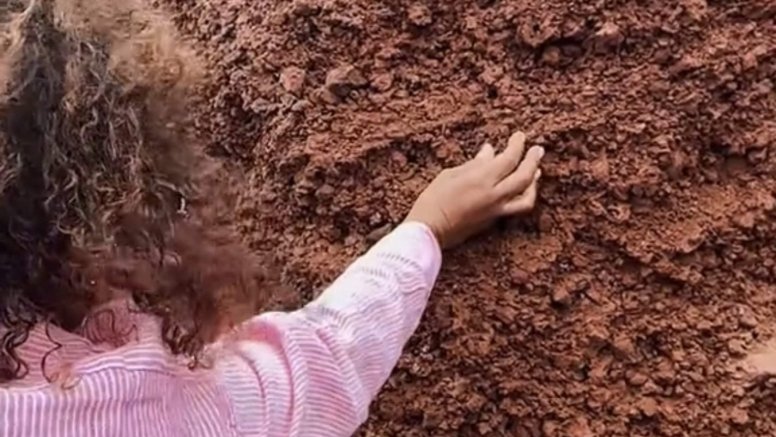
A German tourist, who took the volcanic rocks he stole from Montañas de Fuego to his country, returned them after claiming they had brought him bad luck.
In a handwritten letter sent to the Timanfaya National Park a few years ago and disseminated a few days ago by this entity, this traveler confessed that he suffered "a serious personal tragedy" and that he felt "obliged to return" the pieces of rock that he took from this protected natural space.
"I have heard legends that say extracting volcanic rock from its source brings bad luck, and I fear that has happened to me," justified the letter sent by this citizen.
In this text, he confessed that he had taken pieces of rock from the place where "the hot embers" are located, outside the center of Montañas del Fuego.
The Timanfaya National Park has reminded people via social media that stealing heritage items can result in a fine of up to 3,000 euros. In this regard, they reported that "a large volume of stones and sand" was seized from suitcases at the César Manrique Airport.
Environmental Damage from Stealing Stones
Timanfaya National Park has reported that removing rocks from Timanfaya destroys the habitat of lichens, fungi, and insects, in addition to damaging microsystems and endemic organisms.
In this sense, he recalled that the creation of fertile soil, crucial to combat erosion and desertification, is being prevented.
Likewise, it has indicated that it breaks the food chain and the fauna decreases its population: if there are no rocks, there is no refuge/substrate for invertebrates, and if there are no invertebrates, their predators (lizards, birds...) are left without food. "A catastrophic domino effect," they revealed.
In this regard, he added that volcanic rocks are the "basis of the vernacular architecture of Lanzarote."
"That rock is meaningless in your display case, it's not a souvenir or raw material for a pendant. It belongs to nature. It sustains the life and culture of our island," she continued. "Stealing nature is stealing the future."