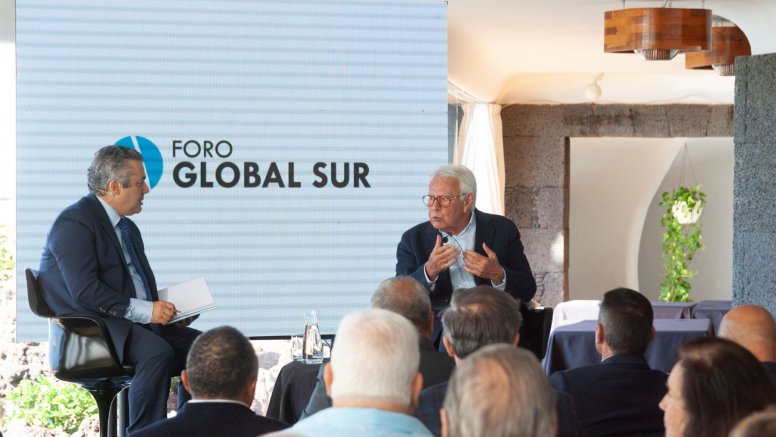
In his participation in the Dialogues of the South Lanzarote Global Forum, the former President of the Government of Spain (1982–1996) and former Secretary-General of the PSOE (1974–1997), Felipe González, offered a global vision of the complexity of the current moment, addressing everything from the geopolitical crisis to the internal challenges of Spanish and European democracy.
### The Geopolitics of Chaos
González described the current international situation as the "geopolitics of chaos," which he considers the worst moment, even before the Cold War. Unlike the Cold War, which maintained a "balance of terror" and was based on rules of the game (even if they were terrible), the current era is characterized by the absence of rules, which implies that there are no guarantees of being able to control emerging problems.
In this context, González warned that chaos is not spontaneous. It is orchestrated by "engineers of chaos" who, through the management of Big Data, seek to influence the preferences or votes of citizens. He pointed out that none of the large Big Data companies are European, but rather American or Chinese, and these companies manage people's lives from birth to death.
Key Conflicts: Sahara, Israel, and Ukraine
The former president analyzed several areas of global tension:
Western Sahara: Regarding Spain's change of position in 2022, González believes that the position of supporting Morocco's autonomy plan is "correct." However, his main concern is that the decision was made "without knowing why it was made," which generates confusion and detracts from the correctness of the measure. He recalled that the Sahara that corresponded to Spain was only 3% of the total desert.
Israel and Palestine: Based on his 53-year account of relations with Israel and Palestine, González recalled the Madrid Arab-Israeli Summit in 1991, the second time in history that the United States and the Soviet Union agreed to seek a solution. The subsequent Oslo Accords (1993) arose from Isaac Rabin's conviction that, while Israel could win wars against states, "we cannot win a war against the Palestinian people." For González, the assassination of Isaac Rabin twisted the path to peace and the two-state solution. Today, he laments the terrible killing of civilians in Gaza, noting that the first to suffer from Hamas are the Gazans. He stated that the main propagator of anti-Semitism worldwide is called Netanyahu. Despite his distrust of Trump, he urged support for the proposed peace plan to stop the massacre of children, the elderly, and women.
Russia and Ukraine: Although Russia is the largest country with the most resources on the planet, its gross product is only slightly less than that of Italy. González maintained that Putin has an imperialist and expansionist vocation (whether Tsarist or Soviet) and is constantly making fun of Trump. In addition, he calculated that at the current rate of advance in Ukraine, Russia would need 200 years of war to occupy the territory.
### Democratic fragility and Europe
González stressed that democracy should not be devalued. The current democratic risk comes from figures like Trump, but also from the belief that democracy must offer immediate answers to the demands of the street.
Regarding the internal situation in Spain, he expressed his concern about social polarization, which arises "from above" and strains relationships even within families. He defended his ideological coherence, indicating that he has remained "as left-wing as he was," and that the criticism that he has moved to the right is due to the fact that detractors have not understood that "socialism is freedom."
Regarding the European Union, he indicated that it has "become old" and reacts poorly. He urged Europe to "take charge of itself" and be responsible for its own destiny, without depending on external powers (the "daddy"). In the geopolitics of chaos, "no one who does not make himself respected will be respected." He supported the increase in defense spending in Spain (reaching 5%, as Trump suggests, even if he does not comply), but demanded that it be explained where the items come from, especially when the government has not presented budgets in the last three years. He pointed out that not presenting budgets, even if the Constitution does not sanction it, fails to comply with the constitutional obligation to present them.
Political Leadership
Asked about what makes a politician a leader, González detailed four basic characteristics:
1. Have a non-mercenary commitment to a project for the country. 2. Be able to be aware of the mood of other citizens. 3. Know how to manage human teams, bearing in mind that information is now within everyone's reach.
Finally, González concluded that, historically, the Spanish only want to "live in peace" and freedom, and there are some determined to spoil that achievement.
Add La Voz de Lanzarote as a preferred Google source.
Stay informed with the latest current news.