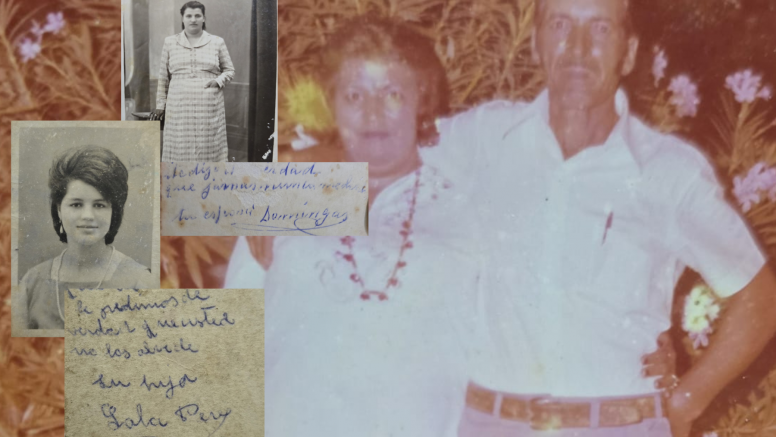
Tahíche was just a village when Dominga Valdivia Betancort was left alone in charge of five children. Her husband, José Domingo Pérez, had left one afternoon from Lanzarote for Gran Canaria and then clandestinely on a boat bound for Venezuela after a first failed attempt. He was one of the 5,000 Lanzaroteans who left the island in search of a future they could not find in Lanzarote. She, one of so many wives who stayed behind, raising her family in a time of particular repression against women.
José Domingo Pérez set off for Venezuela, which began to be known as the eighth Canary Island due to the constant emigration from the archipelago to the Latin American country, with some Lanzaroteños with whom he had coincided working in Cabo Blanco, in Africa. It was the year 1955 when he left in search of something to eat, but the trip that was intended to be a hope for his family turned into the beginning of a new life without her. The Lanzaroteño did not return to his land until 23 years later.
The repression of the Franco dictatorship was added to the economic crisis that left Spain plunged in poverty after the war. Hunger and scarcity became the norm and the Franco government began to ration food, increasing the sale of contraband on the black market. Due to the remoteness of the Canary Islands from the rest of the country and the drought affecting territories like Lanzarote, the post-war period was even harder for the islanders.
Thousands of Canary Islands men migrated alone to countries in North Africa and Latin America with the dream of achieving a better life. The women stayed on the island in charge of their children, hoping their husbands would manage to gather enough money to lift the family out of poverty. However, many never returned, rebuilt their lives and created new families, causing their wives to live as widows, with the big difference that they had not actually died. The fear of suffering the social stigma of the time and shame hid the story of these white widows for years.
Like that of Dominga Valdivia and José Domingo Pérez, many families were forced to separate due to the lack of freedom and opportunities in the Canary Islands, which was aggravated by the limitations of Lanzarote. Severe droughts, difficulty accessing water, food, and the isolation of the territory were, along with repression, the main obstacles that led many to decide to cross the Atlantic in search of a future.
Upon arriving in Venezuela, José Domingo Pérez got a job in the Venezuelan countryside, cultivating and harvesting tobacco leaves. Meanwhile, Dominga Valdivia raised her children in Lanzarote with the help of her mother, enduring real hardships, narrates Zaida González, Dominga's granddaughter, during an interview with La Voz.
"What we now see as a luxury, one day in the countryside, was once the only meal of the day, they would go and pick figs and eat that," narrates his granddaughter. The figs were combined with gofio balls and fresh milk. The hunger of that time also preyed on newborns, as Dominga had several children, she breastfed the children of several neighbors who could not produce milk.
Letters to the other side of the pond
“I ask you please not to forget us,” Lala Pérez pleaded on the back of a photograph she sent to her father in the Latin American country. Lala Pérez was the mother of Zaida González, who recalls that her mother grew up on an island ravaged by hunger and that she was only able to attend school to learn the basics. "She knew how to read and write, and she could also handle numbers," she jokes during the conversation. At that time, Lala also received beatings from the teacher, a common violence in the schools of that time.
When José Domingo left, Lala Pérez was just a child, but in the photograph she sent to Venezuela, she was already a woman. A handful of images were the thread that kept this family, broken by the diaspora, together. Those words traveled the sea at a time when communications were not fluid and news sometimes arrived in the form of rumor, brought by other exiled islanders. The photographs of her children, now adults and married, arrived drop by drop and José Domingo kept them.
Bent by the years in the countryside, Dominga Valdivia's mother worked in the corrals she had in Tahíche, where she took care of goats and donkeys. She had helped Dominga raise her five children, while her husband, Dominga's father, had also set sail for Buenos Aires, the capital of Argentina, with the dream of becoming another islander who made his fortune.
The little money that, very occasionally, José Domingo Pérez sent to his family in Lanzarote was not enough. "He sent something, but what he sent wasn't enough," recalls Zaida González. Thanks to his father returning in the sixties with enough money to buy several plots of land in the village of Tahíche, Dominga was able to alleviate the lack of food in her children's stomachs. In the twenty-three years her husband's exile lasted, poverty forced Dominga to sell the plots of land her father had bought years earlier to support her children.
When her five children grew up and each formed their own family, Dominga Valdivia decided to gather her courage and, in the company of another neighbor from Tahíche, traveled to Venezuela in search of José Domingo. Twenty-three years later, the woman from Lanzarote stayed for a year in the American country and when she found out that her daughter Lala Pérez was going to give birth to her granddaughter, Zaida González, she gave her husband an ultimatum. "She told him that either he came with her or she would go back alone, but that her daughter was going to have a son or a daughter and that she was not going to miss it," recalls her granddaughter the story she grew up with.
Dominga Valdivia and José Domingo Pérez returned to Lanzarote together. "It was strange that he returned, because he was a stranger here, but I did see him as a grandfather," she recalls. After their return to the island, they both moved to Las Caletas, in Teguise, where José Domingo lived as a lover of the sea and fishing. After returning, he worked during his final years at the Teguise City Council.
After more than two decades of sacrifices to support her family, Dominga Valdivia never wanted to talk about her husband's life in Venezuela.
Around 5,000 people from Lanzarote emigrated during Francoism
The chronicler of Teguise, Francisco Hernández, narrates that although there is no official data, because most of the trips were made clandestinely and behind the law's back, around 5,000 Lanzaroteans emigrated during Francoism to countries such as Venezuela, Cuba, Puerto Rico, Argentina, Brazil, Uruguay, and the African coast.
The last great migratory stage in Lanzarote took place between 1940 and 1950, as reflected by Hernández and María Dolores Rodríguez in the document The emigration of Lanzarote and its causes. In this decade, Canarians emigrated clandestinely on boats that "exceeded their maximum capacity, drinking salt water and in unsanitary conditions," reveals the chronicler.
On the ghost ships that set sail overloaded for Latin America, those fleeing political repression for belonging to the Popular Front side gathered with those seeking a future suffocated by the crisis. They did not always migrate alone; sometimes they did so with their families, but many others left "with the promise of returning and never did," explains the author of The White Widow, María del Mar Rodríguez. "There were others who did keep their promise, but it depended on many factors, as some did very well and started another family, forgetting about the one in the Canary Islands, and others did very poorly and out of shame did not want to have contact with the family here," she continues.
These women were experiencing a continuous grieving process, but without having buried any husband or without even knowing if they were still alive or not. This situation drove many of them to a breaking point, as the machismo of the Franco dictatorship prevented them from deciding on their own lives.
Francoist repression of women: "She who did not have a man by her side was a woman split in half"
The dictatorship legally obliged women to always be submitted to the husband. From the early years of the regime, archaic norms were recovered. For example, the only way to break a marriage was with the death of one of the spouses. Francoist laws stated that the husband was responsible for protecting the woman and that she had to obey him, he being her sole administrator and representative. During the dictatorship, women were classified as "incompetent" and could not work without their husbands' permission. All these directives fully affected white widows, who had no contact with their husbands.
The author of The White Widow reveals that women abandoned by their husbands during Franco's regime had to get by taking care of their children, "with a feeling of abandonment and in a society that at that time neither cared for nor protected them." Furthermore, all of this was governed by "the social imperative to maintain decorum for their husbands."
The white widows could not rebuild their emotional, personal, or sexual lives. They lived as if time had stopped for them with their husbands' emigration and were socially forced to stay sheltered at home "because they were marked with an element of stigma," adds María del Mar Rodríguez. "They were in a society where a single woman had very little value, one who didn't have a man by her side was a woman who was half broken, who was missing something," she continues.
The author explains that most women abandoned by their migrant husbands preferred to remain silent: "They would feel ashamed because that carries a lot of weight in this society that often reverses the feeling of guilt onto the victim." Despite the stigma, there were women who broke the silence driven by the need to look for work to feed their children.
Despite the loneliness and feeling of abandonment, these women decided to fight to get ahead, whether they had children or not. To earn some money from here and there, sewing was one of the trades they turned to, pushed by the regime that encouraged these "patriotic" workshops. Others had better luck if their husbands had signed a power of attorney document, which gave them more freedom. Each one's reality was different and varied. "Some had to practically go steal grapes at night to feed their children," exemplifies the writer.
Each story is unique and each woman lived it in one way or another. Some of them traveled to bring back their husbands, others resigned themselves and wanted nothing more to do with them or, on the other hand, chose to continue with their husbands when they returned decades later. "What we have to do as a society is not judge them because they were judged enough already and despite everything they got their families ahead as best they could," concludes the author.
With the support of:
Add La Voz de Lanzarote as a preferred Google source.
Stay informed with the latest current news.